(2012 Update…) CA was the first blog to discuss the recent papers by Wilmking and his associates on “positive and negative responders” – the opposite response of trees to recent warming in which – at the same site – some trees responded positively and some negatively. This is an important observation in trying to provide an explanation for the “divergence” problem – ring widths going down while temperatures go up. Previous discussions included:Wilmking in Alaska and Positive and Negative Responders. Other related posts include Upside Down Quadratic, Twisted Tree Heartrot Hill , bender on Gaspé , Survivorship Bias .
Today I’m going to report on some hot-off-the-press results from Pisaric et al in the March 2007 GRL. (Pisaric is the dendroclimatologist who commented on White Spruce updates.) Continue reading →
The 2000 conference of the IAI project on “Reconstructing Climate Variability and Change from Treelines” contained the following abstract describing a network of high-elevation “temperature-sensitive” tree ring chronologies as follows:
6. An expanded network of long treeline chronologies from the Western US
Brown, P.M.; Woodhouse, C.A. & Hughes, M.K.
We report on new, high elevation, temperature-sensitive tree-ring chronologies from sites in the central and northern Rocky Mountains in Colorado, Utah, Wyoming, Idaho, and Montana, and from the Cascade Range in Washington and Oregon. This new collection of long chronologies, several approaching 1000+ years in length, fills in a spatial gap between long, temperature-sensitive chronologies from the Great Basin and Sierra Nevada to the southwest and from the Canadian Rockies to the north. The goal of this expanded network is to provide a more complete picture of past temperature variability in western North America over the past several centuries through analysis of ring width, ring density, and cell size chronologies from Larix lyalli, Picea engelmannii, Pinus albicaulis, and P. flexilis.
Response functions for new chronologies developed so far have been investigated using seasonal, monthly, and 5-day average temperatures from stations throughout the region. Preliminary results indicate often strong growth responses to growing season temperatures. A comparison of new and existing chronologies suggests periods of spatial and temporal synchrony and as well as asynchrony, both at high and low frequencies, across the region. Late-20th century patterns in several of the chronologies are very asynchronous, with some sites showing unprecedented growth that is possibly indicative of anomalous warming and others showing growth declines that may be related to increases in spring snowpack. Calibration of growth-climate relations using 20th century instrumental data is confounded by changes in relationships during the last few decades.
Could this be the long-sought for dendroclimatological evidence showing that ring widths respond in a positive manner to recent warmth? Continue reading →
In 1999, the IAI launched a major initiative entitled Assessment of Present, Past and Future Climate Variability in the Americas from Treeline Environments . They state: “The overarching scientific goal of this project was to reconstruct climate variability over a major global transect from Alaska to Tierra del Fuego.” While Mann has told us that he had to use chronologies ending by about 1980 because it was too expensive and time consuming for dendrochronologists to collect new data, the report on this initiative stated:
The project has produced considerable data in the form of new tree-ring chronologies, climate reconstructions and related materials. Extensive collections have taken place at over 400 sites, resulting in over 200 chronologies from more than 20 different species.
Continue reading →
Dendroclimatologists have told us that they want to root out misinformation like anyone thinking that white spruce chronologies from northern Alberta archived at the ITRDB are temperature proxies. I’ve conveyed that message to CA readers and I’m happy to report that, as far as I know, CA readers agree that northern Alberta white spruce chronologies archived at the ITRDB are not temperature proxies.
Following that successful mission, I’ve got a project for the Dendro Truth Squad. Shao et al report that Qilianshan junipers are (unsurprisingly) said to be limited by precipitation. The picture below shows Qilianshan junipers and does not contradict the report of Shao et al that they are precipitation limited. (The closing picture in the presentation by Shao et al, see below, evidences precipitation limitation even more dramatically, but, upon checking, it turns out that Dr Shao does not know where this picture comes from and it appears that the picture was inserted in her presentation for dramatic effect only.)
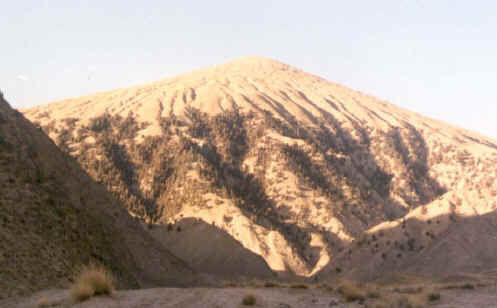
Although Qilianshan junipers are said to be precipitaiton limited, Qilianshan juniper chronologies are directly used as temperature proxies in Crowley and Lowery 2000 and Yang et al 2002, with the Yang composite being used as a proxy in many Hockey Team studies: Mann and Jones 2003, Moberg et al 2005, Osborn and Briffa 2006, Hegerl et al 2006. Obviously this looks like a good mission for the Dendro Truth Squad. Continue reading →
This thread is dedicated to dendroclimatologists who are seeking for a way to answer alleged “misinformation” at climateaudit without having to defend themselves against dozens of follow-up posts. Any posts on this thread from non-dendroclimatologists seeking to argue or contest these comments will be deleted, although posters, including myself, will be free to discuss these pearls on other threads. Given the allegations against us, I’m sure that this will be the most active thread in our history.
Or maybe you just want to give information on site selection or resolving mixed temperature and precipitation signals in the tree ring data. Over to you, dendroclimatologists.
Over at the Dendro listserv, Rob Wilson raised the issue of what dendros should do about climateaudit, noting that he felt a responsibility to “defend dendro practises and correct misinformation.” He went on to say:
Although some of the criticisms and commentary are valid, some of it is simply wrong and misinformed, and in my mind, it is dangerous to let such things go.
Continue reading →
One of the most important IPCC representations is the supposedly tremendous quality control of its review process. I’ve mentioned in passing on a number of occasions that, when I sought to obtain supporting data for then unpublished articles, IPCC threatened to expel me as a reviewer.
I’ve had a few requests to recount my experience with trying to get data from IPCC for unpublished studies. So here’s a short summary of my correspondence with IPCC.
Continue reading →
Here is what Reviewer #3 submitted in his review of the Bürger CPD submission (I’ve taken down the draft review.) He regrets agreeing to do the review (for reasons that will become clear). Even though Reviewer #3 has much goodwill towards Bürger, he is rather a stickler for detail and it seems rather unfair that Bürger should draw Reviewer #3 for this submission and Michael Mann for his last submission, while other authors get cheerleaders. Reviewer #3 hopes that he has managed to separate his comments from his POV, although the separation is not always easy.
He appreciated the thoughtful response from CA readers, especially TCO. The online submission of reviews was turned off when Reviewer #3 sent in his review, so he sent it to the editor by email. We’ll see what happens. Reviewer # 3 writes: Continue reading →
CA readers have followed some of the interesting reviews at Climate of the Past, where some of the exchanges have been lively (although most papers don’t seem to attract much comment.) Two reviews are in on Bürger’s most recent submission and a 3rd reviewer has been invited to give an opinion. However, he’s slow about these things. (CPD reviewers are allowed to identify themselves – Joel Guiot has submitted a review under his own name, and the third reviewer will as well.) The third reviewer is sometimes distracted by interesting by-ways in an article and this is no exception. So I thought that I’d explore some of these by-ways on CA for him. It’s possible that Reviewer #3 will draw on some of this material, although it’s too lengthy and ambling for a review. Continue reading →
While I was reading about rotated varimax PCA in connection with Rob Wilson’s article, I came across R.W. Houghton and Y.M. Tourre, 1992, Characteristics of Low-Frequency Sea Surface Temperature Fluctuations in the Tropical Atlantic, Journal of Climate
Volume 5, Issue 7 (July 1992) pp. 765—772 url. They observed that a PC analysis applied to Atlantic SSTs yielded a dipole in the 2nd EOF. Although this article is not discussed in Vimont and Kossin’s discussion of the Atlantic Multidecadal Mode, both articles seem to be probing similar data – with the Atlantic Multidecadal Mode looking very comparable to the dipole of Houghton and Toure.
Houghton and Toure carried out a rotated varimax on their PCs. The rotated EOFs had very different characteristics. One rotated EOF was concentrated north of the ITCZ and the 2nd rotated EOF was located south of the ITCZ.
Since the series north of the ITCZ was orthogonal to the series south of the ITCZ, the unrotated EOFs more or less corresponded to the sum and the difference of the two rotated EOFs. Houghton and Toure concluded that there was no physical significance to the dipole – other than being the empirical difference of two uncorrelated series.
This seems like an issue well worth reflecting on if one is discussing the Atlantic Multidecadal Mode in a hurricane context.





 Climate Audit