Upside-Side Down Mann and the “peerreviewedliterature”

In Andrew Revkin’s recent blog posting, he made the following observation about blogs, referring in particular to Climate Audit:

What is novel about all of this is how the blog discussions have sidestepped the traditional process of peer review and publication, then review and publication of critiques, and counter-critiques, by which science normally does that herky-jerky thing called knowledge building.

He then asked:

So should this all play out within the journals, or is there merit to arguments of those contending that the process of peer review is too often biased to favor the status quo and, when involving matters of statistics, sometimes not involving the right reviewers?

As CA readers know, I dislike taking generalized approaches to questions like this. Unlike some (in my view) overly patriotic CA readers, I do not regard blogs as a substitute for journals. While (in my opinion) my recent journal submissions have not been fairly reviewed (and there are many points that I take issue with in how academic journals handle reviews), this is not a point that I’ve placed at issue at this blog because, in my opinion, I haven’t fully put the system to a full test (but this issue is definitely on my radar.)

Recently the question of Tiljander sediments and Upside Down Mann arose in a couple of different contexts – at Andy Revkin’s, at realclimate and in a Finnish blog post by Atte Korhola. Mann’s upside down use of the Tiljander proxies was originally reported at CA here in fall 2008 and then reported to PNAS in a published comment by Ross and I. Continue reading

AR4 WGIII Lead Authors' Responses online – at last!

I reported here on my efforts to get the WGIII Review Editors’ comments back online together with the Lead Authors’ Responses and the Review Editors’ Reports.  I had sent Patrick Matschoss, the head of AR5 WGIII TSU an open letter for him to put to the IPCC Bureau urging an open and transparent process in the Fifth Assessment.  Following the usual pattern I can now report some success but continuing reluctance on the part of the IPCC to be truly open and transparent .

I also want to ask any German speaking CA readers for help to understand the ‘Brandenburg’ legal implementation of the Aarhus Convention, as I think we may have to use it.  I have located an English version of the Brandenburg “Inspection-of-Records and Access-to-Information Act”, here, but on page 3 it indicates that we what need is Part 2: Access-to-Information Acts, Book 2: The Environmental Information Act.  If anyone knows of an English language version for this please post a link.  Continue reading

Unthreaded #41

New thread.

Sea Ice – October 2009

Continuing from http://www.climateaudit.org/?p=6734

Core Counts and Reverse Engineering

Recently, after the posting of the Phil Trans B archive on Sept 8, 2009, I determined that the Yamal data set as used by Briffa is not more “highly replicated” than the Polar Urals data set and thus there is no basis for the preferential selection of the Yamal chronology over the Polar Urals chronology into Team multiproxy studies. The seemingly biased selection of Yamal over Polar Urals has been a longstanding concern of mine and was the theme of numerous of my AR4 Review Comments, all of which were repudiated by Briffa, the IPCC author responsible for this section. In light of the abysmal modern replication of the Yamal chronology, the rejection of these comments seems highly questionable.

However, the main response of critics of this site over the past few days (e.g. Tim Lambert, David Appell, Deep Climate, the latter now linked by Andrew Revkin) has not been reflection on the poor replication of the Yamal series or the impact of the now established bias in the selection of Yamal over Polar Urals, but vituperative criticism of me for not being able to determine the poor replication and provenance of the Briffa data set earlier, using the materials available before Sept 2009, including the Hantemirov’s low-replication corridor standardization data set for Hantemirov and Shiyatov 2002 which I had obtained in early 2004, well before I began examining the Yamal data set in more detail after the publication of Osborn and Briffa 2006 and D’Arrigo et al 2006 in Feb 2006.

No opprobrium for the many climate scientists who used Briffa’s abysmally low replication chronology without inquiring into its replication. No opprobrium for those climate scientists to whom precisely the same materials were available and who had also failed to identify the defects in the Briffa data set prior to Sept 2009. No opprobrium for Briffa who had failed to report core counts or provide the data when requested, not just by me but by the authors of D’Arrigo et al 2006. Instead, the criticism was leveled at the first person to actually figure out the poor replication of the Briffa data set because, in their opinion, I should have been able to figure it out earlier. Continue reading

Yamal and the Divergence Problem

One of the aspects of the Yamal discussion that is perhaps clearer to regular CA readers than to new readers is that Briffa’s Yamal chronology was very different from ring width chronologies previously reported in the area (including by Briffa itself.)

Shortly after the publication of Osborn and Briffa 2006 and D’Arrigo et al 2006 in February 2006, I reviewed the findings of Briffa et al (1998) on the wide-spread decline of ring-widths and MXD since 1960 (the “divergence problem”), an issue that was discussed at the NAS panel presentations the following month (and very unsatisfactorily in the NAS report).

Briffa et al 1998 reported on the very large Schweingruber survey – a survey of 314 NH sites selected ex ante to be temperature sensitive. See here for list.

At the time, I excerpted the following graphic from Briffa et al 1998 showing the decline:
Briffa et al. 1998 Original Caption. Figure 6. Twenty-year smoothed plots of averaged ring-width (dashed) and tree-ring density (thin solid line), averaged across all sites in Figure 1, and shown as standardized anomalies from a common base (1881-1940), and compared with equivalent-area averages of mean April-September temperature anomalies (thick line). [SM – it looks to me like the labels in the caption are reversed between density and temperature]

Figure 2 of Briffa et al 1998 breaks this down into regions. The figure below is an excerpt from their Figure 2 showing Siberia – Yamal would be in West Siberia. The left half shows density (MXD), the right half ring width (RW). The figure of particular interest to us is WSIB ring width (third row, right half). The thick line in the left panel shows temperature, the thin line ring width (both smoothed), showing that ring widths in this region, as elsewhere in the world, had not kept pace with temperature. The right panel shows the difference (the “divergence problem”). The “divergence problem” affects both ring width and density.
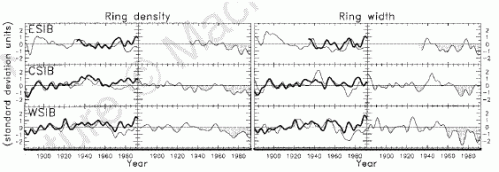

From Briffa et al 1998 Figure 2. Figure 2 Regional tree growth and temperatures over the past 120 years. Decadally smoothed tree growth (thin lines), maximum-latewood density or ring width, plotted against mean summer temperatures (thick lines), April–September for density and June–August for ring width, for each of the regions described in Fig. 1. The difference series (growth minus temperature), shaded to emphasize negative values, are shown to the right of each pair of curves. All data series have been scaled to have zero mean and unit variance over the period 1881–1940 (except the short ESIB temperature series which uses 1932–75

One of the sites included in this survey is Khadyta River, Yamal. I’ll do a count of how many series are included in the WSIB region, but it is obviously a considerable number.

The “divergence problem” has been discussed on many occasions at this site. If ring widths have gone down in the last half of the 20th century despite increasing temperatures, how can we use information from prior periods to reconstruct past temperatures? Kurt Cuffey was much puzzled by this conundrum at the NAS panel hearings.

In the present case, we’re talking a different sort of divergence entirely. Here we’re not talking about temperature. We’re talking about the discrepancy between Schweingruber’s large-scale network of both ring width and density ( a network involving hundreds of cores and thousands of measurements), with a WSIB network with dozens of sites where late century ring widths and MXD go down, as compared to Yamal – one site where late century ring widths go strikingly up.

I got an email this morning in which Hantemirov told a correspondent that they used 120 cores in a forthcoming study and only used long cores for corridor standardization because that’s what you need for this method. This confirms my prior point that the requirements of the corridor method were different than the RCS method and that a much larger population of cores was available, though, for some reason, not used in Briffa et al 2008.

However, Hantemirov also says that the results with a larger population are very similar to the Briffa results – raising the question of why the Yamal results are so different from Polar URals and the Schweingruber network – a question that I’ll ask him. Hantemirov:

Low number of used for reconstruction subfossil series is explained by standardisation method (“corridor method”). We had to select the longest series. The same concerns to living trees. There are not much old living trees in this area (in contrast to Polar Urals), therefore we used only 17 (not 12) samples from living trees. At that time we had close collaboration with CRU and I sent to Keith Briffa these raw data.

So, selection of samples has been made by me taking into account length of individual series as well as common requirements to increment cores (exclusion samples with compression wood, rotten wood etc.).

As to reliability of recent increase in tree growth – we have updated our data using many additional subfossil and living trees and using RCS-method. I.e. we used not only long series. Therefore many (120) living trees have been used. Finally, we have got almost the Briffa’s result. These results not published yet. I’m going to prepare paper at the end of this / beginning next year. Some preliminary data you can find in some kind of report in Russian

Click to access KHantemirovRM.pdf

fig 2 – sample replication, fig 5 – temperature reconstruction (smoothed by three filters – 50-, 100- and 200-year)


Yamal and IPCC AR4 Review Comments

I was one of the more industrious reviewers for IPCC AR4. In my Review Comments, I made frequent reference to Yamal versus the Polar Urals Update, expressing concern about the rationale for using Yamal rather than Polar Urals, an issue that is once again in play. Keith Briffa was the section author and can be deemed to be the author of the responses. Continue reading

Gavin's Guru and RCS Standardization

Obviously, there has been considerable controversy over the past few days over the Yamal data.

First, let’s observe the continued silence of field dendros on the dispute. None have stepped forward so far to support Briffa’s use of 10 cores in 1990 (and 5 in 1995). As others have observed, their silence is rapidly becoming loud. And it’s not as though Climate Audit is so well loved in dendro circles that dendros would not be willing to speak out against it.

The graphic below shows the disparity between core populations at Yamal and the other two sites in Briffa et al 2008. In 1990, both Avam-Taimyr and Tornetrask-Finland had 105 and 113 respectively (51 and 34 in 1995), whereas Yamal had only 10 cores in 1990 and 5 in 1995 (!) Continue reading

A Thread for Lorax

Reader Lorax has many things to say about Climate Audit, all bad as far as I can tell. Editorially, this is leading to OT discussions on many threads, so I’ve established a thread for discussions with Lorax. (I’ve backdated the thread slightly so that it’s not at the top of the masthead right now.)

Atte Korhola: political and social playground

There is an interesting, and, in my opinion, very bold,  comment (dated 9/27, here in Finnish (archive) ; Google Translation) in a Finnish web journal by professor Atte Korhola entitled “Recession in Climate Science”. Korhola:

Esitän kärkeen heti teesin, jonka mieluusti alistan julkiseen kritiikkiin: kun myöhemmät polvet tutustuvat ilmastotieteeseen, he luokittelevat 2000-luvun alun tieteen historian noloihin lukuihin. He tulevat kummastelemaan ja käyttämään aikaamme varoittavana esimerkkinä siitä, kuinka tieteen keskeisten arvojen ja kriteereiden annettiin pikku hiljaa unohtua itse tutkimusteeman – ilmastonmuutoksen – muuttuessa poliittiseksi ja sosiaaliseksi temmellyskentäksi.

My translation:

I put immediately forward a thesis that I’m glad to expose to public criticism: when later generations learn about climate science, they will classify the beginning of 21st century as an embarrassing chapter in history of science. They will wonder our time, and use it as a warning of how the core values and criteria of science were allowed little by little to be forgotten as the actual research topic — climate change — turned into a political and social playground.

Later in the text he gives two recent examples, where the core values have been forgotten. The first example is “various reports and studies” that “describe ever increasing horrors of climate change” examplified by the recent UNEP-incident. The other example is worth quoting in full. Korhola:

Toinen esimerkki on arvovaltaisessa Science-lehdessä hiljattain julkaistu tutkimus, jossa arktisten alueiden keskilämpötilojen todetaan olevan nyt korkeammalla kuin kertaakaan aikaisemmin kahteen tuhanteen vuoteen. Tulos saattaa hyvinkin olla totta, mutta tapa jolla tutkijat tähän päätyvät, herättää kysymyksiä. Proksi-aineistoja on on otettu mukaan valikoidusti, niitä on pilkottu, manipuloitu, silotettu ja yhdistelty – ja esimerkiksi omien kollegoideni aiemmin Suomesta keräämät aineistot on jopa käännetty ylösalaisin, jolloin lämpimät jaksot muuttuvat kylmiksi ja päinvastoin. Normaalisti tällaista pidettäisiin tieteellisenä väärennöksenä, jolla on vakavat seuraukset.

Another example is a study recently published in the prestigious journal Science, in which it is stated that the average temperatures in the Arctic region are now much higher than at any time in the past two thousand years. The result may well be true, but the way the researchers arrive at this conclusion raises questions. Proxies have been included selectively, they have been chopped up, manipulated, smoothed, and combined – and, for example, data previously collected from Finland by my own colleagues has even been turned upside down so that the warm periods become cold and vice versa. Normally, this would be considered as scientific falsification, which has serious consequences.

I took part in the discussion that followed. Also the current Yamal dispute came to surface, and this is what Korhola had today to say about it:

McIntyren ja ClimateAuditin esittämä kritiikki on otettava vakavasti. Mannin ja kumppaneiden RealClimate tekee siitä lähinnä pilkkaa uusimassa blogissaan. Se voi kuitenkin pitkän päälle koitua omaan nilkkaan.

The criticism by McIntyre and ClimateAudit needs to be taken seriously. RealClimate of Mann & co is mainly making fun of it in the latest post. It may well be in the long run that this is shooting oneself in the foot.

Finally, in order not to cause any unnecessary troubles to prof. Korhola, let me be very clear about this: prof. Atte Korhola is not a “climate skeptic”.