Back Online

Back in Toronto after two weeks in Thailand. One of my sons got married and my wife and I spent time traveling with my son and new daughter-in-law and my daughter. I left New York on Monday Mar 9 back to Toronto and left the next morning for Thailand, pretty groggy when I arrived on late Wednesday evening Bangkok time. The wedding was on Saturday.

After the wedding, we debated between going to the beach or going up north and, in deference to my tendency to sunburn, we went up “north” – Chiang Mai being nearly (!) 19N, not far from the Arctic Circle, and then into the hills to Pai, a lofty 486 m. Pai turned out to be sort of a hippie/backpacker enclave, a far cry from busy Bangkok. When we left, Bangkok was 36C; I hardly watched any TV, but I saw one CNN international weather survey and Bangkok was the hottest place that I noticed on their survey that day (tho I didn’t notice anything from the Persian Gulf which might well have been hotter.) We spent a few days in each locale. My wife and daughter stayed on after I left and have just returned from the beach.

We’ve spent some time recently discussing speleothems in tropical caves. Interestingly, one of the tourist things in Pai are caves – we visited the very large Spirit (Lod) Cave about 38 km NE of Pai, only about 10 km as the raven flies from the Myanmar border, but I don’t think that there any roads into Myanmar closer than than Mae Hong San, which is about 100 km away. There’s another cave on the tourist maps at Chiang Dao, also in this area. This part of Thailand has a pretty strange modern history as parts of it were settled by Kuomintang remnants, who controlled the opium trade for many years. I’ll do a separate post on this cave, drawing it to the attention to Jud Partin or any other interested speleo, if for some reason, it’s not on his radar screen. (I have no knowledge of whether it is or isn’t; it may well be. )

We’ve talked about UHI from time to time and, in that context, the temperature difference between Bangkok and Pai was pretty noticeable, especially at night. Bangkok was hot all the time, but Pai was actually fairly cool in the morning and evenings. Chiang Mai was intermediate. Yes, there’s a difference in altitude, but the difference in temperature was more than the 3 deg C lapse rate. Pai also seemed drier than Bangkok and perhaps that contributed as well. Arriving in Bangkok, I watched the temperatures as the plane descended in the late evening and as I recall the lapse rate at 11 pm was only about 3 deg C in the lowest 2000 m or so.

I thought a bit about about water “cycle” feedback, a topic from the Heartland conference that interested me the most. I was particularly interested in the presentations by Richard Lindzen and William Kininmonth, both of whom I met for the first time. I’ll write some notes on this topic. I mulled over the pros and cons of making the all-in water “cycle” feedback a major new theme for the blog. In terms of dealing with “big questions”, arguably it would be the most useful allocation of effort, but it would require me to make a major investment of time and energy in a large new topic, at a time when I have much unfinished business on the proxy front. Please wait until I make a more detailed post before commenting on this issue.

I took some drafts of a long overdue reply to Wahl and Ammann. Ross has been bugging me to deal with this for a long time and wrote a draft; I have my own draft. I really, really dislike having to respond to this article, as I find it virtually impossible to write a reply that isn’t very sharply worded. Given that they pretty much replicated every one of our results (and that their code virtually matches ours, as noted in May 2005), it is frustrating that they claim the exact opposite – they purport to refute our findings, a false claim that IPCC and the climate community readily relied on. Combined with the fact that they dragged out providing their SI until over 3 years after their original press release and 2 1/2 years after the IPCC deadline for publication. Having said that, the ball is in our court now and has been since summer 2008, so I guess we’ll have to respond. This will definitely disturb any potential serenity at the blog.

Internet service was actually readily available even in hippie Pai, but I was glad of the break. I appreciated the posts by Roman, Ryan and UC in my absence. The two Jeffs seem to have made some interesting progress on AVHRR, but it looks like investigations are stalemated a bit by the continuing inability/refusal of Steig and coauthors to provide the monthly AVHRR data as used in their study. With much improved understanding of RegEM from the Steig analyses, I’m looking forward to re-visiting the Mann et al “EIV” recon, which we didn’t touch in our prior look at this topic.

I was much appreciative of Anthony’s efforts on the server front. I asked Anthony in New York why we shouldn’t just transfer CA onto wordpress where everything was provided for free. WUWT has greater traffic than CA (tho CA traffic is also very large, having run over 6 million hits/year for the last couple of years) and WUWT functions perfectly on a wordpress format. A couple of CA functions aren’t available on wordpress – Latex and bulletin board. However, we could easily manage without latex (tho it’s nice on occasion). As to the bulletin board, I would be quite content to cut it loose – actually I’d like to do so as I don’t support or monitor it.

However, Anthony said that there was quite a bit of hidden traffic to CA in the form of links to graphics as well as posts and that a change of address would cut off an important resource. He felt that it was very important that there be continuity of the resource and URL. Readers at both sites supported this view with some extra contributions. (I again express my appreciation for ongoing contributions since, as I’ve mentioned on occasion, this is important to my being able to continue devoting time to the site.)

I was glad of the break, but back to the grindstone. Lots of things to write about.

Unthreaded #38

I’ve lost track of the number of “unthreadeds” on CA, but the last one at 800 + posts is getting a bit unwieldy. So please continue here. – Anthony

The new CA server has arrived

UPDATE: 3/19 – I have the server updated with the latest distro packages, and now configured as LAMP with Apache2, MySQL5, and PHP. Working on getting WordPress installed and operational next. After that, there is quite a bit of WordPress content, plugins, and configurations to move over as well as to recreate a number of folders and files from the original machine. It will be a few days yet before a move to the new hardware is ready to attempt. – Anthony

Thanks to the generous donations of many people here, I was able to purchase a new fully configured (and guaranteed for 3 years for parts) Linux based server to be the new home of CA. It is shown below after I first fired it up to make sure it survived the shipping:

For anyone interested, here are the specs: Continue reading

Mann 2008 – Replication II

Let’s continue Mann 2008 – Replication with EIV. To run regreclow.m and regrechigh.m you’ll need files climate, eofnumb, and proxyN, where N runs from 1 to 19. I’ve run prepinputforrecon.m with required folder structure (C:\holocene\s1\zuz10\work1\temann\ etc.) in my computer. After that I did run regrechigh.m in folder

C:\holocene\s1\zuz10\work1\temann\zzrecon1209\nhnhscrihad\highf

and regreclow.m in folder

C:\holocene\s1\zuz10\work1\temann\zzrecon1209\nhnhscrihad\lowf

The regem options in high-version are

OPTIONS.regress = ‘ttls’;
OPTIONS.regpar = eofnumb(istep)
OPTIONS.stagtol = 5e-2;
OPTIONS.maxit = 30;
OPTIONS.inflation = 1;
OPTIONS.disp = 1;
OPTIONS.relvar_res = 0.05;
OPTIONS.minvarfrac=0.85;

and in the low-version

OPTIONS.regress = ‘ttls’;
OPTIONS.regpar = eofnumb(istep)
OPTIONS.stagtol = 5e-3;
OPTIONS.maxit = 100;
OPTIONS.inflation = 1;
OPTIONS.disp = 1;
OPTIONS.relvar_res = 0.05;
OPTIONS.minvarfrac=0.85;

Here maxit is 100, so this one takes about 10 minutes with my oldish laptop. Will try to find a way to upload the results here (two 3 MB zip files). High-frequency recon19 shows that I wasn’t completely lost with this comment suggesting RegEM is ICE-like calibration method :

Jean S figured out how the results (reconN -files) are related with archived nhnhscrihad_smxx (screened, NH, iHAD ):

  1. For each step, compute  recon=high_recon + low_recon.
  2. Proxies are standardized earlier in the process (high+low unity variance and zero mean in the calibration period). One needs to take std and mean of the target series, iHAD_NH_reform, and rescale the recon, recon= recon*sigma+mu
  3. There is a warning about over-fitting in the paper, so do this only for the steps N=11..19
  4. Combine the results of each step

Note that the number of proxies in highf and lowf inputs is not necessarily the same. Here’s the result and the archived nhnhscrihad_smxx:

As Jean S implied here , after 10 minutes of regem running, all you get is a linear combination of the proxies.

MAKEPROXY.m has lines

%@@@@@@@@@@@@@@@@@@@@@@@@
hhhigh=0; % 0 means screening on raw data  (old)
% 1 means screening on high-f data (new)
%@@@@@@@@@@@@@@@@@@@@@@@@@

so I tried the option hhhigh=1 as well. The results will be zipped here soon, don’t worry. Now I’ll just show the low-proxies(19) with high-f screening:

Hmmm. Well, there are only 6 proxies in this step, and the hockey stick is hiding. But Mann SI says:

As a further safeguard against potentially nonrobust results, a minimum of seven predictors in a given hemisphere was required in implementing the EIV procedure.

..so you’ll have to ignore this high-pass-correlation -screened proxy set 😉

Update (UC):
I added proxy names (hopefully correctly)  to the figures Jean S refers below, there’s something I don’t quite understand. See the AD500 step,

In the AD600 step, fisher-proxy enters the game, note how much the reconstruction changes:

Some 0.6 C change due to one added proxy. Weight of the curtis-proxy increases quite a lot, and there are many sign changes.

Steig Mystery (almost) Solved!

Thanks to some insight from Ryan O (#43), we have been able to make progress on the puzzle of where the values in the Steig paper came from. In fact, it now is quite apparent that Steig et al used the reconstructions based on the AVHHR satellite data rather than the ones based on the AWS dataset .

First, we should make it clear that Shuman used a regression which was based on the annual sequences which we looked at in the previous post (and got a perfect fit both in the trends as well as in the 95% error bounds). To demonstrate this, we use R starting with the monthly data defined in comment RomanM (#20). This has to be converted to anomalies before the regression can be carried out.
Continue reading

Sudden Climate Change Syndrome

I arrived in Bangkok late Wednesday night local time – lots of travel. I returned from the Heartland conference to Toronto on Monday night, left Toronto early morning Tuesday for Bangkok, connecting in Tokyo with a two-hour layover in Vancouver. I’d looked at going from New York but surprisingly Air Canada’s prices from Toronto were better than any prices from New York and, like nearly everybody, I’m really watching expenditures these days. After about 24 hours in the air – and over 30 hours travel time all in, finally in Bangkok.

It was fairly mild in Toronto when I left – about 5 deg C highs. Before I left, I learned that, presumably as a result of global warming, daily highs were about 33 deg C in Bangkok. Naturally, I was extremely worried about whether I could adapt to a 28 deg C change in temperature in only 36 hours. Should I acclimatize myself in 1 deg C intervals? If I tried to adjust to a 28 deg C change all at once, wouldn’t I be at the same sort of risk as a diver decompressing too fast? Wouldn’t it be safer to acclimatize to each 1 deg C change in temperature for a week or so, before trying to scale Everest, so to speak? My son assured me that it was quite safe and that other brave adventurers had adapted to sudden climate change in the past. I was unconvinced but set off anyway.

After a few days, I am happy to report that I have managed to adapt to this sudden climate change. I was strangely fatigued for a few days. Bangkok time is 11 hours different than Toronto and I understand that this fatigue phenomenon has been termed “jet lag” by researchers unfamiliar with the many ways in which climate change can manifest itself, but that the most recent research either Nature or Science in press – I’m not sure which) has demonstrated that it is really a form of “sudden climate change syndrome”.

I was also concerned about the effect of global warming on Thailand since my last visit in 1968. The projected temperature in Thailand for my arrival was already far higher than Hansen’s projected temperature for Toronto under doubled CO2. Perhaps Bangkok had been overrun by dinosaurs and other Cretaceous monsters since my last visit. It turned out that Bangkok had indeed been overrun, but by Toyotas, Hondas and air conditioners. If you want to drive across the city, you’d better allow a couple of days.

I have some notes on the Heartland Conference, which I’ll post up either later today or next week. I was only able to attend on Monday because of travel commitments. I was most interested in a few presentations that dealt with issues relating to “water cycle feedback”, using this term to encompass clouds, water vapor, latent heat and lapse rate feedbacks – the non-”sociological” part of Lindzen’s keynote speech and session presentations by William Kininmonth and Jan Veizer. More on this on another occasion.

I’m not going to permit comments on this thread because I don’t want people using the above two sentences as a springboard for expounding their own views and solutions, while I’m not online to keep an eye on things. Plenty of time when I’m back.

Thanks to Ryan and Roman for providing interesting posts while I’m away and to Anthony for his support in so many ways and for posting up my ppt. I’m offline for a week.

Steve's presentation at ICCC 2009

I shared a panel with Steve McIntyre at ICCC 2009, and he made his presentation publicly available. I’m providing the link here for anyone interested. If you don’t have PowerPoint 2007 on your PC, a free viewer is available here.

There are also Office 2007 file compatibility updates for older versions of Office/PowerPoint available here.

Steve covers much of his work on Climate Audit and his deconstruction of Mannian methodology in the presentation. Regular CA readers will find some familiar things in it.

Steve McIntyre – Do We Know that the 1990s Were the Warmest Decade of the Millennium?

Click for PowerPoint (.pptx format)

UPDATE: Also PDF here (thanks to Sinan)

Speaking Notes here

And now on YouTube (thanks to RDunn)

http://www.youtube.com/watch?v=Tnpu6kIIFtY (updated)

Great Depression! Global hurricane activity reaches new lows.

Post by Ryan N. Maue, Florida State University COAPS

Global hurricane activity has decreased to the lowest level in 30 years.


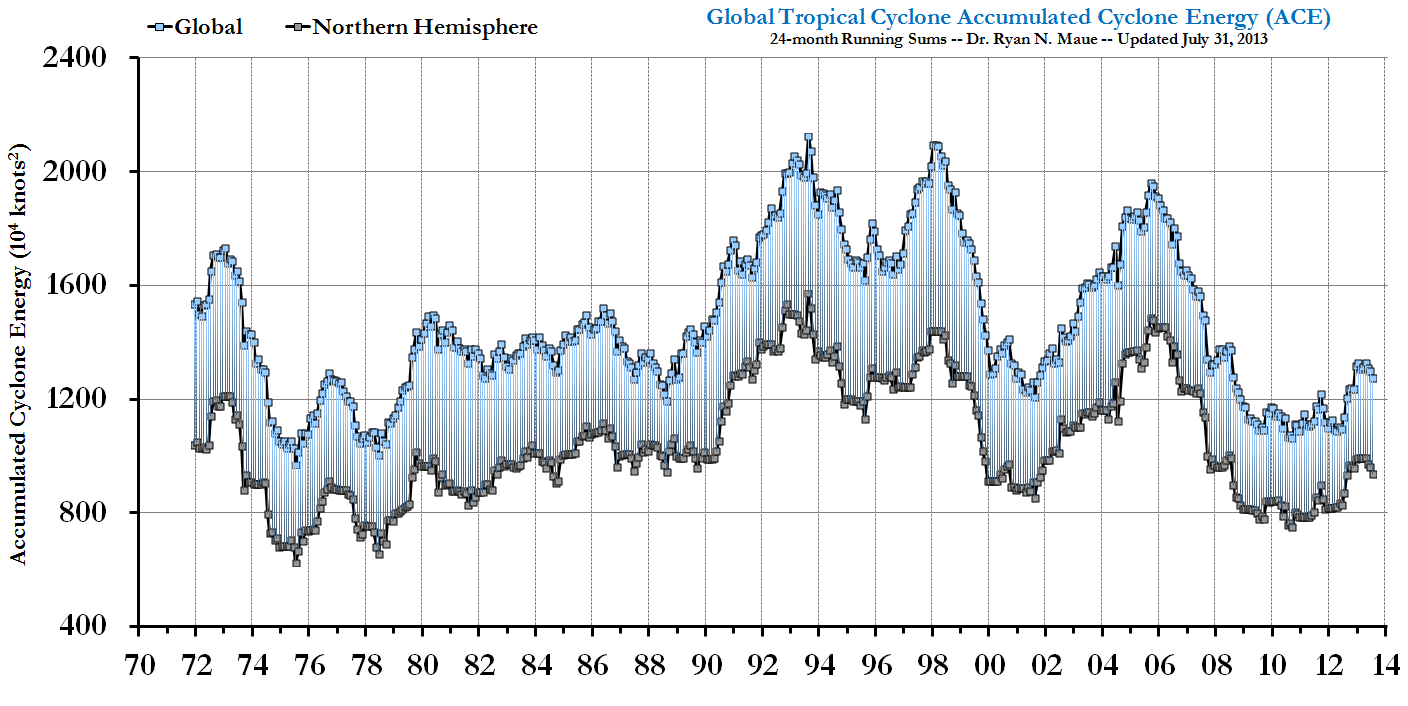
Figure: Global 24-month running sum time-series of Accumulated Cyclone Energy updated through April 21, 2009.

Very important: global hurricane activity includes the 80-90 tropical cyclones that develop around the world during a given calendar year, including the 12-15 that occur in the North Atlantic (Gulf of Mexico and Caribbean included). The heightened activity in the North Atlantic since 1995 is included in the data used to create this figure.

As previously reported here and here at Climate Audit, and chronicled at my Florida State Global Hurricane Update page, both Northern Hemisphere and overall Global hurricane activity has continued to sink to levels not seen since the 1970s. Even more astounding, when the Southern Hemisphere hurricane data is analyzed to create a global value, we see that Global Hurricane Energy has sunk to 30-year lows, at the least. Since hurricane intensity and detection data is problematic as one goes back in time, when reporting and observing practices were different than today, it is possible that we underestimated global hurricane energy during the 1970s. See notes at bottom to avoid terminology discombobulation.

Using a well-accepted metric called the Accumulated Cyclone Energy index or ACE for short (Bell and Chelliah 2006), which has been used by Klotzbach (2006) and Emanuel (2005) (PDI is analogous to ACE), and most recently by myself in Maue (2009), simple analysis shows that 24-month running sums of global ACE or hurricane energy have plummeted to levels not seen in 30 years. Why use 24-month running sums instead of simply yearly values? Since a primary driver of the Earth’s climate from year to year is the El Nino Southern Oscillation (ENSO) acts on time scales on the order of 2-7 years, and the fact that the bulk of the Southern Hemisphere hurricane season occurs from October – March, a reasonable interpretation of global hurricane activity requires a better metric than simply calendar year totals. The 24-month running sums is analogous to the idea of “what have you done for me lately”.

During the past 6 months, extending back to October of 2008 when the Southern Hemisphere tropical season was gearing up, global ACE had crashed due to two consecutive years of well-below average Northern Hemisphere hurricane activity. To avoid confusion, I am not specifically addressing the North Atlantic, which was above normal in 2008 (in terms of ACE), but the hemisphere (and or globe) as a whole. The North Atlantic only represents a 1/10 to 1/8 of global hurricane energy output on average but deservedly so demands disproportionate media attention due to the devastating societal impacts of recent major hurricane landfalls.

Why the record low ACE?
During the past 2 years +, the Earth’s climate has cooled under the effects of a dramatic La Nina episode. The Pacific Ocean basin typically sees much weaker hurricanes that indeed have shorter lifecycles and therefore — less ACE . Conversely, due to well-researched upper-atmospheric flow (e.g. vertical shear) configurations favorable to Atlantic hurricane development and intensification, La Nina falls tend to favor very active seasons in the Atlantic (word of warning for 2009). This offsetting relationship, high in the Atlantic and low in the Pacific, is a topic of discussion in my GRL paper, which will be a separate topic in a future posting. Thus, the Western North Pacific (typhoons) tropical activity was well below normal in 2007 and 2008 (see table). Same for the Eastern North Pacific. The Southern Hemisphere, which includes the southern Indian Ocean from the coast of Mozambique across Madagascar to the coast of Australia, into the South Pacific and Coral Sea, saw below normal activity as well in 2008. Through March 12, 2009, the Southern Hemisphere ACE is about half of what’s expected in a normal year, with a multitude of very weak, short-lived hurricanes. All of these numbers tell a very simple story: just as there are active periods of hurricane activity around the globe, there are inactive periods, and we are currently experiencing one of the most impressive inactive periods, now for almost 3 years.

Bottom Line
Under global warming scenarios, hurricane intensity is expected to increase (on the order of a few percent), but MANY questions remain as to how much, where, and when. This science is very far from settled. Indeed, Al Gore has dropped the related slide in his PowerPoint (btw, is he addicted to the Teleprompter as well?) Many papers have suggested that these changes are already occurring especially in the strongest of hurricanes, e.g. this and that and here, due to warming sea-surface temperatures (the methodology and data issues with each of these papers has been discussed here at CA, and will be even more in the coming months). The notion that the overall global hurricane energy or ACE has collapsed does not contradict the above papers but provides an additional, perhaps less publicized piece of the puzzle. Indeed, the very strong interannual variability of global hurricane ACE (energy) highly correlated to ENSO, suggests that the role of tropical cyclones in climate is modulated very strongly by the big movers and shakers in large-scale, global climate. The perceptible (and perhaps measurable) impact of global warming on hurricanes in today’s climate is arguably a pittance compared to the reorganization and modulation of hurricane formation locations and preferred tracks/intensification corridors dominated by ENSO (and other natural climate factors). Moreover, our understanding of the complicated role of hurricanes with and role in climate is nebulous to be charitable. We must increase our understanding of the current climate’s hurricane activity.

Background:
During the summer and fall of 2007, as the Atlantic hurricane season failed to live up to the hyperbolic prognostications of the seasonal hurricane forecasters, I noticed that the rest of the Northern Hemisphere hurricane basins, which include the Western/Central/Eastern Pacific and Northern Indian Oceans, was on pace to produce the lowest Accumulated Cyclone Energy or ACE since 1977. ACE is the convolution or combination of a storm’s intensity and longevity. Put simply, a long-lived very powerful Category 3 hurricane may have more than 100 times the ACE of a weaker tropical storm that lasts for less than a day. Over a season or calendar year, all individual storm ACE is added up to produce the overall seasonal or yearly ACE. Detailed tables of previous monthly and yearly ACE are on my Florida State website.

Previous Basin Activity: Hurricane ACE

BASIN 2005 ACE 2006 ACE 2007 ACE 2008 ACE 1982-2008 AVERAGE
Northern Hemisphere 655 576 383 431 557
North Atlantic 243 83 72 144 104
Western Pacific 301 274 212 185 280
Eastern Pacific 97 204 55 82 156
Southern Hemisphere* 285 182 191 164 229

* Southern Hemisphere peak TC activity occurs between October and April. Thus, 2008 values represent the period October 2007 – April 2008.

The table does not include the Northern Indian Ocean, which can be deduced as the portion of the Northern Hemisphere total not included in the three major basins. Nevertheless, 2007 saw the lowest ACE since 1977. 2008 continued the dramatic downturn in hurricane energy or ACE. The following stacked bar chart demonstrates the highly variable, from year-to-year behavior of Northern Hemisphere (NH) ACE. The smaller inset line graph plots the raw data and trend (or lack thereof). Thus, during the past 60 years, with the data at hand, Northern Hemisphere ACE undergoes significant interannual variability but exhibits no significant statistical trend.


So what to expect in 2009? Well, the last Northern Hemisphere storm was Typhoon Dolphin in middle December of 2008, and no ACE has been recorded so far. The Southern Hemisphere is below normal by just about any definition of storm activity (unless you have access to the Elias sports bureau statistic creativity department), and the season is quickly running out. With La Nina-like conditions in the Pacific, a persistence forecast of below average global cyclone activity seems like a very good bet. Now if only the Dow Jones index didn’t correlate so well with the Global ACE lately…
Notes:
Hurricane is the term for Tropical Cyclone specific to the North Atlantic, Gulf of Mexico, Caribbean Sea, and the Pacific Ocean from Hawaii eastward to the Mexican coast. Other names around the world include Typhoon, Cyclone, and Willy-Willy (Oz) but hurricane is used generically to avoid confusion.

Accumulated Cyclone Energy or ACE:

is easily calculated from best-track hurricane datasets, with the one-minute maximum sustained wind squared and summed during the tropical lifecycle of a tropical storm or hurricane.

Its a Mystery!

Ok, coffee break’s over, back on your heads! Let’s get back to business here…

I like puzzles. They provide no end of intellectual entertainment – and there is a thrill with figuring out the solution, particularly if the solution is done in a particularly elegant fashion. A good source of puzzles seems to be climate science papers which involve (sometimes extremely simple) statistical analyses.

This puzzle stems from a throwaway line toward the end of the Steig et al. Antarctic paper. The line is one of those typical “our analysis is correct because it sort of looks to us like something that somebody else did earlier and nobody complained about it” which are often thrown out without any further specific corroboration:
Continue reading

UAH and RSS out for Feb 09, but show divergence

The UAH and RSS global temperature anomaly data was posted while Steve and I were at the ICCC in New York. I’m unable to setup a graph for these while I’m on the road, so a short table will have to do:

RSS (Remote Sensing Systems, Santa Rosa)
RSS data here (RSS Data Version 3.2)

RSS Jan09   .322
RSS Feb09   .230

UAH (University of Alabama, Huntsville)
Reference: UAH lower troposphere data

UAH Jan09   .304
UAH Feb09   .350

Oddly, a divergence has developed, and opposite in direction to boot.

I spoke with Dr. Roy Spencer at the ICCC this morning (3/10) and asked him about the data divergence. Dr. Spencer had not yet seen that data, since he has been attending the conference. The data of course has been released by his associates and staff back at UAH. Here is what he had to say: Continue reading