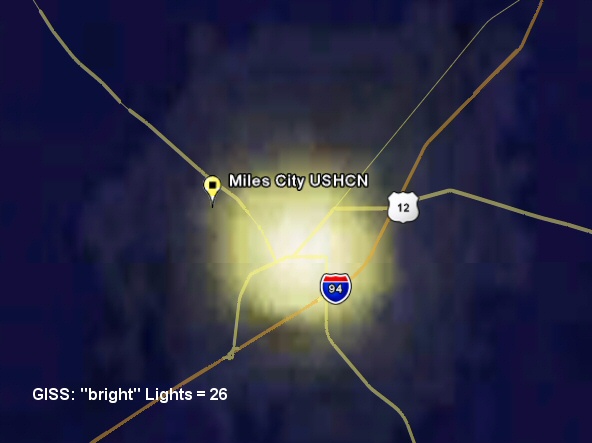
There’s no post-1988 data for Cobija or Rurrenabaque.
Thus spaketh Tamino, a pseudonymous climate blogger who occasionally takes the time to hurl invective at Climate Audit.
As so often in matters climate, I casually wondered how Tamino knew this. My puzzlement grew by merely googling “cobija weather”. To my enormous surprise, there were a number of websites that purported to give up-to-the-hour information on weather in Cobija, where as I write, it is 29 deg C. with wind from the NNW at 6 mph.
In the past, we here at Climate Audit have assisted UCAR in locating the missing civilization of Chile. Perhaps today we can do NASA a good turn by locating the mysterious lost city of Cobija, Bolivia.
According to Wikipedia, Cobija has approximately 25,000 inhabitants, is the seat of a university and has two airports. So it is indeed puzzling that there is apparently no data after 1988.
Googling “cobija climate”, I promptly located a site which contained not merely today’s data for Cobija but information going from 1973 to the present without interruption, neatly arranged in annual tables. The mystery deepened.
This site contained an identification number “850410”. Using the first 5 digits and the name, I searched for possible sources of the mysterious data available on the internet, but which the GHCN historical network and NASA had been unable to locate. This turned up many lists.
Collecting myself from my astonishment, I thought for a minute about the seeming easy availability of the data for commercial services on the internet and I wondered whether it might be located on one of the primary daily lists (GHCN Daily) http://www1.ncdc.noaa.gov/pub/data/ghcn/daily/ghcnd-stations.txt and sure enough Cobija and several Bolivian cities were listed. Indeed, they turned out to be sites selected for inclusion in the GCOS (GSN) network!
30200085041 -11.0300 -68.7800 -999.9 BL COBIJA GSN 85041
30200085043 -11.0000 -66.1200 -999.9 BL RIBERALTA GSN 85043
30200085114 -13.3300 -64.1200 -999.9 BL MAGDALENA GSN 85114
30200085141 -14.4700 -67.5700 -999.9 BL RURRENABAQUE GSN 85141
Daily information was available at http://www1.ncdc.noaa.gov/pub/data/ghcn/daily/gsn/30200085041.dly. I downloaded this data, calculated monthly averages for all months with at least 14 days of values and compared the results to the GISS dset1 information, as shown below.
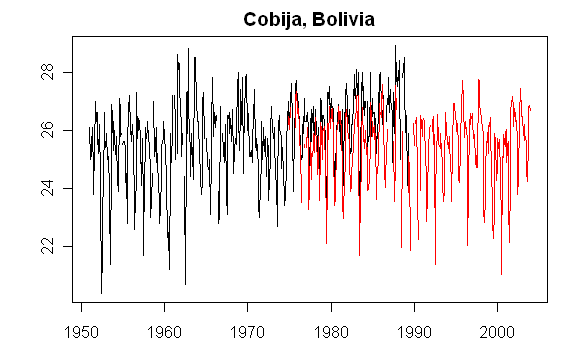
Black – NASA; red – GSN
I did the same thing for Rurrenabaque, another site said by Tamino (relying on NASA) to have no values after 1988. The comparison is shown below.

Black – NASA; red – GSN
During the period of overlap between the GISS dset1 record and the GSN record (1973 on), the GISS version increases at about 0.6 deg C per decade relative to monthly averages calculated directly from GSN daily information as shown below.
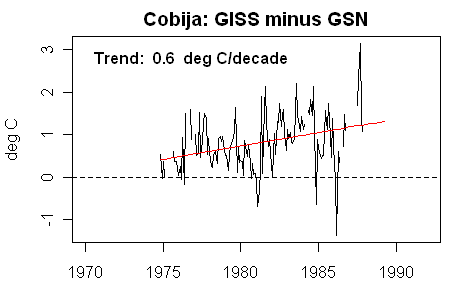
What accounts for the relative increase in the GISS version relative to the GSN version? At present, I don’t know. The primary cause is not at the GISS level, as the GISS version is closely related to the GHCN Raw version. The difference appears to be in how GHCN Monthly handles the original data – a topic that we’ve not even scratched yet.
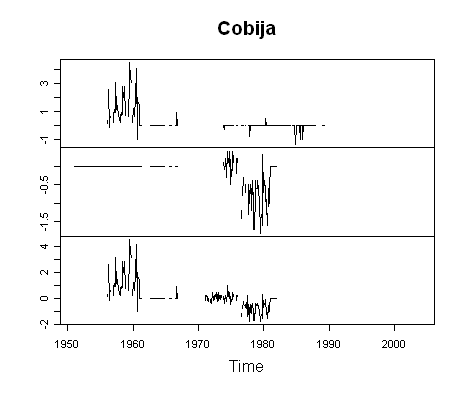
The GISS dset0 file contains three Cobija versions which presumably derive form GHCN somewhere: one goes from 1951-81, one from 1956 to 1989 – both having very long gaps in the 1960s and 1970s and a third version from 1956 to 1989. In some portions, the versions are virtually identical; in other portions, major discrepancies arise. The differences between the three versions is shown below:
So we’ve solved one mystery and encountered others. We’ve established that Cobija (and Rurrenabaque) both have data after 1988. Indeed, the data is collected and stored at the GHCN Daily site. Unfortunately, in this case, the left literally doesn’t seem to know what the right hand is doing as the GHCN Monthly site has failed to link to the updates occurring at the GHCN Daily site.
Tamino says that climate scientists are aware of these problems and “working hard” to resolve them.