Von Storch, Zorita and Gonzalez-Raucen have issued the following statement on the NAS Panel Report (link): Continue reading →
The early rumors on the NAS Panel was that it was “two handed” -on the one hand,…, on the other hand, … with something for everyone. I’d characterize it more as schizophrenic. It’s got two completely distinct personalities. On the one hand, they pretty much concede that every criticism of MBH is correct. They disown MBH claims to statistical skill for individual decades and especially individual years.
However, they nevertheless conclude that it is “plausible” – whatever that means – that the “Northern Hemisphere was warmer during the last few decades of the 20th century than during any comparable period over the preceding millennium”. Here, the devil is in the details, as the other studies relied on for this conclusion themselves suffer from the methodological and data problems conceded by the panel. The panel recommendations on methodology are very important; when applied to MBH and the other studies (as they will be in short order), it is my view that they will have major impact and little will be left standing from the cited multiproxy studies. You can find the report and the recorded briefing here.
Continue reading →
The NAS Panel is scheduled to issue its report, "Surface Temperature Reconstructions for the Last 2,000 Years" at 11 a.m. on Thursday. I suspect that many people would expect me to be worried about what the panel will say.
Actually, I’m not worried in the slightest.
Based on presentations to the panel, NAS is in an extremely awkward position if their original intent was to whitewash the situation. If they touch the key questions at all, they have little wiggle room in which to avoid some pretty adverse findings. If they avoid or don’t answer the key questions – some of which are simply reporting on factual situations, then the House committees are going to be pretty mad at them for wasting their time.
Here are some of the key questions where I’ll be looking to see if the NAS Panel provided answers or played dodgeball. Continue reading →
David Stockwell has an interesting post on the lack of public archiving of bird flu sequences, drawing on a longer post by Declan Butler.
So apparently, noone is opposed to depositing the sequences in Genbank immediately, but noone is taking the decision to do so. In the Nature editorial, Dreams of flu data we argued:
Genetic data are also lacking. When samples are sequenced, the results are usually either restricted by governments or kept private to an old-boy network of researchers linked to the WHO, the US Centers for Disease Control and Prevention, and the FAO. This is a far cry from the Human Genome Project, in which all the data were placed in the public domain 24 hours after sequencing. Many scientists and organizations are also hoarding sequence data, often for years, so they can be the first to publish in academic journals. With the world facing a possible pandemic, such practices are wholly unacceptable. Nature and its associated journals are not alone in supporting the rapid prior exposure of data when there are acute public-health necessities.
Lonnie Thompson is much closer to 24 years than 24 hours for not archiving his (still unarchived other than a miniscule summary) Dunde data. The bird flu data hoarders are neophytes in comparison. Let’s see if their data is still unarchived in 2025 – otherwise climate scientists will be unimpressed with such amateur data hoarding.
Ou (J Clim 2001), " Possible Bounds on the Earth’s Surface Temperature" is an attempt to explain why a climate “not unlike the present-day one has prevailed on the earth since its early history when the sun was considerably dimmer”, a question that Lee was musing about and, IMHO, an interesting question. The tricky thing is how you get both ice age and hothouse periods not only without careening out of control, but going to the other side, again without careening out of control. Ou also has a more recent article on the same topic that I’ve noticed but haven’t read. I’m not vouching for anything here other than I found the article interesting and the question stimulating. Most climate models have very strong positive feedbacks and intuitively one feels that if they were applied to the history of the Earth, they would have projected the Earth turning into either Venus hothouse or Mars icehouse long ago. (I don’t "know" that they would do this, it’s just an impression.) Continue reading →
A few days ago, I mentioned that I thought that Bürger et al 2006, while recognizing the linear relationship between MBH proxies and their RPCs, had incorrectly formulated the form of the relationship as the form of the linear relationship was inconsistent with my own derivation, which I had cross-checked and verified against source code (not that the methodology is "correct" only that the representation of the methodology is accurate.) This has led to an interesting exchange with Gerd Bürger, which I’m now in a position to summarize.
Gerd initially thought that my derivation must be incorrect. I asked him to show how he got Tellus equation 8. (I thought that the form of Tellus equation 8 was ugly and contained unnecessary complications but that was seemingly a side issue.) Gerd sent in a derivation which looked plausible; when I tried the calculations his way, you could get Tellus equation 8 so I figured that maybe it was OK after all. The calculations still didn’t seem to reconcile, so I figured that I’d gotten lost somewhere in the reconciliation – although I’d spent lots and lots of time on it.
Gerd then wrote in correcting his calculation and stated that Tellus equation 8 did contain an error after all, so that my original conclusion was correct. Gerd says that the error does not affect their simulations and I suspect that this is so. However, it directly affects the argument in Bürger et al 2006 about VZ variance attenuation. I’m not sure that this argument is all that valid anyway, but the argument doesn’t seem to apply with a corrected equaiton 8 or at least it will require a total re-working. Continue reading →
John A thought that it would be worthwhile to draw attention to some articles on scientific reaction to Al Gore’s film "An Inconvenient Truth". and started this post. I have kept his links and quotations, but otherwise re-written this post.
I haven’t seen Al Gore’s film and may comment on it myself later. I suspect that the film uses the most lurid and sophomoric images available and invites equally sophomoric responses. I think that there are some valid issues, but these debates tend to get reduced to sound-bites. Continue reading →
Right now, I’m working on two main projects where I intend to produce papers for journals: one is on the non-robustness of the “other” HS studies; the other is on MBH98 multivariate methods. The latter topic is somewhat “in the news” with the two Bürger articles and with the exchange at Science between VZ and the Hockey Team goon line of Wahl, Ritson and Ammann. (“Goon” is a technical term in discussion of hockey teams: Hockey Teams all have enforcers sent out to fight with and intimidate opposing players.)
From work in progress on the second project, here are some comments on the linear algebra in Bürger et al. Contrary to B-C claims that MBH98 methods cannot be identified in known multivariate literature, I show that – even though this is seemingly unknown to the original authors and later commentators – MBH98 regression methods can be placed within the corpus of known multivariate methods as one-factor Partial Least Squares (this is probably worth publishing by itself although it opens the door to other results) . (Update – I’ve edited this to reflect comments from Gerd Bürger, which have reconciled some points.) Continue reading →
By Stephen McIntyre
|
Posted in MBH98, Multivariate, Replication, Statistics
|
Tagged algebra, borga, magnus, multivariate, orthogonal, overfit, pls, stone, stone and brooks
|
8 new tree ring measurement data sets have archived this week at WDCP in northern Alberta by Meko. The sites are around 58N, 111W , well to the northeast of the Jasper site (52N, 117W) which is used in nearly all the multiproxy studies. I did a “standard” type chronology fitting negative exponential curves by core if they fit, horizontal straight line if they didn’t. Here are my calculations for the 8 sites (the authors did not archive chronologies, only measurements).
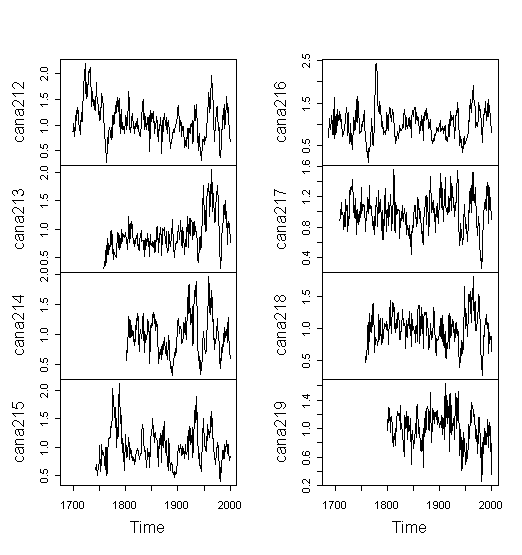
Figure 1. 8 New Sites archived in June 2006 at WDCP
Here is the average of the 8 series.
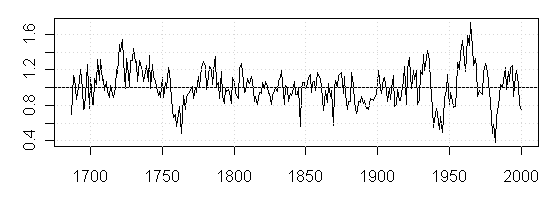
To the best of my knowledge, these ring widths were not collected as an industry-funded disinformation tactic or with any specific intent to discredit the Hockey Team.






A few inconvenient truths
John A thought that it would be worthwhile to draw attention to some articles on scientific reaction to Al Gore’s film "An Inconvenient Truth". and started this post. I have kept his links and quotations, but otherwise re-written this post.
I haven’t seen Al Gore’s film and may comment on it myself later. I suspect that the film uses the most lurid and sophomoric images available and invites equally sophomoric responses. I think that there are some valid issues, but these debates tend to get reduced to sound-bites. Continue reading →