If you actually look at the medieval proxy index of the "other" studies (Briffa 2000, Crowley and Lowery 2000, Esper et al 2002, Moberg et al 2005), the medieval proxy index is usually just a razor’s edge less than modern proxy index – just enough that the study can proclaim with relief that the modern values exceed all values in the past millennium. However, there’s a lot of data handling that is a lot like accounting and there are decisions that are like accounting decisions. If the profit is very slim, wise investors know that there were might have been some decisions where choices were made to get the accounts into the black, which might equally have gone the other way.
My view of the "other" studies is that the relative levels of the medieval and modern proxy index are very non-robust and dependent on a very few series – bristlecones for example. Another issue of this type is the substitution of the Yamal series for Polar Urals, once the Polar Urals update showed a high MWP value. In February of this year, after about 2 years of trying, I got some data from Esper on the Polar Urals Update and posted a few posts on this topic a few months ago. See Polar Urals: Briffa versus Esper Polar Urals Spaghetti Graph
I got a bit off this topic during the NAS Panel and some other issues, but I re-visited this with a quick and interesting calculation. Of all the reconstructions, Briffa 2000 is by far the easiest as you don’t have to run the gauntlet of weird methods. The measurement data for key sites (Tornetrask, Yamal and Taimyr) is unavailable but there is still analysis that can be done without a complete file.
Briffa 2000 uses 7 canonical series – Tornetrask, Yamal dba Polar Urals, Taimyr, Yakutia, Jasper aka Alberta aka Athabaska, Mongolia and the Jacoby treeline composite. Most of these recur in every subsequent study and all the "other" studies can be said to reflect slight variations of this composite. Briffa does a simple average of available data. His series are archived here
so emulating Briffa 2000 is a matter of minutes rather than months (other than the measurement data.)
In my earlier posts, I was pretty sarcastic about the substitution of the hockey-stick shaped Yamal series for the high-MWP Polar Urals Update as being opportunistic at best and about the Polar Urals spaghetti graph – if you had spaghetti at a single site, how come all the multiproxies seem to agree so well?
But did this "matter"? Let’s check out the impact of the single substitution of the Polar Urals Update (as used in Esper) back into the Briffa 2000 roster. Recall that Briffa et al (Nature 1995) was about the Polar Urals, claiming that the old version showed that 1032 was the coldest year of the millennium. So Briffa knew all about the Polar Urals site (which has been used directly or as the aka Yamal) in every study.
The Briffa 2000 reconstruction, as shown below, has a highish MWP, whichis just a titch less than the modern values. The medieval values (averaged) are just a titch lower than 20th century and some years look as high.
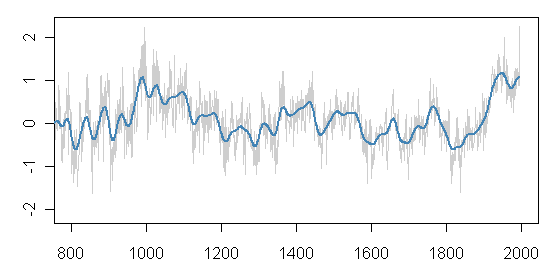
Figure 1. Briffa 2000 reconstruction.
Now let’s the review the bidding, by showing the difference between the Polar Urals update and the Yamal substitution – the one with a pronounced MWP, the other with a pronounced 20th century, otherwise quite a bit in common. But hardly a very "robust" method when two nearby sites yield such contradictory results.
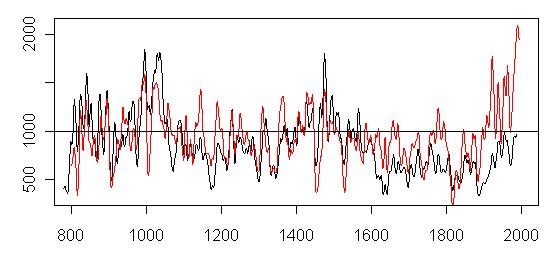
Figure 2. Black – Polar Urals; red- Yamal.
Now here is the result of simply making one subsitution. The relative position of the modern and MWP periods are reversed and reversed substantially – this is with the subsitution of just one series.
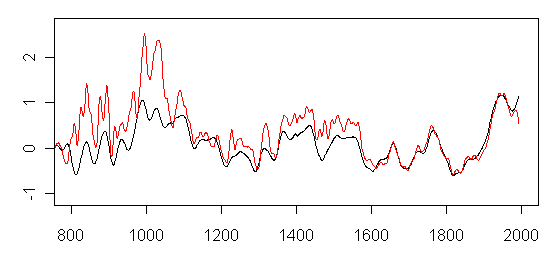
Figure 3. Briffa 2000-type reconstruction, with Polar Urals update.
Yeah, I know that they say that they couldn’t calibrate the Polar Urals Update and "had" to do the substituion, but somehow Esper managed to do a calibration and there is a lot of similarity to Yamal so the calibration couldn’t be all that bad. (How does Esper ensure that the MWP stays below modern levels? Of his 8 or so MWP series, he has not one but two foxtail series, which help his accounting).
By the way the Polar Urals Update has nearly double the correlation to gridcell temperature as Yamal In this connection, I checked the reported correlation to gridcell temperature from Osborn and Briffa 2006 at Science for Yamal and they are incorrect. I even got the temperature data as used by Osborn and Briffa and the correlation still doesn’t match, but that’s for another day.
If you can get such different results merely by substituting Polar Urals Update for Yamal, how can you assign "confidence intervals" to such a reconstruction. When results depend on such seemingly minor accounting decisions, you have to examine each accounting decision as each decision may be material,









 Climate Audit