As I mentioned earlier today, Niwot Ridge is about 45 minutes drive from UCAR headquarters in Boulder (which hosts the IPCC WG1 TSU). I’ve identified 5 archived chronologies from Niwot Ridge, including two chronologies discussed in Kienast and Luxmoore 1988 as contradicting Graybill’s claims of enhanded post-1950 growth. Graumlich 1991 distinguished the two studies on the basis of altitude, but I pointed out that, at Niwot Ridge, the Graybill PIFL site was actually lower in altitude than the Kienast and Luxmoore sites (both PCEN). I also pointed out that Woodhouse did a PIFL study at the same altitude as Graybill, a few miles away. Anyway, here are the 5 tree ring width chronologies (there’s also an MXD chronology not shown so far.)

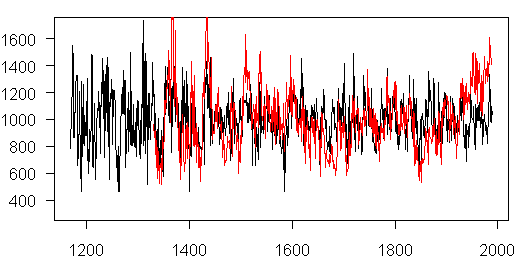
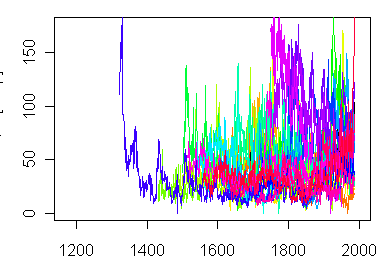
Niwot Ridge chronologies. Red- Graybill PIFL ‘ blue Woodhouse PIFL. 1) Hansen-Bristow PCEN; 2) Woodhouse PIFL; 3) Graybill PIFL; 4) Kienast PCEN; 5) Schweingruber PCEN (used in Kienast and Luxmoore).
The differences between the site chronologies are obviously quite remarkable. The Kienast and Schweingruber site chronologies do not appear to have been taken more than a few hundred yards from the Graybill chronology, although the species PCEN- Engelman spruce) differs from Graybill’s IFL (limber pine). However, Woodhouse is exactly the same species at the same altitude from a few miles away.
Here’s something amusing re MBH. The Woodhouse and Graybill site chronologies (both PIFL, both at the same altitude) are both used in MBH (for some reason, the Schweingruber and Kienast chronologies are not used, although many Schweingruber chronologies are). What are the weights of the two sites in the MBH98 PC1?
| Site |
EOF1 Weight |
| Graybill co545 |
0.2299 |
| Woodhouse co511 |
0.0025 |
So the HS-shaped series has a weight nearly 100 times larger than the non-HS shaped series, even though these are series of the same species within a couple of miles of one another. TCO has been grinding about why I regard this weighting as erroneous and what the correct weights should be? Or whether the "real " problem is the principal components methodology or the proxies?
I find it very difficult to be a judge at that particular beauty contest. How can one look at such disparate chronologies and come away with any view as to what the "correct" weighting is? How can both the Graybill chronology on the one hand and the Woodhouse/Kienast/Schweingruber chronologies on the other hand both be meaningful "proxies"? Yes, the HS shaped series is given 100 times the weight of the other series, but this is not just an error in geographical weighting. There’s something wrong with the method, as we’ve said from the beginning, with its biased picking; it’s not just that the geographic weights are wrong, but that it’s severely biased.
There’s also something fundamentally wrong with the confidence intervals claimed for tree ring chronologies. You see a statistic called the Subsample Signal Strength or Expressed Population Signal, where under the circumstances of any of these sites, the dendro people would claim that their signal is accurate to within very small percentages – but such claims are clearly unreconciliable with the big divergences between nearby series – a completely different Divergence Problem than the NAS Panel has in mind, but a big one nevertheless.
Another issue that I’m beginning to wonder about: how solid is the Graybill data anyway? The discrepancy between the HS-shaped Graybill series and the very different appearing Woodhouse, Kienast and Schweingruber series is worrying, although the Hansen-Bristow series has points in common with Graybill. There’s a lot of weight being placed on Graybill’s data – don’t you think that someone within the past 20 years should have replicated his results? (Oh, wait a minute, Hughes did resample Sheep Mountain in 2002 – it’s just that he hasn’t reported the results.) Tomorrow or the next day, I’m going to post up some worrying aspects to the Jacoby-D’Arrigo series at Churchill, Manitoba.
Update (Saturday):
Here is a figure showing the Graybill and Woodhouse PIFL chronologies on the same scale. Their correlation is 0.46. Graybill said that he was particularly looking for strip bark trees. Maybe that accounts for the difference. But the difference in 20th century HS-ness between samples taken by two different researchers on the same trees at the same elevation within a couple of miles of one another is pretty amazing and needs to be reconciled.








 Climate Audit
Daily Telegraph
A nice favorable mention today in an article by Bob Carter in the Daily Telegraph today.
Bob Carter is an Australian geologist, who has carried out extremely interesting analyses of clnmate variability over the past 3.6 million years. I showed one of his graphs here -scroll to the bottom.
This is not an entirely unbiased article, as Bob was the first person to encourage me to pursue research in this area back in mid-2003 when no one had ever heard of me, I’d never written an accademic article and was just musing on the internet. He emailed me to say that I was looking at proxy issues in a different way than anyone else and that what I was doing was worthwhile. We’re about the same age, I’ve met him in San Francisco at both AGU conferences that I’ve been at and we get along famously.