Last Friday, Science sent me measurement data used at 10 Esper sites — thanks to Science for this. Measurement data for 4 important sites (the Boreal and Upperwright foxtail sites; Polar Urals and Mongolia) were not sent. Hanson of Science commented that the Polar Urals site and some of the sites that he checked were at ITRDB.
Esper et al [2002] did not provide data citations to ITRDB data sets (nor did Hanson). Working backwards from the measurement data now provided by Esper, it turns out that, for a number of sites, one can locate combinations of ITRDB sites that constitute the Esper sets. However, I was certainly unable to do so without consulting the Esper data and I’ll show through an example the nature ofd the obstacles to guessing how to combine candidate data sets. Continue reading →
There’s an interesting irony in the GRL rejection of the Ammann & Wahl Comment and it will be interesting to see how this gets handled. It turns out that the A&W Climatic Change depends on their GRL submission for their test of statistical significance for the RE statistic. So even though the GRL referee thought that there was nothing new in the GRL submission, it turns out that it contained something that is essential for their Climatic Change submission. The issue is substantive and not just formal. I’ll show the connection. Continue reading →
GRL has rejected the Ammann and Wahl Little Whopper (shortly after Climatic Change accepted the Big Whopper). We previously posted up our Reply to the Little Whopper here. You can see previous discussion of this by the category "Wahl and Ammann". Since the Comment is not being published, neither is the Reply. I wonder whether they will make changes to the Big Whopper to reflect this rejection or simply drive on (as Mann and Jones did in 2004 following the rejection of the MBH submission to CC.)
What a total waste of time. Famiglietti mouthed off to Envronmental Science and Technology last August and replaced Saiers as editor in charge of our file. He then took the comments by Ritson and by A&W (already rejected by Saiers) out of the garbage can, told us that the Ritson comment was accepted, then he rejected the Ritson comment after he saw our reply. Likewise with Ammann and Wahl. Needless to say, Famiglietti did not say that the Little Whopper was rejected because it withheld adverse results or misrepresented our work, but merely because "the key points of the debate are already out there" – which was the same (perhaps polite) reason that Saiers gave in the first place last May.
If it was rejected because the "key points were already out there", why did Famiglietti need us to write a Reply? He should have been able to tell from reading the article. Or if he couldn’t tell from that, he should have been able to tell from reading our letter to Saiers, which listed all the problems in the Little Whopper, including its repetition of points already raised in Huybers. We re-sent the letter to Famiglietti, so he had no excuse.
Buncha jerks.
This post got deleted in the server crash. I typically post up from written text, but usually do a final edit as I input onto the blog, so the present note will probably differ a little from what I posted up yesterday, but probably not materially.
Mann did not present anything germane that had not already been presented at realclimate or Ammann-Wahl. As a result, in my opinion, we had fully anticipated and dealt with all his points in our presentation the previous day. Certainly, he said nothing that caused me any concern about the validity of our points. Perhaps the most surprising aspect of his presentation was his response to a question about the verification r2 statistic, in which he denied ever calculating the statistic as that would have been “silly and incorrect reasoning”. Given that we’d presented specific evidence that he had calculated this statistic, this seemed to me to be an unpromising line of defence for him. Continue reading →
As you’ve noticed, there was a server crash and the site has been restored from a back-up. I’m told that the site is on a new server. The recurrent down-time leading up to the crash was presumably related. Lost in the backup are my post on Mann at the NAS panel, my update to the Cook et al. post and all comments on Cook et al. and Mann at the NAS panel. My apologies to all. It has nothing to do with us but with the webhost provider. Hopefully the new service has been upgraded in the process.
Reader Bart S. has argued that Cook et al [QSR 2004] disposed of the "Divergence Problem", the name applied at the NAS panel on March 2-3, 2006 for the problem that, if the proxies do not record late 20th century warming, how can we be sure that they recorded potential earlier warming in the MWP.
Since many people here are alien to the scientific litterature on the topics they discuss, i would like to draw the attention to a paper published by Cook et al. in QSR 2004, I am sure it has been audited here before, but the audit seems to have failed to notice the fact that the paper speeks directly to the “divergency” issue. First by showing that the diergency is an issue not for the complete set of time series of Esper et al, but only for the northern ones, as also Briffa said in 1998, then showing that during medieval times this difference or divergency between mid and high latitude series does not appear. Bottom line – no evidence of MWP divergency.
I’ve not posted before on Cook et al [2004], but it’s not obvious to me that it represents an advance beyond Briffa’s cargo cult explanations for divergence.
Also see posts 529 and 570.
Continue reading →
Otto-Bliesner asked me how I would do a reconstruction. As I’ve said on other occasions, I said that I didn’t know. I’m really reluctant to just apple-pick some series but it’s prbably worthwhile showing that you can pick apples as well as cherries. More constructively, I think that there are some approaches that look better than others. I don’t think that Mannian data mining or forms of cherry picking are very promising. There are many problems with tree ring "site chronologies", but that doesn’t mean that Moberg’s little collection of 11 series is any magic bullet. Out of the various individual proxy studies that I’ve read, I think that two of the most interesting are Naurzbaev et al [2004], about which I reported here and a new one, Millar et al [2006], online here (I’d previously commented on a poster on the same topic here) . The topic has particular resonance for readers of this site as Millar et al. have done a detailed analysis of high-altitude (3000+ m) in the Sierra Nevadas, near the foxtails and bristlecones. Here is an excerpt from the Abstract:
Deadwood tree stems scattered above treeline on tephra-covered slopes of Whitewing Mtn (3051 m) and San Joaquin Ridge (3122 m) show evidence of being killed in an eruption from adjacent Glass Creek Vent, Inyo Craters. Using tree-ring methods, we dated deadwood to 815-1350 CE, and infer from death dates that the eruption occurred in late summer 1350 CE….Using contemporary distributions of the species, we modeled paleoclimate during the time of sympatry [the MWP] to be significantly warmer (+3.2 deg C annual minimum temperature) and slightly drier (-24 mm annual precipitation) than present,
Continue reading →
Back to reporting on our presentation to the NAS panel, after which I’ll report on Mann. We presented last in the day, immediately following von Storch. Hughes and Mann presented on Friday morning. We gave them a long written presentation, and touched the high points in our PPT, also providing them with a CD of our papers. Our PPT presentation is cited in the NAS "other materials"; our "handout" is mentioned but not cited. Continue reading →
If you glance to the bottom of the sidebar on the right hand side, you will find a brand new, shiny, and in keeping with CA’s overriding philosophy, free visitor counter with the added bonus that we can then all view where you’re browsing from. Over time you’ll see that we get visitors, trolls and stalkers from all over the globe.
Hovering the mouse over a flag will show the related country, for those of you who don’t know what the Maple Leaf flag is for.
Now Steve, about Google Adsense…
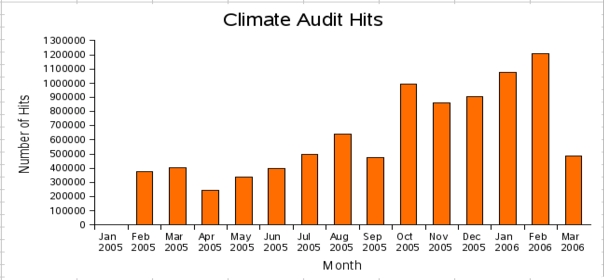
A propos of nothing, I decided to check out the statistics provided by the webhost (Webserve.ca) on climateaudit.org, since we didn’t know whether the recent statistics were an aberration or a short sample from a long trend.
Using advanced statistical analysis tools (OpenOffice Calc) and image transformation technologies (Krita) I present the real statistics of this weblog:

For those who like pictures, here is the dastardly plot:
What else do the stats show?
Well, there’s a 4-5% drop on weekends but a peak viewing (+2%) on Mondays compared with the rest of the working week.
Looking to hourly stats, its appears that most viewers are reading this from work, since most hits appear in the North American morning. I hope your bosses know this.
The stats also show that 50% of you browse using Internet Explorer, 31% use Firefox or Netscape browsers, and Apple Safari accounts for 5%
When you compare this with the Alexa ranking, you can see that ClimateAudit is drastically underrecorded by people stupid enough to install the Alexa spyware toolbar. So there.





 Climate Audit