I wrote recently about the Yamal substitution for the Polar Urals series in both Osborn and Briffa [2006] and D’Arrigo et al, 2006. This substitution is not incidental as the Yamal version had by far the strongest closing uptick in either data set, while the updated Polar Urals ring width series (1998 update) had elevated MWP levels. The substitution is not explicitly justified in either article.
Also see here here here. Continue reading →
As I’ve mentioned before, you have to really watch the pea under the thimble whenever Briffa is presenting a series. I showed before how the post-1960 decline in MXD reconstructions was simply excised from the record and carried forward into the IPCC spaghetti graph where the overlay of colors made the detection virtually impossible to detect.
There’s a curious difference in the end portions in the two versions of the smoothed MXD graph shown below: you’ll notice that one of them is truncated earlier than the other. Look how the second graphic goes a little lower at the end.

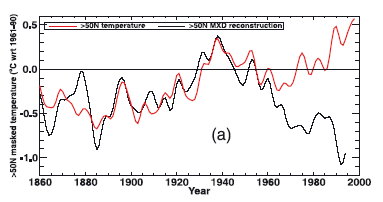
Top: From Briffa et al [1998]; bottom – from Briffa et al [2004].
When I tried to figure out the reason for the difference, I ended up collating graph versions for a whole series of Briffa articles from 1998 to 2006 from 7 different journals. Was there any moral to the story? I’m not sure. But they certainly have got a lot of mileage out of the same dataset in different journals – without ever listing the sites.
Continue reading →
The continued negligence of the major journals in ensuring that paleoclimate authors archive data in accordance with journal policies is very frustrating and, as previously noted, has reared its ugly head once again with Osborn and Briffa. I have had little luck in the past with Science (except for the Kilimanjaro sample dO18 data) but here’s one more go. I think that Benny Peiser is planning to encourage CCNet readers to write Science ( bhanson at aaas.org) in support of this request. Continue reading →
There’s an interesting article online here by David Goodstein of Caltech, in which he notices that misconduct problems seem rife in biological sciences administered by NIH and very infrequent in sciences administered by NSF. He identifies three factors as common in problems, noting that exact reproducibility in physical sciences is a major deterrent to fraud. If you look at the ingredients in climate science, I hardly need to editorialize.
Goodstein: Continue reading →
The National Academy of Sciences (NAS) has presumably been criticized in the past for the composition of panels (from the evidence of the mere existence of the 1997 law on committee balance and composition). This law and resulting policies provide for a comment period on proposed committees. Ross and I have exercised our rights under this policy and today sent the following letter to NAS. Continue reading →
It is reported here that the University of Pittsburgh Research Integrity Panel concluded that Dr. Gerald Schatten didn’t intentionally fabricate data, but he committed “research misbehavior” in signing his name to Dr. Hwang Woo-suk’s work in South Korea.
The panel found Schatten, as co-author with Hwang on a 2005 article in the journal Science, “did not exercise a sufficiently critical perspective as a scientist.” By not properly checking the veracity of the paper, Schatten committed “a serious failure that facilitated the publication” of the work, the panel said….
The report was also critical of Schatten’s acceptance of $40,000 from Hwang over 15 months, including $10,000 in cash while attending a press conference after the 2005 paper was published…
The report details how Schatten helped Hwang gain recognition, something the panel said likely encouraged Hwang to offer Schatten authorship of the paper. Schatten nominated Hwang for foreign membership in the United States National Academy of Sciences and with others for a Nobel Prize.
The panel also noted another example of Schatten putting his name to a paper where he seemed to have little or no input. In a Hwang paper on the cloning of a dog, Schatten’s only contribution as co-author was to suggest that a professional photographer take the dog’s picture, the panel said. Independent tests indicate Hwang’s claims to have cloned a dog are true.
We have a number of readers who are highly qualified econometricians. I think that initially they find it hard to believe the description of Hockey Team statistical practices. Martin Ringo is one such reader, who has a doctorate in "finite sample properties of a variety of feasible, generalized least squares estimators". He’s sent in the following discussion of principal components reconstruction from a different aspect than any that I’ve considered – whether the temperature PCs from the short calibration period will even accomplish what MBH want. Marty:
Even if we had the exact PC component from the SVD of the long series, it is not enough to reconstruct the temperatures. (That is, even if MBH’s proxies could perfectly estimate the temperature PCs, they still won’t be able to reconstruct what they want to reconstruct.) To reconstruct the temperature, even the averages across all the grids, one needs a better estimate of the post-multiplying matrices associated with the long series SVD than the post-multiply matrices of the short series will give.
Continue reading →
In the last few days the issue of funding the BBC was recently discussed on Slashdot. There is a proposal to tax personal computers on the off-chance that they might use the BBC’s online resources and even watch streaming video rather than watch TV. I’m pretty sure that such a tax would fall foul of the European Union as a subsidy to a State-controlled corporation.
But what are they spending extra money on?
Continue reading →
Readers of this site are familiar with various efforts by UCAR and UCAR personnel to discredit us, ranging from the April 6, 2005 presentation in Washington by Ammann, Bradley and Crowley discussed here , the long-standing effort by Ammann and Wahl to discredit us leading to the UCAR press release of May 11, 2005, announcing the submission of two papers (and their subsequent failure to report the GRL rejection), the use of UCAR’s press release by Mann, Houghton and others in evidence to Congress, the outrageous remarks to ES&T by UCAR scientists Trenberth and Mahlman, etc. etc.
It has obviously not escaped my attention that two of the proposed NAS panelists are from UCAR – something which I’m uneasy about To make matters worse, it turns out that one of the two panelists, Bette Otto-Bliesner, Deputy Section Head, Climate Change Research, is actually Caspar Ammann’s boss, shown (left) in a pastoral photo below and has co-authored many presentations with Ammann. The other, Doug Nychka, has co-authored with Ammann and is listed on one of Ammann’s webpages as a current collaborator not only with Ammann, but with Mann.

Paleoclimate Modeling Group, Climate Change Research Section, National Center for Atmospheric Research
They all look like nice people, but that’s not the question. It turns out that NAS has some quite nuanced policies about panel composition and balance and it seems inconceivable to me that these Ammann collaborators meet either the letter or spirit of NAS policies. There are 14 days left for feedback to NAS on these appointments and I hope that some of you will avail yourselves of this opportunity – feedback form here. Continue reading →
I’m not sure that there’s a huge demand for more linear algebra on MBH98, but here’s the rest of the proof that the NH temperature index in an MBH98-type calculation is simply a linear combination of proxies and, when only one temperature PC is reconstructed, the weights are proportional to the correlation between each proxy and the temperature PC1. Continue reading →





 Climate Audit
BBC hypes climate modelling scare again
In the last few days the issue of funding the BBC was recently discussed on Slashdot. There is a proposal to tax personal computers on the off-chance that they might use the BBC’s online resources and even watch streaming video rather than watch TV. I’m pretty sure that such a tax would fall foul of the European Union as a subsidy to a State-controlled corporation.
But what are they spending extra money on?
Continue reading →