Intelligible Code

Just a short note today on code for McShane and Wyner and its comments. The discussion of McShane and Wyner has been greatly enhanced first by their archiving of code and secondly by simplifications of the code both by the online community and discussants.

Most of the McShane and Wyner analysis is in R, making this part of their analysis quickly accessible to a wide community. (Their Bayesian analysis is not in R – it seems to be in WinBUGS.) There’s a lot of self-teaching in R programming and I nearly always learn something from reading other people’s code. Sometimes you see things that you think that the other guy could learn. For example, I find it handy to organize R data sets as time series (“ts”) objects – not used by Mc-W. I like to have objects in use available on the internet for download using download.file(…, mode=”wb”), rather than packing things up in zip-files. It’s a small stylistic preference.

I was able to get the R portion of their code to operate quickly and easily, but I’m not familiar with WinBUGS and wasn’t sure how much overhead would be involved in figuring it out.

Meanwhile, I spent some time looking at the code for Gavin Schmidt’s (Schmidt, Mann Rutherford) comment on McShane Wyner. The code is night and day different from the code of Mann et al 2008, which is ponderous and opaque to the point of virtual unintelligibility. While the entire point of the Schmidt comment is nothing more than preserving bristlecone impact without mentioning bristlecones, the code of their comment is clean and easy to follow.

One useful improvement to the McShane-Wyner code is the collection of their code into a well-organized master script, much improving the ease of replicating results. Their master script makes extensive use of the source command. Occasionally they have second-tier source commands (called from a source script) rather than keeping all the source commands in the master script, but this is a stylistic nit.

Their other major improvement is applying the port of the Bayes portion of McShane-Wyner to R originally developed at a blog blog here. This port requires the R-package rjags AND the separate installation of JAGS 2.1.0 . It took me a while to figure out that JAGS 2.1 needed to be installed separately, but once that was done, I was able to proceed uneventfully.

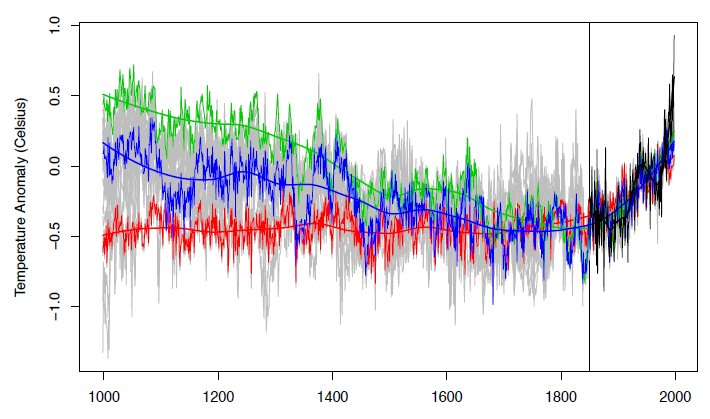
For the most part, the reconstructions illustrated in Mc-W Figure 14 are based on a variation of MBH98-99 methodology (and not the lasso methodology used in the red noise analyses) i.e. they did a principal components analysis of proxies and gridded temperatures (with the M)8 network) and reported various permutations, yielding a lot of different squiggles. The big issue in the various permutations is not discussed by Mc-W or (especially) by Schmidt, as it pertains to the extremely stale issue of the presence/absence of strip bark bristlecones.

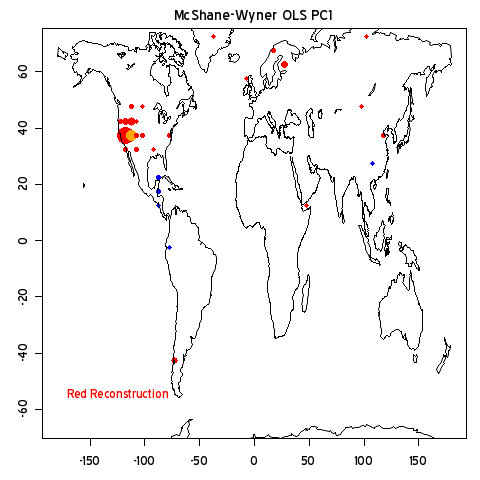
I mentioned previously that the 93-series network used by McShane-Wyner included 24 strip bark chronologies and 2 Korttajarvi sediment series. Because there are so many strip bark chronologies and no attempt is made to downweight all these nearby chronologies, they dominate the PC1 in the AD1000 network even without Mannian centering – a point originally made in McIntyre and McKitrick 2005 (EE), but mostly ignored. It can therefore hardly be a surprise that the “red” hockey stick shaped reconstruction in McW Figure 14 (see below) looks like MBH99, because it is simply one more avatar of MBH99 bristlecones.

In the following graphic, I’ve indicated the weights of individual gridcells by the weights of the filled circle – a technique used here on a number of occasions. After all the huffing and puffing of megaflops of multivariate analysis, it all comes down to a vector of linear weights of the original proxies (in calculating the weights, I’ve used linear algebra shown at CA in the past.) Other permutations are less weighted towards bristlecones.


Figure 2. Weights by Gridcell of Proxies in Mc-W 93 Proxy PC1 (radius is square root of weight)

Schmidt et al contested the Mc-W 93-series network as not being “properly” selected. They reduce the network to 55 proxies, excluding the two Tiljander series retained in the MW 93 and tree ring series with fewer than 8 cores. Bristlecones remain well represented, needless to say. I’ll discuss their version on another occasion, together with a no-bristlecone version.

The availability of code stimulates discussion since you can see what they actually did and it hugely mitigates the arid controversies all too typical of climate science about whether one had correctly guessed at some bizarre methodological quirk.

An Interlude

I’ve obviously been in a quiet blogging patch. My wife and I were visiting our daughter who lives in western Canada.

I’m still amazed and flattered at my inclusion on the New Statesman list. I will post my reflections on this inclusion at some point, but I want to discuss the point more from a sociological than personal point of view. I also want to think about it for a while before commenting.

I spent some time re-visiting Yamal issues in the light of Climategate correspondence. I had hoped that the inquiries would have actually inquired into Yamal. I’ve got quite a bit of pending material on this which I’ll get to some time.

I’ve also spent a fair bit of time on Ljungqvist 2010 (and 2009). I’ve corresponded cordially with Ljungqvist and now have a complete collection of his 2010 proxies – a few of which, interestingly, were downloaded from Climate Audit (e.g. the Esper version of Polar Urals). Ljungqvist sent me a Supplementary Information listing the URLs from which data sets were downloaded, including some data sets in which the website was denoted only by its IP address, rather than its name – the IP address was Climate Audit before the move to wordpress. At this point, my interest is not with the “results”, but with the data. Ljungqvist’s collection includes many paleolimnological proxies, some of which overlap Kaufman et al 2009, but others that are not available elsewhere. Rather than getting too fussed about medieval-modern differentials in one squiggle rather than another, I would like to go a little deeper into the paelolimnological data as a whole – re-examining what, if anything, can be deduced from it. We discussed a number of data sets in connection with Kaufman et al 2009, but there are others that warrant examination.

Ljungqvist also introduced a new speleothem proxy. Speleothems have been playing an increasing role in recent multiproxy collections – Mann et al 2008 has a lot of speleothems in the AD1000 network. There have been interesting speleothem datasets archived at NCDC in the past 18 months – many involving Chinese speleothems, archiving practices for which seem to be much, shall we say, prompter than for speleothems from Raymond Bradley’s NSF-financed unit at the University of Massachusetts or Lonnie Thompson’s NSF-financed ice cores.

I’ve also spent time on McShane and Wyner – unfortunately, more time after submitting our discussion than before. The 93-proxy dataset that they use in their AD1000 reconstruction includes 24 strip bark series and 2 Korttajarvi series (Tiljander) without removing the contaminated segments. So it requires great caution in interpreting their results other than where they are, in effect, only mathematical. While I welcome their interest in the field, I wish that they hadn’t used things like “lasso” that aren’t actually in use in the field.

I also spent some time re-visiting boreholes – the interpretation of which seems very problematic. I’ve taken a look at some pre-inversion measurements in mining areas that I know a bit about and have some work in progress.

Also I noticed some interesting things about accumulation time series in long glacier holes – work in progress on that.

As regular readers know, as interesting as I find the statistical issues of reconstructions, I think that climatescientists spend too much time worrying about multivariate techniques – most of which is lost energy in the absence of adequate statistical theory anyway – and far too little time worrying about the data. A statistical model that encompasses 6-sigma strip bark excursions is not easy to develop, but I don’t see how the field advances without developing such a theory. I had some cordial correspondence with McShane and Wyner, who are very interested in the statistical aspects of the reconstruction projection and will hopefully be interested in these problems as well.

Speaking of which, I’ll also mention another article that discusses statistical aspects of climate reconstructions that, to my great shame, I didn’t attend to when it first came out – Loehle and McCulloch 2008, a situation that I also hope to remedy. I had presumed that this article was simply a corrigendum, but it has a very interesting discussion of “cross-sectional heteroscedasticity” in the context of CPS reconstructions. Hu McCulloch also has an excellent working paper on reconstruction methodology, attention to which is long overdue.

New Statesman 50

Here’s something that sure surprised my family (and me.)

McShane and Wyner Discussion

McShane and Wyner is being published as a “discussion paper” and has attracted numerous submissions so far, including a discussion by Ross and I which has been accepted. As readers have noticed, discussions by Schmidt, Mann and Rutherford and by Tingley are online. Other submissions have been made by Wahl and Ammann and by Nychka et al.

Too much discussion so far has focused on whether or not Mc-W’s short history of the dispute has captured all the nuances of the dispute. I presumed that they were trying to merely trying to set the table in a few pages, but, needless to say, this short history has attracted controversy (which I’m not going to dwell on today.) It’s too bad that climate scientists have focused so much on this minor aspect of the paper. Most of the rest of the attention has been paid to their “own” reconstruction later in the paper, about which I will comment on another occasion.

Today I’m going to comment about the analyses in their sections 3.2 and 3.3, which are, in effect, an extended commentary on benchmarking the RE statistic – though few, if any, climate scientists seem to have grasped this point thus far, in part, because MW do not clearly link their analysis to this issue, though the relationship is quite clear.

MW observe that the climate science practice of assuming that the “proxies” are a “signal” plus low-order AR1 noise is not one that is supported by observed AR1 coefficients – see their Figure 4. This is a point familiar to CA readers. They observe that pseudoproxy tests limited to low-order AR1 noise insufficiently replicate observed proxies and conduct more testing simulations using “empirical AR1” coefficients and brownian motion (random walk) pseudoproxies.

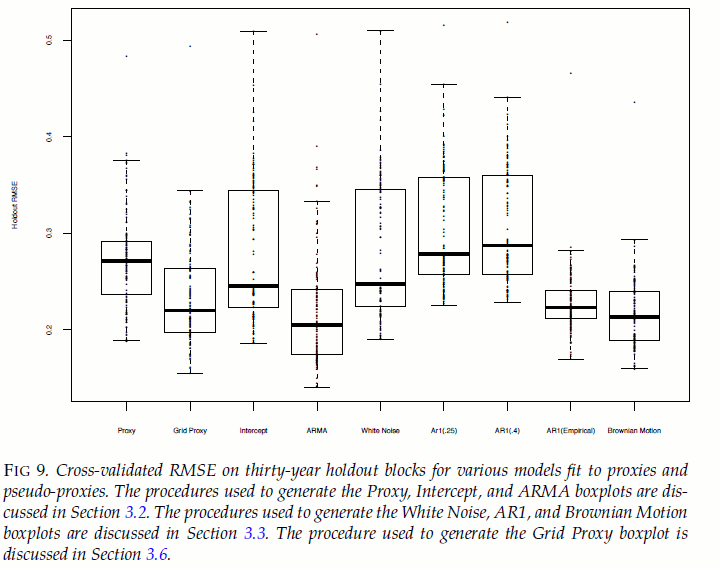
Their test template is to calculate holdout (i.e. verification) RMSE (root mean square error) statistics using the lasso multivariate methodology, summarizing their results in their Figures 9 and 10. The denominator in an RE calculation is proportional to the square of the RMSE of the “in-sample mean”, which they also call the “intercept” model. Thus, the RE of a proxy reconstruction is directly linked to the RMSE of the proxy reconstruction and the in-sample mean RMSE_{intercept} as follows:

RE_{proxy}= 1- holdout_RMSE_{proxy}^2/ holdout_RMSE_{intercept}^2

The benchmarking against a class of pseudoproxies is calculated from the distribution obtained from simulations:

RE_{pseudoproxy}= 1- holdout_RMSE_{pseudoproxy}^2/ holdout_RMSE_{intercept}^2

In their Figure 9, if the RMSE boxplot for a class of pseudoproxy is better(smaller) than the RMSE boxplot for the in-sample mean (intercept), then the RE statistic for the proxy reconstruction will not prove “significant” against that class of pseudoproxy.

They make the surprising observation that white noise pseudoproxies outperform low order red noise (the usual climate science benchmark) under their test. More controversial claims arise from their observation that “empirical AR1” pseudoproxies and Brownian motion pseudoproxies( random walks) outperform actual proxies under their test setup. (This can be seen in the smaller RMSEs in the figure shown below.)

The benchmarking of RE statistics was an issue that was put into play in McIntyre and McKitrick 2005a, where we observed that you could get high RE statistics from pseudoproxies with autocorrelation coefficients mimicking the autocorrelation coefficients of actual proxies, rather than the very low-order AR1 coefficients assumed (without proof) by climate scientists. While MW cite us favorably on the concept of “empirical AR1” pseudoproxies, they unfortunately don’t directly link their figures to the issue of RE benchmarking as clearly as they might have – confusingly tracing the issue back to von Storch et al 2004 (which addressed a different issue), rather than McIntyre and McKitrick 2005a,c.

They did their simulations using a multivariate method ( the “lasso”), familiar in their community, but not actually used in paleoclimate. They faced a tradeoff here – between analysing the properties of the proxy network using a methodology known to the outside world (as opposed to today’s version of RegEM or CPS). I think that they’d have been better off doing a form of CPS, as it would have removed an obvious criticism. Having said that, my own surmise is that the relative performance of Mann08 proxies versus pseudoproxies will not be particularly sensitive to the use of CPS versus lasso. I just don’t see that the weighting patterns from the lasso are going to be different enough to radically change the results.

They accurately note that the Team responded vehemently against the concept of “empirical AR1” coefficients in Ammann and Wahl 2007. The battleground issue here is whether the high AR1 coefficients observed empirically are properties imparted to the “proxies” by the climate system or whether they are because of gross problems with the proxies. Ammann and Wahl (2007) has argued that using autocorrelation coefficients estimated from actual proxies results in

“train[ing] the stochastic engine with significant (if not dominant) low frequency climate signal rather than purely non-climatic noise and its persistence”.

This was asserted rather than demonstrated and, as we know, assertion suffices far too often in climate science. It seems evident that if the proxy networks contained a “dominant” or even “significant” “low frequency climate signal” (as Ammann and Wahl assert), then the graphs of the proxy series would have a consistent low frequency appearance (as opposed to the visually inconsistent appearance shown in MW Figure 6 and elsewhere.) Ammann and Wahl do not explain this. The very inconsistency of the series within proxy networks such as Mann et al 2008 argues forcefully against the interpretation of high empirical autocorrelation coefficients as being imported from a climate “signal”, as opposed to being an inherent feature of the proxies themselves.

So while I expect that climate scientists will argue against “empirical AR1” coefficients as too severe a pseudoproxy test, I, for one, do not think that “empirical AR1” coefficients are too severe a test – if anything, they are probably not severe enough. (Note that empirical AR1 coefficients place less structure on the autocorrelation than the hosking.sim simulations used with the NOAMER tree ring network in our 2005 simulations and simplify this aspect of this analysis.) MW makes the following additional and reasonable observation in dismissing Ammann and Wahl’s objection to empirical AR1 coefficients:

it is hard to argue that a procedure is truly skillful if it cannot consistently outperform noise– no matter how artfully structured.

I’ll discuss their “own” reconstructions on another occasion.

Who Chose the Eleven? An Answer

The Oxburgh Report stated:

The eleven representative publications that the Panel considered in detail are listed in Appendix B. The papers cover a period of more than twenty years and were selected on the advice of the Royal Society.

This statement has been questioned ever since the publication of the Oxburgh Report. That the Royal Society did not select the papers has been clear for some time.

In Oxburgh’s testimony to the Parliamentary Committee, Oxburgh stated:

Q – Right. Can you tell us how did you choose the 11 publications?
Ox- We didn’t choose the 11 publications. They were basically what… We needed something that would be provide a pretty good introduction to work of the unit as it had evolved over the years. The publications were suggested to us came via the university and by the royal society, I believe. We feel ..let me just emphasize..they were just a start… because all of us were novices in this area, we all felt that they were a very good introduction – we moved on. We looked at other publications… we asked for raw materials, things of that kind. The press made quite a meal out of the choice of publications. For anyone on the panel, this all seems over the top. It didn’t have that significance.
Q – there are two things that arise out of that. It was a small unit. Are you saying that Jones, the subject of the investigation, chose the papers that were to be investigated… and that it wasn’t the panel or royal Society?
Ox – No suggestion Jones chose them,
Q – Where did they come from?
Ox- I believe they came … I suspect that that the […] involved was Professor Liss who was acting head of the unit who’d been brought in from outside the unit…he’s been an chemical oceanographer who is broadly interested in area. he in consultation with people with royal society and maybe others outside the unit who had some familiarity.
Q -So the list did not come from the unit – you’Re absolutely categorical ?
Ox – Well I cant
Q – So the list did not come from CRU?
Ox – I can’t prove a negative. There’s absolutely no indication that it did.
Q – Your publicity said that it came from royal society. The Panel given list before royal society asked.
Ox – I… Not as far as I know. You Might be right but I don’t believe so. No certainly I don’t think that can be true.

In a recent post, I observed that the list of eleven publications was sent out as early as March 4 – well before a perfunctory email from Trevor Davies to Martin Rees and Brian Hoskins of the Royal Society on March 12 saying that Oxburgh wanted to be able to say that the list had been chosen “in consultation with the Royal Society”, even though the list had already been sent out.

I recently noticed that Lisa Williams of the UEA Registrar’s Office was shown as the author of the list version sent to panelists – thereby offering a lead towards solving the authorship of the list, which was accompanied by the statement:

These key publications have been selected because of their pertinence to the specific criticisms which have been levelled against CRU’s research findings as a result of the theft of emails.

Today – after almost six months – the riddle of who prepared the list is resolved. Continue reading

Climategate Inquiries

Andrew Montford’s review of the Climategate Inquiries is released today and is online here.

Ross McKitrick’s is online here.

Who Recommended Oxburgh?

Who recommended Oxburgh to chair the Science Appraisal Panel? Who indeed?

In their press statement announcing the “Science” Appraisal Panel, the University of East Anglia stated:

His [Oxburgh’s] appointment has been made on the recommendation of the Royal Society, which has also been consulted on the choice of the six distinguished scientists who have been invited to be members of the panel.

We’ve already seen a case where an untrue statement about the role of the Royal Society was inserted into the Oxburgh report (the false claim that the eleven papers had been “selected on the advice of the Royal Society”.)

So it’s reasonable to ask for evidence of the Royal Society’s recommendation. Thus far, none has turned up.

In fact, it appears that the University’s statement is once again untrue and that Oxburgh was recommended by a UK government official, rather than the Royal Society. Continue reading

UEA “Welcomes” Untrue Muir Russell Finding

Shortly after the release of the Muir Russell report, I criticized their wrongheaded and untrue finding that there had not been an outstanding FOI request at the time of the notorious Jones’ request to delete all emails seeking information on IPCC correspondence that, in Fred Pearce’s words, was a ‘subversion” of IPCC policy on openness and transparency. See here for a review showing the falseness of their “finding”.

In a statement on Sept 2, 2010, UEA takes satisfaction in being cleared, despite the manifest falseness of the finding since David Holland’s FOI 08-31 prompted the delete email.

10.7 A number of emails appeared to incite deletion or evidence deletion of other emails, although there was no evidence of emails being deleted that were the subject of a request for disclosure. We accept this shows insufficient awareness of and focus on obligations under the FoIA/EIR, but we welcome the finding that there was no attempt to delete information with respect to a request already made. This confirms assurances already given to the Vice-Chancellor by colleagues in CRU that they had not deleted material which was the subject of a request. We have underlined that such action would have been one of the key elements necessary to constitute an offence under Section 77 of the FoIA and Section 19 of the EIR, the others being that information had actually been deleted, that it was deleted with the intention to avoid disclosure and that it was disclosable and not exempt information. Professor Jones has commented that, while emails are cleared out from time to time, this is to keep accounts manageable and within the allocated storage. (92, 28)

While Muir Russell had no excuse for their untrue finding (given the references to FOI in the subject line of the email), amazingly, the University left critical FOI request 08-31 out of its list of FOI requests tabled with the Muir Russell inquiry. See here for the UEA submission listing all FOI requests. David Holland’s FOI request 08-31 is missing from the list.

I noticed this omission at the time and notified UEA FOI Officer Palmer both of the error in the Muir Russell report and the University’s omission in their filing with Muir Russell, offering them the opportunity to notify Muir Russell of the error and asking Muir Russell to correct his report accordingly.

From: Steve McIntyre
Sent: Tuesday, July 13, 2010 10:39 AM
To: Palmer Dave Mr (LIB)
Subject: Muir Russell

Dear Mr Palmer,

As I’m sure you’re aware, the Muir Russell inquiry incorrectly stated that they had seen “no evidence of any attempt to delete information in
respect of a request already made”, notwithstanding the fact that email 1212063122.txt of May 29, 2008, which they cite, occurs two days after and in reaction to David Holland’s request 08-31 of May 27, 2008.

I notice that the Muir Russell inquiries collation of FOI requests at their website 02 July CRU FOI&EIR requests.pdf omitted request 08-31 in their list of FOI and EIR requests. Under the circumstances, it is, to say the least, an unfortunate omission. Do you know why 08-31 was omitted from the Muir Russell list of requests?
Regards, Stephen McIntyre

Palmer replied that the omission was inadvertent and that they had mentioned it in their submission to the ICO and their public log. They didn’t mention whether they had mentioned in it in their submission to Muir Russell.

From: Palmer Dave Mr (LIB)
Sent: July-13-10 2:05 PM
To: Steve McIntyre
Subject: RE: Muir Russell

Dear Mr McIntyre
Thank you for drawing this matter to my attention. Having checked our records we realised that this request is indeed missing from the list provided to the Russell review. It is not on the list because the ‘CRU indicator’ within the FOI/EIR request master log was incorrectly set to ‘No’. This was simply due to human error and for which we, and I, apologise.

I would assure you that we have made no secret of this request; indeed, it was mentioned on several occasions in our most recent submission to the ICO in connection with the request for which we recently received a Decision Notice and is listed on our public Disclosure Log (see: https://www.uea.ac.uk/is/foi/disclosure/research)

We have now corrected the error on the master log and sent a revised version of the list to Sir Muir Russell.
Best wishes
Dave Palmer

I revisited the Muir Russell website and the list remains uncorrected at the Muir Russell website.

I’m quite sure that the omission of the critical email request was inadvertent, but it still was extraordinarily careless on a critical point, to say the least.

But, under the circumstances, it is exceedingly inappropriate for the University to take any satisfaction whatever in the finding that “there was no attempt to delete information with respect to a request already made” since the finding was incorrect, the FOI officers of the University know that it was incorrect and the University contributed at least in part to the untrue finding by filing an incorrect list of FOI requests with Muir Russell.

More Oxburgh Misrepresentations

Almost none of Oxburgh’s testimony to the Science and technology Committee can be taken at face value. Even on something as simple as climate background of Lisa Graumlich and Kerry Emanuel, Oxburgh’s statements to the committee were untrue. Continue reading

Who Made the List?

The Oxburgh report stated that the eleven papers listed in their bibliography had been “selected on the advice of the Royal Society”. This assertion was immediately criticized at Andrew Montford’s and here. The Oxburgh Report’s claim that the papers had been selected “on the advice of the Royal Society” can be said with almost total certainty to be untrue – though they have taken no steps to issue a corrigendum. Nor has the identity of the author of the list ever been revealed by Oxburgh or the Royal Society. I think that I’ve figured out who actually prepared the list. Continue reading