A data set that was almost as controversial in MBH98 as the Graybill bristlecones was the Gaspé cedar chronology used by Jacoby and d’Arrigo. An interesting new cedar chronology from Quebec has just appeared at NCDC, shown below. The third chronology shown below is an unreported update to the Gaspé series. I reported the unreported update in a 2005 post (see comments by Martin Wilmking, a young dendro interested in the divergence issue). Also see 2007 discussion here.
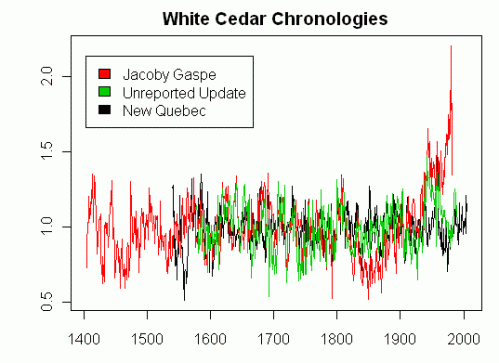
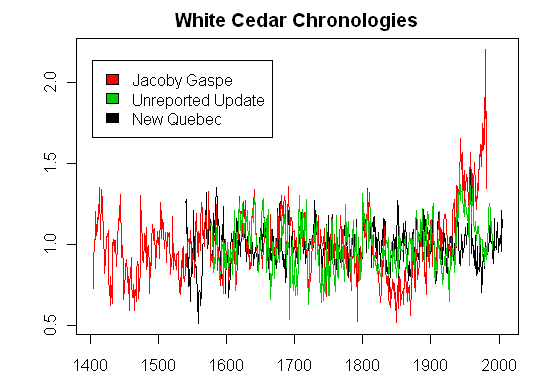
Figure 1. Three Quebec White Cedar Chronologies.
The red chronology is cana036 (St Anne’s River), a chronology used in Jacoby and D’Arrigo 1989, 1992; a chronology that was as important in the AD1400 network as the bristlecone PC1. (We discussed it at length in MM2005 (EE); our attention was attracted to it because, out of 435 series in MBH, it was the only series where early values had been “infilled”, presumably in order to “get” it into the troublesome 1400 network.)
The green chronology is a digitized version of an unpublished update that I obtained somewhat by accident. As I reported in some early CA posts here, here and here , Jacoby and d’Arrigo did not publish the updated information, refused to provide a digital version of the update and refused to identify the location of either the original site or the update. In the linked post, I provide Jacoby’s “a few good men” explanation of why not all data should be reported; D’Arrigo is the dendro who explained to an astonished NAS panel that “you have to pick cherries if you want to make cherry pie”. Jacoby was very big on the idea that trees could teleconnect to world climate bypassing local climate, an idea that achieved its most Rococo implementation in the Mann papers. The HS shaped Gaspé chronology is used in Rutherford et al 2005, Mann et al 2007 and Mann et al 2008.
The Gaspé chronology was never published in a proper study – the only publication that I’ve seen is by Sheppard and Cook in a recreational magazine, (Sheppard, P.R., Cook, E.R. 1988. Scientific value of trees in old-growth natural areas. Natural Areas Journal 8(1):7–12.) where they observe that little was known of cedar chronologies and other studies. Some of the leading cedar specialists in the world are at Ross’ university (Guelph) and they explained to us in 2004 that cedars grow best in cool moist years.
The new data (C. Dagneau and D. Duchaine) goes from 1540-2005 and is also white cedar from Quebec. It has a 0.41 correlation to the withheld Gaspé update and only 0.12 to the questionable data used in Mann and other studies. (Note: The elevation of the timbers in this study is not known. Neither is the elevation of the cana036 (St Anne’s River) series with the pronounced HS shape and, as noted, above, Jacoby refused to provide information on the location. Presumably the unreported update version was at similar elevation to the original Cook sample, whatever that was. Rob Wilson has also incorporated European historical timbers with uncertain provenance into altitude chronologies, though I’ve not determined whether there are considerations that he employed that are inapplicable here. A proper comparison obviously requires updating the proxies – something long overdue in Gaspé and the reason why I originally requested location information from Jacoby, as it was then my intent to re-sample these trees.)
I recently reported on the inconsistency between new data versions and Team data versions at Sheep Mountain, Tornetrask and Polar Urals. Gaspé is one more example. It is hard for me to see how objective scientists could use such data without showing its validity.
Update: Reader Reference observes:
This site looks interesting, http://www.foretgaspesie-les-iles.ca/ Ah now, how about this pdf report? Regeneration dynamics of Thuja Occidentalis L. in old mesic cedar stands on the Gaspé Peninsula. A natural regeneration study of Eastern White Cedar? Always wanted to know why it is so hard to grow Thuja sp. from seed. (OT).
Wow, look at the spiral twist on those trunks, need to take care orientating the core barrel there. Let’s see now, where are these beauties located? Rivière Dartmouth watershed 49 01’N 64 50’W, 8% slope, (click on the Terrain button and Zoom out a bit). Inside the Forillon National Park? Oops, I’ll probably need permits to study there….
Let’s try this location in the Réserve écologique de la Grande Rivèrie watershed 48 36’N 64 49’W (definitely need permits here!), 4% slope circa 200m elevation. Mesic slope?, mineral flush, plenty of ground water, all a Thuja needs for a long and happy life.
Update 2; My correspondence asking for data;
Here is correspondence regarding Gaspe prior to CA being started. It’s as polite as anyone could ask. And CA didn’t exist. After a year of effort, I got nothing. This obviously not an isolated incident.
3/19/2004
Dear Dr Cook,
I note that you collected this site (cana036) many years ago. I was wondering if you published on this site and, if so, could provide me a reference. Thanks, Steve McIntyre
3/22/2004
I have not published anything about this chronology. Gordon Jacoby and Rosanne D’Arrigo have used it however in some of their climate reconstructions. You will need to contact them for references.
Ed
3/22/2004
Thanks for the reply. I’ve seen the Jacoby-d’Arrigo references and, in fact, that’s what occasioned my interest. It was included in their “northern treeline” index – which seemed a little odd to me, since the site is far from the treeline. I also notice that the earliest portion of the chronology (not used by Jacoby and d’Arrigo) is based only on one tree. If you were doing the chronology today, would you include the portion based on only one tree in your site chronology? Also do you know (from past notes or otherwise) any details about potential logging or other forestry operations in the area?
Thanks, Steve McIntyre
3/29/2004
Dear Ed,
Curiously, this site has an extraordinarily large (and disproportionate) influence in the results of Mann et al (1998). I’m planning to get a tree ring specialist from Quebec to re-visit the site. Do you by any chance have a map (or other description) of your sample locations which you could send me?
Also, the early part of the archived chronology is based on only one tree. Would it be fair to say that if you were to re-do the chronology today, you would not publish the portion of the chronology relying on only one tree?
Thanks, Steve McIntyre
4/12/2004
Hi, bringing forward this inquiry again and checking whether you had a map of the sample locations for cana036? Thanks, Steve McIntyre
4/14/2004
Dear Rosanne,
I [understand] that there is some data extending Ed Cook’s archived data (ending in 1982) up to 1991. It is highly relevant to some studies that I am currently carrying out and I would appreciate the updated series version both in crn and rwl forms. Thank you for your attention.
Regards, Steve McIntyre
4/14/2004 [communicated from Rosanne]
the data you have are probably superior with regards to a NH signal.
5/5/2004
Dear Dr. Cook,
I was hoping that you could attend to this inquiry. I was hoping to get to this site in June or July. It’s also my understanding that other unarchived data from Gaspe has been collected by LDEO and I would appreciate information on this as well. Thank you for your attention.
Regards,
Steve McIntyre
8/23/2004
Dear Dr. Cook, I’ve run across short discussions of this chronology in Sheppard and Cook, Natural Areas Journal (1988) and again in Cook and Peters (1987). I would like to arrange for someone to visit this site prior to winter and would appreciate particulars on its exact location.
In the Natural Areas Journal article, you also reference a cedar site in Michigan which has not been archived. I presume that the pending cedar site in Maine refers to Sag Pond – is this correct?
Regards, Steve McIntyre
9/24/2004
will send something to you next week.
Ed
10/15/2004
Any progress with this?
Steve
10/15/2004
Hi Steve,
I will do my best next week. I have been a bit over the top on things lately.
Ed
11/16/2004
Any progress on this?
Steve
1/31/2005
Dear Dr. Cook, as I mentioned in my email to Connie Woodhouse, I would appreciate a listing of the sites used in your interest recent article in Science , Cook et al [2004], preferably in a format that includes ITRDB codes where available. Connie Woodhouse mentioned that you travel frequently – which is certainly evident from the varied places that you have reported on. I think that it would be a good idea to simply archive the listing as an additional SI, but in any event, I would appreciate the listing. Thanks, Steve McIntyre
PS if you’ve had an opportunity to locate the exact location of the Ste Anne River, Gaspe tree series, I would appreciate it. I’ve had no luck getting the 1991 update to this series from Dr Jacoby, all of which is quite frustrating, and lends itself to criticism.
2/4/2005
Dear Connie, I’ve sent a request to Cook without any acknowledgement. In view of Cook’s previous behaviour, I do not think that the problem arises from Cook’s travel. In your capacity as a co-author, I re-iterate my request for identification of the sites and, if you do not have the information, request that you take responsibility for obtaining the information and then forwarding to me. I’m tired of sending unacknowledged emails to Cook. Regards, Steve McIntyre
Update 3:
Francois and Bender, I might have found the Gaspe cedar location. Take a look here here . Right description, right location AND, like Graybill sites, easy access.
Original Caption: headwaters of the Ste Anne River
On the morning of our second day, we started our ‘serious’ exploration of the Gaspé by driving north up the 86-mile valley of the Grand Cascapedia River, which rises near the Chic Choc mountains in the central part of the peninsula. Highway 299 is a great road, with very little traffic, winding its way between the fast-flowing river and forest covered hills.
It was about 11:30 AM by the time we reached the Gite du Mont-Albert area of Gaspésie Provincial Park, the main starting point for tourist activities in this part of Quebec, renowned for its hiking and winter-skiing activities.
After paying our C$3.50 per person day-use fee at the Interpretive Centre, Sue and I confirmed that the higher trails leading into the peaks were still closed due to snow depth, so we decided to at least try the relatively short ‘Belvedere (Lookout) de la Lucarne’ route. Here, Sue is starting up the trail through the forest shortly after noon and the 2nd photo shows me with some of the peaks in the background as we emerge in a clearing higher up the slope. The 3rd photo shows one of the trail signposts to help keep us sorted out on the interconnecting system (along with a small map that I had printed from the internet before leaving home). In less than a half-hour, we had reached the wooden ‘belvedere’ on a small rise, where we had great views of the mountains in all directions (4th and 5th photos). Because the trails are interconnected, we decided to continue onward down the slopes to the nearby Sainte-Anne River and circle back to the Gite area by a different route….
We had noticed many piles of Moose droppings as we ascended and, sure enough, only a few minutes after leaving the belvedere we stumbled upon one of these large beasts browsing beside the trail. It was as surprised as we were and ambled off into the forest before I could draw my camera!
After descending from our Lucarne ‘lookout’ perch, we crossed Highway 299 and quickly encountered the narrow upstream reaches of the Sainte-Anne River as seen here. A very well-built pedestrian bridge (2nd photo) allowed for easy crossing and we were soon exploring along the banks of this fast-flowing and clear body of water. We had brought a cooler with us when we left on this Gaspé trip and used supplies from it to make ourselves some cheese and tomatoe sandwiches before setting of on the hike. There were not a lot of dry places to sit in the forest this early in the season, but we managed to find some boulders beside the river to use as seats while we enjoyed an early afternoon picnic and the sound of rushing water (3rd photo).
On our way back to our parked car, we continued along this side of the river before crossing a second foot-bridge to return to our starting point. Along the way we came across many places where winter snow was still hanging on in the shadows of the forest (4th photo) and also a few diversions off the trail because of winter blow-down trees (5th photo). Shortly after skirting that large specimen snapped off at ground level, we met two Park maintenance workers heading toward it with a chainsaw as they carried out their clean-up duties prior to the real start of the tourist season. By 2:30 PM, we were in our car and headed for the north coast, planning to stay in Ste.-Anne-des-Monts where our little stream finally reaches the St. Lawrence River.









 Climate Audit