Unthreaded #13

Continuation of Unthreaded #12

Long Beach WA

surfacestations.org is back online and there are some good improvements in layout. In the page directory for each state, there are now thumbnails for the stations with information. New stations are coming in all the time. Today’s tide brought in another interesting Washington site from Gary Kobes – Long Beach WA (454748; 72791002). Its physical appearance is pretty good as these things go – maybe a little near the road, but in a rural area.

Here’s a thumbnail – go to the site for the portfolio.

So what does the temperature history look like? Does this rural site show the powerful 20th century temperature increase that we see at sites like Phoenix Airport, Fresno Airport and even “rural” sites like Marysville and Petaluma? I’m afraid that you can guess the answer.

Continue reading

Ukiah CA

Russ Steele, who’s been working closely with Anthony Watts and who also deserves much credit for this recent initiative, reports on Ukiah CA at his blog here

Ukiah is in the same gridcell as Petaluma. Russ shows a picture of the weather station which is on grass – there’s a tree nearby, but no incinerators, barbecues, air conditioner exhaust, MIG fighters, asphalt; it’s not mounted on a concrete slab. According to Russ, The curator says that the station has not changed location since 1931 (this may not be totally correct as the CDIAC file shows a couple of short moves). The CDIAC file shows only one small change in observation time: at 5 pm from 1892 to 1974 and at 6 pm thereafter, so that there is a negligible potential bias in time-of-observation adjustment.

It sounds like the sort of station that should be used a framework for analysis of nearby stations, such as Petaluma. So let’s see what the adjustment jockeys do. You’d better sit down first.
Continue reading

Petaluma CA

Check out Petaluma CA at Anthony Watts’ blog.

Anthony has shown the GISS unadjusted temperature graphic. In this case, the GISS raw data appears to be mostly the same as USHCN adjusted (filnet) up to different rounding; a few isolated values available in USHCN are missing in GISS raw for some strange reason. I’m starting to keep track of the GISS raw source, as I pick up these files. I’m going to check whether the USHCN filnet is consistently picked up or not. At any rate, it is here.

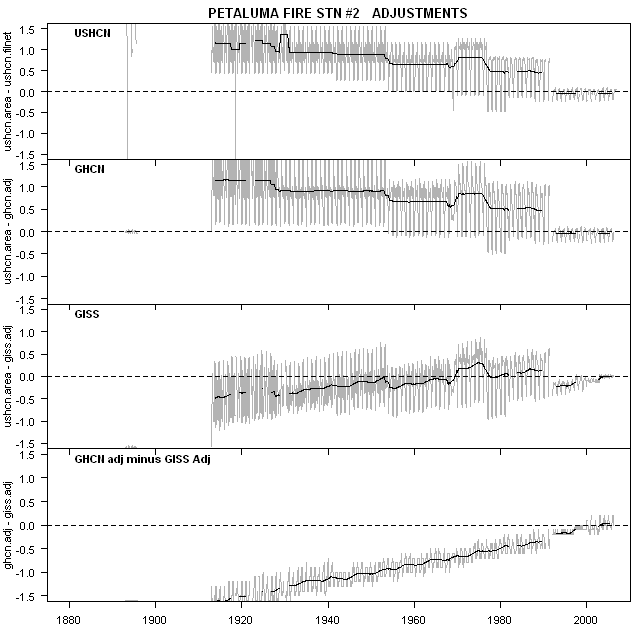
The GHCN raw version is the same as USHCN raw version and differs from the GISS raw version. The GHCN adjustment has the effect of lowering early 20th century temperatures relative to modern temperatures. The GISS adjustment goes the opposite direction from the GHCN adjustment. Two figures are shown below. First the raw USHCN minus the three adjusted versions: USHCN, GHCN and GISS and then the amount of the GISS adjustment relative to the GHCN adjustment, which reaches up to 1.5 deg earlier in the century.

In the cases that I’ve examined, Parker uses GSN data (which appears to be equivalent to GHCN raw data where they overlap.) In this case, Hansen adjusts for 1.5 deg of urban warming that Parker has demonstrated not to exist. If Parker is right then the GISS data is seriously understating 20th century warming by adjusting for a supposed urbanization trend effect that Parker has “demonstrated” is not present in the data.

petalu11.gif
Figure 1. Adjustments to Petaluma (in deg C)

Here are the 7 versions overlaid:

petalu10.gif
Figure 2. Petaluma CA versions

The station history at CDIAC is not up to date http://cdiac.ornl.gov/ftp/ushcn_monthly/station_history showing moves with directions are shown in 1927, 1941, 1954, 1968, 1969, 1981 and 1991, but not two recent moves listed at MI3. Obstructions at the present site are listed at MI3 as: “MMTS 259/35 F&P 055/10 TREES 001-030/30-45/15-3 TREES 150-210/320-180/3-5 TREES 240-330-359/40-30-25/12-13-15 BLDG 280-330/45-55/6-6ll”. Go to Anthony’s pictures for more details on the obstructions described on the form so laconically.

USHCN Minimum Temperature Trends

Here are 6 graphics showing contours plots of USHCN A) 1900-2006 trends for 1) raw 2) tobs 3) adjusted; followed by the same plots for B) 1948-2006 (same start as Parker) 1, 2 , 3 as before. The top 20 are shown for each case here. (Case A2 is missing because I forgot to save it, but it looks like A1). Continue reading

Parker and Fresno Airport

Fresno Airport is one of the sites in the Parker 2006 network that is used to argue that there is a negligible UHI component in temperature increases in the major indexes. Here is a picture of this rustic location (which is still on the surfacestations.org to do list):

Parker has a figure showing results for Fresno. I’ve collated all the relevant daily NCEP and temperature data for Fresno online here and tried to replicate this figure without success. Continue reading

Did Jones et al 1990 “fabricate” its quality control claims?

Did Jones et al 1990 “fabricate” its quality control claims? This hard-hitting question is asked by Doug Keenan here. He cites the following claims from Jones et al 1990 and Wang et al:

The stations were selected on the basis of station history: we chose those with few, if any, changes in instrumentation, location or observation times. [Jones et al.]

They were chosen based on station histories: selected stations have relatively few, if any, changes in instrumentation, location, or observation times…. [Wang et al.]

Keenan observed that those statements are vital for the papers. For many years, no one knew what stations were used in Jones et al 1990. Only after recent FOI actions in the UK publicized here at CA did a list of the stations used in Jones et al 1990 become available in March 2007, after years of obstruction. Since then, Keenan has corresponded recently with both Jones and Wang, seeking a valid explanation of the above claims. His conclusion:

The essential point here is that the quoted statements from Jones et al. and Wang et al. cannot be true and could not be in error by accident. The statements are fabricated.

Continue reading

The Nifong Disbarment

Mike Nifong, the prosecutor of the Duke lacrosse scandal, is in the news for being disbarred for his handling of the prosecution of the Duke lacrosse team. This illustrates the difference in how concealment of material information is treated in most walks of life and the failure of the IPCC to see any moral dilemma in its role in actively concealing the adverse post-1960 results of the Briffa et al reconstruction. The IPCC authors’ response to criticism of the deletion was only that it would be “inappropriate” to show the adverse post-1960 results. Surely it’s “inappropriate” not to show them.

There’s another amusing connection. Tom Crowley, a key member of the Hockey Team, who acted as Michael Mann’s stunt double at the scheduled House Energy and Commerce Committee hearing last summer (Mann sending a lawyer’s letter to the great amusement of the Republicans), prominently supported the now disbarred prosecutor. Here are a couple of amusing blog articles on Crowley here and here . Like the IPCC, Crowley seemed to see no problem with misconduct if it’s in a “good cause”.

Update – as noted by a poster below, Crowley retracted his comments shortly after making them, stating:

On Nov. 13, The Herald-Sun published an “Other Voices” piece by me concerning the Duke lacrosse case. I have subsequently been informed of errors in that letter. In particular my blanket statement about behavior of the lacrosse team was neither fair in general nor applicable to the particular case now in dispute. I apologize for this and any other errors.

The response to my letter has made me more aware of the intense emotions that are associated with this case. These tensions can only be bad for campus-community relations, and I strongly support any efforts to reduce them. Finally, I sincerely hope that lessons learned from the lacrosse case will be applied to future cases in order to lift the standards of justice for all in Durham County.

Usually, it’s prudent to try to get your facts right before making allegations.

Update: Just to be clear, I’ve met Crowley; we sat beside each other at the first House hearings and then I went out for beer afterwards with him and Myron Ebell and others – my mother would have approved of the diplomacy involved in getting this group together – and had a nice chat with him.

Our emails back and forth have been cheerful although ridiculously unproductive. He likes basketball which increases his standing immeasurably in my books. I mentioned a long time ago that I thought his text Crowley and North was very interesting and better than Bradley’s book.

He’s written some non-hockey stick articles which are pretty interesting. I’ve been meaning to post up some of his comments on lapse rate. However, he wrote an article in EOS in 2005 slagging me in which, like his letter on the lacrosse team, one fact after another was wrong. Nanne Weber of KNMI started off with a very unfavorable impression of me due to this article. I submitted a reply to EOS which they took 6 months to review and then rejected as being no longer topical, although the reviewer agreed that I had legitimate grievances with the Crowley article. I asked for a retraction and got nowhere.

Perhaps, in the spirit of reconciliation of Crowley’s retraction here, he might turn his mind to a similar retraction of his EOS article.
How IPCC AR4 authors defended the Briffa data deletions

I recently received a copy of how IPCC authors answered the review comments, including their answers to the requirement of one reviewer that the deleted Briffa data be restored (and an explanation given for the inconvenient bits.) You may recall the observation of one reader in the discussion of Swindle, the reader observing:

If a practising scientist selected a 1987 data set over more recent versions, failed to cite it correctly, altered the appearance of the data without a clear explanation and didn’t include the data from the last 20 years then I think we’d all be asking serious questions about their professionalism.

I observed that there had been a serious alteration of the Briffa et al 2001 reconstruction in which diverging post-1960 values were simply chopped off. One of the IPCC 4AR reviewers called for the deleted post-1960 values to be shown both for Briffa et al 2001 and Rutherford et al 2001. Here’s how the authors responded. It’s pretty amazing, maybe even “gobsmacking”. Continue reading

Godowitch et al 1985 on Urban Boundary Layers

Today I want to talk about a terrific 1985 article Godowitch et al,, 1985. Evolution of the Nocturnal Inversion Layer at an urban and nonurban location, J Clim Appl Met 791 ff available online here, which helps put some of the UHI discussions in a more complete perspective.

Instead of just considering UHI from a snail point of view (ie. transects from city center to country along the surface) it considers the entire vertical structure over the course of a night, which turns out to be richly textured and to offer much insight to what’s going on at surface.

This is all obviously old hat to Pielke Sr who seems to have cut his teeth on boundary layers, but is helpful to people like us coming into the middle of the debate. (It might have been useful to Parker as well, who also seems to have come into the middle of the debate arriving from prior study of SST bucket adjustments.) Continue reading