It seems quite possible to me that study of glacier changes would actually shed some useful light on the relative levels of the MWP and modern warm period. I’m quite prepared to let the chips fall where they may (although I would deny that this would vindicate the statistical falsehoods of the Mann HS, any more than a belated discovery of some other type of WMD in Iraq would vindicate Powell’s claim that aluminum tubes were conclusive proxy evidence of WMD.)
What frustrated me about the NAS Panel’s treatment of glaciers is the amateurism of the review. I’d love to see a detailed and critical exposition of what’s known about the "Green" Alps or about the lengthy research on glacier fluctuations in the Rockies – as soon as one delves into the literature, one sees just how detailed the latter is. But instead of that, the NAS panel highlighted a then unpublished reference to an organic from Quelccaya, published in a pamphlet style by Lonnie Thompson, rather than as an organized geological report with maps and cross-sections. In effect, they relied on the worst documented site, rather than the Alps or the Rockies.
This made me wonder about a couple of things – why has the Team not made more noise about glaciers? And what did the IPCC say about glacier changes?
I’ve posted some extended excerpts from IPCC 1AR and 2AR online in the past here and here as a reference and will review comments on glaciers from the three published IPCC reports,
IPCC 1AR (1990)
IPCC 1AR (1990) noted evidence for worldwide warmth in the mid-Holocene and cited extended glaciers in the recent past in nearly all alpine areas of the world as evidence for a Little Ice Age, citing the text Grove 1989.
There is growing evidence that worldwide temperatures were higher than at present during the mid-Holocene (especially 5000-6000 BP), although carbon dioxide levels appear o have been quite similar to those of the pre-industrial era at this time. Thus parts of western Europe, China, Japan, the eastern ISA were a few deegrees warmer in July duing the mid-Holocene than in recent decades…
Cooler episodes have been associated with glacial advances in alpine regions of the world; such "neo-glacial" episodes have been increasingly common in the last few thousand years. Of particular interest is the most recent cold event, the Little Ice Age, which resulted in extensive glacial advances in almost all alpine regions of the world between 150 and 450 years ago (Grove 1988) so that glaciers were more extensive 100-200 years ago than now nearly everywhere (Figure 7.2 – Figure of glacier temini 1650 on). In a few regions, alpine glaciers advanced down-valley even further than during the last glaciation (for example, Miller, 1976). Some have argued that an increase in volcanism was repsonsible for the coolness (Hammer, 1977; Porter 1986); others claim a connection between glacier advances and a reduciton in solar activity (Wigley and Kelly 1989)…At present there is no agreed explanation for these recurrent cooler episodes. The Little Ice Age came to an end only in the 19th century. Thus some of the warming since 1850 could be a recovery from the Little Ice Age rather than a direct reslt of human activities. So it is important to recognize that natural variations of climate are appreciable and will modulate any future changes induced by man.
IPCC 1992
IPCC 1992 had no discussion of glaciers, but the following comment about ice core oxygen isotpoes is intriguing. In subsequent reports, the Aristarain results disappear from view without explanation.
Oxygen isotope measurements from the northern Antarctic Peninsula have been interpreted as evidence of warmer [bold in orig] temperatures during the 19th century compared with the 20th century (Aristarain et al 1990). However the isotope/temperature links is weak both physically and statistically (Peel 1992) and accumulation rate changes which are more directly related to in situ temperatures point to cooler conditions in the 19th century (Jones et al 1992).
IPCC 2AR (1996)
IPCC 2AR makes virtually no mention of glaciers. Here’s their listing of methods to deduce past climates:
Climates from before the recent instrumental era must be deduced from paleoclimatic records. These include tree rings, [now with pride of place] pollen series, faunal and floral abundance in deep sea cores, isotope analysis from coral and ice cores and diaries and other documentary evidence.
Glaciers didn’t even make their list. Their main focus is on characterizing the MWP and LIA as local and regionally variable events, based on Hughes and Diaz 1994 – a horrendously bad study – and Jones and Bradley 1992. For example:
The term Little Ice Age is often used to describe a 400-500 year long, globally synchronous cold interval, but studies now show that the climate of the past few centureis was more spatially and temporally ocmplex than this simple concept implies (Jones and Bradley 1992).
In passing, it’s interesting to observe the same blindness to bristlecones in IPCC 2AR as just shown by the NAS panel. They state specifically:
The possible confounding effects of carbon dioxide fertilization needs to be taken into account when calibrating tree-ring data against climate variations.
But they then go on to cite a ring width series from Campito Mountain from Lamarche 1974, without mentioning Lamarche et al 1984 or Graybill and Idso 1993. The only comments about glaciers or that I could find are the following:
The interpretation of ice core records from polar ice sheets and tropical glaciers may be in some cases limited by the noise inherent in snow depositional processes especially dueing this period when climate changes were rather small (by comparison, for instance, with the large rapid changes [in the Pleistocene] discussed in the next section.
… Recently analysed ice cores from the north-central Andes (Thompson et al 1995) indicate that temperatures were cool in the 200-500 years before the present. Strong warming has dominated the last two centuries in this region.
New Zealand tree rings reproduce the warming observed instrumentally since about 1950 although there is also a suggestion of warmer periods in the 18th and 19th centuries (Salinger et al 1994) near a time of maximum mountain glacier ice volumes in the Southern Alps of the country…
Alpine glacier advance and retreat chronologies (Wigley and Kelly, 1990) suggest that in at least alpine areas, global 20th century temperatures may be warmer than any century since 1000 AD and perhaps as warm as any extended period (of several centuries) in the past 10,000 years.
It seems unlikely, given the smaller regional changes, that global mean temperatures have varied by 1 degree C or more in a century at any time during the last 10.000 years (Wigley and Kelly, 1990).
I discussed Wigley and Kelly 1990 last year here. Boy I get tired of seeing people from the Team being cited in diverse contexts – why is Wigley being cited on glaciers rather than Holzhauser?
IPCC TAR (2001)
IPCC TAR has two somewhat inconsistent considerations of glaciers. Mostly it’s straight from the Team, but, as noted below, there is an interesting question raised about them, which has mostly gone unnoticed.
In section 3.1, they state the following:
2.31. Coarsely resolved climate trends over several centuries are evident in many regions e.g., from the recession of glaciers (Grove and Switsur, 1994…The SAR examined evidence for climate change in the past, on time-scales of centuries to millennia. Based on information from a variety of proxy climate indicators, reconstructions of mountain glacier mass and extent, and geothermal sub-surface information from boreholes, it was concluded that summer temperatures in the Northern Hemisphere during recent decades are the warmest in at least six centuries. …A number of important advances have been in key areas such as ice core palaeoclimatology (e.g., White et al., 1998a)
I have trouble locating a quote from IPCC 2AR which supports that claim that reconstructions of mountain glacier mass and extent
showed that summer temperatures are the "warmest in at least siz centuries". Maybe I’ve missed the quote, but I don’t think so.
In section 2.3.2.1, they say that information from glacial moraines, inter alia, can supplement "high-resolution proxies" such as tree rings, still occupying pride of place.
High-resolution proxy climate indicators, including tree rings, corals, ice cores, and laminated lake/ocean sediments, can be used to provide detailed information on annual or near-annual climate variations back in time. Certain coarser resolution proxy information (from e.g., boreholes, glacial moraines, and non-laminated ocean sediment records) can usefully supplement this high-resolution information. Important recent advances in the development and interpretation of proxy climate indicators are described below.
They briefly discuss ice cores, which I won’t excerpt here. About glacial moraines, they say that these can provide "reliable information on past temperature changes", cinting, among others, Raper et al 1996 – who prove to be those well-known glaciologists, Raper, Briffa and the ubiquitous Wigley:
Mountain glacier moraines
The position of moraines or till left behind by receding glaciers can provide information on the advances (and, less accurately, the retreats) of mountain glaciers. Owing to the complex balance between local changes in melting and ice accumulation, and the effects of topography which influence mountain glaciers (see Section 2.2.5.4), it is difficult to reconstruct regional (as opposed to global) climate changes from the extent of mountain glaciers alone (Oerlemans, 1989). For example, both increased winter precipitation (through greater accumulation) and lower summer temperatures (through decreased melting or “ablation”) can lead to more positive glacial mass balances. The inertia of large glaciers dictates that they respond to climate change relatively slowly, with delays of decades or occasionally centuries. For smaller, fast moving glaciers in regions where precipitation and accumulation are moderate, temperature changes are usually the dominant factor influencing mountain glacier masses and lengths. Here glacier moraine evidence in combination with other lines of evidence can provide reliable information on past regional temperature changes (Salinger, 1995; Holzhauser and ZumbàÆà⻨l, 1996; Raper et al., 1996; Salinger et al., 1996).
In section 2.3.3, as against the view of a more or less worldwide cool LIA expressed in IPCC 1990, relying on Grove 1989, they advocate the dog’s breakfast view of the LIA, relying on Bradley 1999 – his textbook on Paleoclimatology, rather than a primary source.
Evidence from mountain glaciers does suggest increased glaciation in a number of widely spread regions outside Europe prior to the 20th century, including Alaska, New Zealand and Patagonia (Grove and Switsur, 1994). However, the timing of maximum glacial advances in these regions differs considerably, suggesting that they may represent largely independent regional climate changes, not a globally-synchronous increased glaciation (see Bradley, 1999). Thus current evidence does not support globally synchronous periods of anomalous cold or warmth over this timeframe, and the conventional terms of “Little Ice Age” and “Medieval Warm Period” appear to have limited utility in describing trends in hemispheric or global mean temperature changes in past centuries. With the more widespread proxy data and multi-proxy reconstructions of temperature change now available, the spatial and temporal character of these putative climate epochs can be reassessed.
The IPCC notes in passing a seeming discrepancy between glacier and tree-ring information from New Zealand and Tasmania, but do not explain it (And I’m unaware of any subsequent efforts to resolve the discrepancy.)
glacier evidence from the Southern Alps of New Zealand suggests cold conditions during the mid-17th and mid-19th centuries (Salinger, 1995). Dendroclimatic evidence from nearby Tasmania (Cook et al., 2000) shows no evidence of unusual coldness at these times.
The most intriguing discussion is perhaps in section 2.2.5.4, where discrepancies in the timing of glacial retreat and timing of instrumental and proxy reconstruction increases are noted. They point out that glacial retreat commenced prior to the instrumental and reconstruction increases.
The recession of mountain glaciers was used in IPCC (1990) to provide qualitative support to the rise in global temperatures since the late 19th century…
Nevertheless, work done so far indicates that the response times of glacier lengths shown in Figure 2.18 are in the 10 to 70 year range. Therefore the timing of the onset of glacier retreat implies that a significant global warming is likely to have started not later than the mid-19th century. This conflicts with the Jones et al. (2001) global land instrumental temperature data (Figure 2.1), and the combined hemispheric and global land and marine data (Figure 2.7), where clear warming is not seen until the beginning of the 20th century. This conclusion also conflicts with some (but not all) of the palaeo-temperature reconstructions in Figure 2.21, Section 2.3 , where clear warming, e.g., in the Mann et al. (1999) Northern Hemisphere series, starts at about the same time as in the Jones et al. (2001) data. These discrepancies are currently unexplained…
Finally, they note the evidence from the 5000-year old Oetzal ice man, also cited by the NAS Panel.
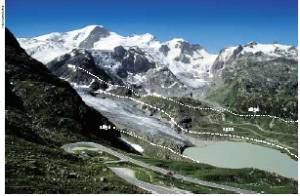
Finally, indications in the European Alps that current glacier recession is reaching levels not seen for perhaps a few thousand years comes from the exposure of radiocarbon-dated ancient remains in high glacial saddles. Here there is no significant ice flow and melting is assumed to have taken place in situ for the first time in millennia (e.g., the finding of the 5,000-year-old Oetzal “ice man”).
The disgorging of ancient organics from glaciers is an interesting, important and provocative argument, that needs careful dissection. It deserves careful consideration with proper publishing of stratigraphy and adequate geological reports. Of course, Hormes et al reported that the 1995 jokulhaup disgorged organics from many different periods, some earlier than 5000 years ago and some later. So the interpretation is not easy.
None of the IPCC reports mention the work in the Rockies – and it’s very extensive, both by Luckman and associates, but also up and down the coast.
I’m puzzled by the above comment about no "significant ice flow". I don’t pretend to be authoratiative on glaciers, but at Quelccaya and other tropical glaciers (and I presume that this applies to temperature glaciers), the width of the layers decreases more or less in a negative exponential as you get deeper and earlier. Thus the top 50 m may cover 100 years and the bottom 10 m about 1000 years. So there’s always compression, extrusion and flow, presumably at all points of the glacier. What’s the basis of the claim that there was no "significant ice flow" – no citation is given? I’m not saying that, at the end of the day, the glacier recession might not be the greatest in a few thousand years – just that I’d love to see the point properly argued and presented.
Of course, even if the glacial recession proved to be the greatest in a few thousand years, it is obviously not "unprecedented". Regardless of how one spins the reslts, we see unequivocal evidence for forests far above modern tree lines. I realize that the forersts and glaciers may not be inequilibrium with present climates, but equally I’ve not seen arguments to suggest that present climate would support forests at locations where they have been identified in sub-fossil forms. (I’m not saying that such an argument can’t be made, merely that I haven’t seen it.)
some discussion
Bradley 1999; Raper et al 1996 Bradley, R.S., 1999: Paleoclimatology: reconstructing climates of the Quaternary Harcourt. Academic Press, San Diego, 610 pp.
Raper, S.C.B., K.R. Briffa and T.M.L. Wigley, 1996: Glacier change in northern Sweden from AD 500: a simple geometric model of StorglaciàÆà⣲en. J. Glaciol., 42, 341-351.






 Climate Audit
It's Hard to Imagine…
As you all recall, the NAS panel let MBH off rather lightly in respect to disclosure and the House Energy and Commerce Committee couldn’t be bothered. So all in all, MBH dodged a bullet and you’d think that they’d have been wise enough to leave well enough alone. But no. In today’s Nature, Mann, Bradley and Hughes send an astonishing letter, in effect re-opening disclosure issues after everyone else had got bored with it. MBH write:
Well, readers of this site can doubtless think of many ways in which they could have been more "explicit about the uncertainties".
Some of the "poor communication by others" is conveniently documented at Mann’s website for MBH98 and MBH99, he lists various press clippings. Not all the links still work, but some do. Contemporary examples of poor communications victimizing MBH include:
USA Today is one example of "poor communication by others", saying:
And, of course, the CBC:
I’m sure that MBH took every conceivable step to try to redress these "poor communications by others" and were frustrated when their efforts to ensure uncertainties were emphasized by these publications were rebuffed.
The victimization was not just in the press, but even their own colleagues victimized poor MBH. At CRU, Phil Jones – and I’m sure they felt certain that they could rely on Phil – let them down by saying atthe CRU website:
No wonder they feel let down. But one of the worst offenders in victimizing poor MBH was the University of Massachusetts press office, which issued news releases for both MBH98 and MBH99, ( obviously over the vehement protests of Mann et al), claiming that "advanced statistical techniques" were used. The MBH98 news release stated:
The MBH99 news release stated:
FAQ for MBH99 can be retrieved from the Wayback Machine here.
How frustrating it must have been for Mann et al do be so frequently victimized by "poor communications by others" – even by their own university press office – with themselves helpless to do anything about it. It must have taken great personal fortitude and courage to survive such adversity.