As noted in my previous post, Marcott, Shakun, Clark and Mix disappeared two alkenone cores from the 1940 population, both of which were highly negative. In addition, they made some surprising additions to the 1940 population, including three cores whose coretops were dated by competent specialists 500-1000 years earlier.
While the article says that ages were recalibrated with CALIB6.0.1, the differences between CALIB6.0.1 and previous radiocarbon calibrations is not material to the coretop dating issues being discussed here. Further, Marcott’s thesis used CALIB6.0.1, but had very different coretop dates. Marcott et al stated in their SI that “Core tops are assumed to be 1950 AD unless otherwise indicated in original publication”. This is not the procedure that I’ve observed in the data. Precisely what they’ve done is still unclear, but it’s something different.
In today’s post, I’ll examine their proxy #23, an alkenone series of Isono et al 2009. This series is a composite of a piston core (MD01-2421), a gravity core (KR02-06 St. A GC) and a box/multiple core (KR02-06 St A MC1), all taken at the same location. Piston cores are used for deep time, but lose the top portion of the core. Coretops of piston cores can be hundreds or even a few thousand years old. Box cores are shallow cores and the presently preferred technique for recovering up-to-date results.
There are vanishingly few alkenone series where there is a high-resolution box core accompanying Holocene data. Indeed, within the entire Marcott corpus of ocean cores, the MD01-241/KNR02-06 splice is unique in being dated nearly to the present. Its published end date was -41BP (1991AD). Convincing support for modern dating of the top part of the box core is the presence of a bomb spike:
A sample from 3 cm depth in the MC core showed a bomb spike. The high sedimentation rate (average 31 cm/ka) over the last 7000 years permits analysis at multidecade resolution with an average sample spacing of ~32 years.
Despite this evidence for modern sediments, Marcott et al blanked out the top three measurements as shown below:
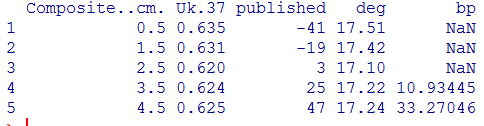
Table 1. Excerpt from Marcott et al spreadsheet
By blanking out the three most recent values of their proxy #23, the earliest dated value was 10.93 BP (1939.07 AD). As a result, the MD01-2421+KNR02-06 alkenone series was excluded from the 1940 population. I am unable to locate any documented methodology that would lead to the blanking out of the last three values of this dataset. Nor am I presently aware of any rational basis for excluding the three most recent values.
Since this series was strongly negative in the 20th century, its removal (together with the related removal of OCE326-GGC30 and the importation of medieval data) led to the closing uptick.
BTW in the original publication, Isono et al 2009 reported a decrease in SST from Holocene to modern times that is much larger than the Marcott NHX estimate of less than 1 deg C, reporting as follows:
the SST decreased by ~5 °C to the present (16.7 °C), with high-frequency variations of ~1 °C amplitude (Fig. 2).
A plot of this series is shown below, with the “present” value reported by Isono et al shown as a red dot.