Antarctica

Discuss here.

Hansen's "Rural" Peru

Hansen’s downward adjustments of Peruvian temperature records by as much as 3 deg C is based on the presumptive quality of Peruvian “rural” sites. If one even spends 40 minutes examining the locations of these sites, any resemblance to rural USHCN sites disappears.

In addition, the failure of NOAA and NASA to update their records is notable. In some case, NOAA maintains up-to-the-hour records of sites which GHCN and NASA have not updated in decades. I counted 13 Hansen-rural sites in Peru.

Brief comments on each one follow. Online versions at NOAA are mentioned – see this source citing NOAA (I haven’t sourced the data at NOAA directly at present). Continue reading

The Adjusters Visit Peru

We have talked about finding Waldo for a while. Here are a few interesting graphics showing the Adjusters in Peru. Here are 4 stations where temperatures in the mid-20th century have been lowered by around 3 deg C. These are all reverse UHI effects.

peruh44.gifperuh42.gif

peruh46.gif

peruh47.gif

For all of the above graphics, I’ve plotted original monthly data without taking an annual average. The annual variation in monthly temperatures is only a few degrees. Given this very placid temperature variation, how can Hansen simply assume that something happened that threw the measurements off by 3 deg C?

In order to make adjustments of this magnitude, Hansen should have written to the Peruvian meteorological service and asked them for an explanation or interpretation of any results that didn’t appear to make sense. If he were unsatisfied with the explanation, maybe he could decide not to use the data. In order to make adjustments of this magnitude, he should have to prepare a detailed technical report on Peruvian station histories showing how the problems originated.

As I’ve noted before, I increasingly wonder whether it makes any sense for academic scientists like Hansen (or Jones) to be reporting temperature statistics. They don’t appear to have the faintest interest in the gritty details. So turn the calculations over to professional data analysts.

Code 1 Stations: the Top Guns in S California

As an exercise, I’ve plotted the locations of the GISS Code 1 stations in the US, color coded them to show the ones that end early and then examined the Code 1 stations in California where there is a combination of both a strong GISS trend anomaly and station survey completion. Continue reading

Re-visiting Dawson, Canada

In May 2007, we took a look at station data for Dawson, Canada, data that is important to dendros because it goes back to the gold rush days of the late 1890s and because there are important tree ring chronologies in the area. In this case, the dendros decided that the GHCN adjusted data was unreliable and used the Canadian adjustments. At the time, Rob Wilson gave encouragement to the analysis of station data as it was obviously frustrating to dendros to have to sort through station versions and to be put in a position where they had to pick one temperature history version rather than another – not something that a dendro should really have to do. Looking back on this post, I can see definite progress in our ability to sift through the various adjusted versions. Continue reading

Googling the lights fantastic

UPDATE – GISS LOCATIONS AND GLOBAL NIGHTLIGHTS KML DATABASE FOR GOOGLE EARTH NOW ONLINE!

Thanks to data provided by Steve McIntyre and conversion skills provided by Barry Wise, we now have the first ever interactive global mapping tool for nightlight ratings and GISS stations worldwide that encompass USHCN and GHCN station locations.

Download it from the surfacestations website here

How to download: right click, save target as,  then save to your disk, double click it to open in Google Earth, (free download here) and follow the instructions below for turning on the city night lights layer in the text below. In the file, the icons are set as follows:

A = dark
B= dim
C= bright

Original post:

Yesterday I had a phone conversation with Steve Mosher. We were talking through some of the puzzlements of the GISS code and how it dealt with city nightlights, urbanization, the USA, and ROW. One of the big puzzles is why GISS uses counts of nightlights for an urbanization adjustment in the USA, but uses population data in the ROW. Why not keep everything on one method for a consistent result?

During the conversation, it occurred to me that there may be a tool available to us that will help us understand how nightlights look from space in relation to the placement of USHCN and GHCN weather stations, so we could check against the GISS lights database. My hunch paid off.

As luck would have it, Google recently partnered with NASA to include “city lights” data. With a little searching, I found I could add a layer to Google Earth (the free download program version, not the web browser version) and see what Imhoff must have seen, when he was researching his paper, except this is newer imagery. According to the source at NASA’s Earth Observatory web page, the visualization date of imagery is 10-23-2000

gearth_usnightlights600.jpg

Here is what they say about it:

This image shows levels of light pollution across the globe. The brightest areas of the Earth are the most urbanized, but not necessarily the most populated—for example, compare western Europe with China and India.

The light pollution data used to create this image was measured by the Defense Meteorological Satellite Program (DMSP) Operational Linescan System (OLS). The OLS was originally built to view clouds by moonlight, but it is also used to map the locations of permanent lights on the Earth’s surface as shown here. This composite shows the data as processed by NOAA’s National Geophysical Data Center and artistically rendered over a false-color night version of NASA’s Blue Marble: Next Generation global map.

It turns out to be quite easy to enable this feature in Google Earth, but it is well hidden, and I only found it after doing a search of their support forums. The screencap below shows how to enable it by simply clicking on the NASA “Earth City Lights” checkbox in the layers control window by opening the “Features” folder and scrolling down.

gearth_layers.png

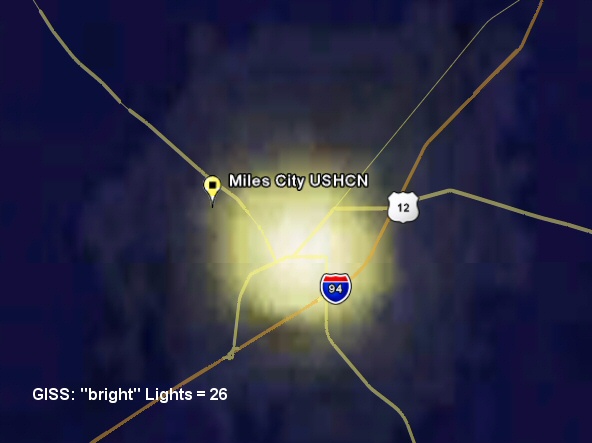
Once I had this new layer working, it was quick work to add some USHCN stations locations and get some snapshots of what their GISS lights=”X” image actually looks like. Since we have been discussing several stations recently, I thought I’d try those first. Below are some screen captures of Lampasas, TX, Miles City, MT, Mount Shasta, CA, Cedarville, CA, and Moncton, N.B. Continue reading

Is Station History Important?

Several recent posts and hundreds of associated comments have focused on the subject of temperature adjustments. TOBS, homogeneity, scribal records, rural versus urban … it is enough to make one’s head spin. I understand the desire to adjust data, but I often wonder if the problem is simply intractable and the adjustments we do have in place are a bit naive. I often ask myself: can the rich historical record of a station overwhelm the well-meaning attempts to adjust for observation times, UHI, and other factors? How often were stations relocated? What were the surroundings like? How accurate were the instruments? Were the instruments properly calibrated? What happened when the curator became ill, or had pressing business matters to attend to, or overslept? Multiply this by a hundred, or five thousand … do the variations simply become noise we can filter out? I think when we are comparing years to an accuracy of hundreths of a degree, these questions become important.

Last summer I stumbled across a paper published January 21, 2005 by Stephen R. Doty and Dr. Lesley-Ann Dupigny-Giroux titled “THE HISTORY OF SURFACE WEATHER OBSERVING IN BURLINGTON, VERMONT, 1832-1973”. I posted a copy of it on surfacestations.org. One of the stated goals of this paper was to produce a document that future studies can use to evaluate the validity of the data that were collected here, judge the trustworthiness of the observers who collected them, and determine the climatological significance of the whatever variability may be discerned. I found the paper an interesting and revealing study of one of the many USHCN sites across the country, and it is the most complete historical description of any USHCN site I have run across to date. It describes in great detail how the Burlington station moved its way eastward from its original location in downtown Burlington to its present location at the airport. Along the way it was moved to rooftops, windows, close to ground level, close to porches, near parking lots and runways. I was particularly drawn to this history because I lived for nearly 20 years in the Burlington area beginning in 1982, and I am very familiar with the city and locations described throughout the paper.

I wrote this post not to prove a point for or against AGW. In fact, one should see that no conclusion can be made with respect to AGW by examining this station’s record (well, at least I don’t think a conclusion can be drawn). I wrote it really to point out that the surface record is a poor measure of climate change, at least when we are attempting to measure with sub-degree accuracy. Unless the complete station history for each station in the record is fully understood and compensated for, we are doing nothing more than guessing when comparing the present to the past.

The following image is taken from the paper, showing the various station locations between 1832 and 1973:

I have tried to summarize the changes this station has seen over its lifetime. Below are paraphrased descriptions of the station locations since 1880. I selected the years after 1880 since they are covered by the GISS record, although FILNET does go back to 1837. I also used an alphabetic label next to my descriptions for use on several plots. In a few cases I note additional thermometer information taken from the USHCN station history file, such as change in instrumentation and/or height. Continue reading

19 Versions and Whadda You Get

Recently Anthony Watts noted that the Lampasas TX station was relocated in 2000 to an extremely poor location and attributed a hockey-sticking of the Lampasas series to this re-location. In a comparison that I made with nearby Blanco TX (which is the sort of comparison that USHCN says that they do), it seemed plausible that the move could have added over 1 deg C. Atmoz argued that the site problems had a negligible impact and that there was some presently unknown problem with the GISS algorithm, which I dubbed a UFA (unidentified faulty algorithm). In order to examine this a little more closely, I waded one more time into the swamp of temperature data, re-collating various versions of the Lampasas temperature series, eventually ending up with 19(!) different versions of the Lampasas TX temperature history. Perhaps, borrowing the language of climate modelers, we could dub these an “ensemble”.

These include various versions of the NASA GISS “raw” and “adjusted” series, scraped from the NASA website last year (causing some controversy within the climate blog world), but which now yield an interest resource for comparing these different versions.

Here’s one comparison that caught my eye and caused me to re-work the material in a little more detail. This shows the impact of the Hansen adjustment (USHCN adjustments are additional) over three stages: green- pre-identification of the “Y2K” error; red – immediately post identification of the Y2K error identification reflecting corrections implemented in Aug 2007; black – the current adjustment, which includes the various changes made (without announcement) in Sept 2007 and which caused considerable puzzlement here as we decoded them. NASA has now provided information and the present documentation while, hardly to the standards that I would recommend, are an improvement and better than the documentation for rival collations, such as CRU.

As soon as one sees this graph, one wonders: what caused the NASA-stage adjustment for Lampasas TX in the early part of the 20th century to increase by as much as 0.3 deg C in the early part of the century? By raising this question, I do not imply that all policy initiatives should be put on hold pending resolution of this matter (which seems to be an all too typical straw man response), but mere curiosity: what is it in the behavior of the algorithms that leads to this result? Why is the temperature history of Lampasas TX being thrashed around this way? And this revision is taking place in one of the best documented networks in the entire world? And the changes are not just the Y2K adjustment as the major change occurred after the initial adjustment for the Y2K error.

texas53.gif
Figure 1. NASA GISS Adjustments to the Lampasas TX station history. Continue reading

Back from Georgia Tech

First, let me thank me thank Judy Curry for inviting me to make a presentation at their seminar series and for both spending so much time and energy showing me around the department and hosting me so hospitably. I was the guest at many interesting presentations by able young scientists and at splendid lunches and dinners on Thursday and Friday. I also wish to thank Julien Emile-Geay for his role in initiating the invitation.

Readers of this blog should realize that Judy Curry has been (undeservedly) criticized within the climate science community for inviting me to Georgia Tech. Given that the relatively dry nature of my formal interests and presentation (linear algebra, statistics, tree rings etc.) and that I’ve been invited to present by a panel of the National Academy of Sciences, it seems strange that such a presentation to scientists should provoke controversy, but it did. Readers here should recognize the existence of such a controversy before making ungracious remarks to my hosts. I must say that I was disappointed by many comments on the thread in which I announced that I was going to Georgia Tech (many of which broke blog rules during a period that I was either too busy or too tired to moderate and have now been deleted.)

For critics of the invitation, I wish to assure them that neither Julien (nor Judy) ever explicitly or implicitly agreed with anything that I said and that I do not interpret a failure to rebut any particular point or claim as acquiescence. Quite the opposite. However, any climate scientists who stridently criticized Judy Curry for the invitation should also consider the possibility that she was one chess move ahead of them in what she was trying to do and how my visit was organized.

Right now I have two related but functionally distinct “hats” in the climate debate.

One role is that of conventional (or in my case, slightly unconventional) scientific author, with a few articles and conference presentations on millennial reconstructions. This role is, of course, made livelier both by my unconventional route to writing these articles and by the interesting events that followed them, not least of which was consideration by the NAS and Wegman panels and an appearance before a House of Representatives subcommittee.

The other role is that of proprietor of a climate blog with a big, lively and vociferous audience, arguably a distinct role by now. The emergence of blogs is a media phenomenon in itself, but, in the climate community, blogs are uniquely active. (This is interesting in itself and deserves a little reflection.) Within that community and even within the larger blog community, Climate Audit has established both a noticeable presence and unique voice. I don’t want this post to turn into a reflection on Climate Audit (we can reflect on that on another occasion), but there was little doubt in my mind that scientists at Georgia Tech were far more familiar with Climate Audit than with MM 2005 (GRL) etc.

I’m pretty sure that Judy Curry perceived that: because so much of my personal exposure to climate scientists has been through the dross and bile of the Hockey Team, this has affected the representation and perception of third party climate scientists at a popular blog and it would be beneficial to the portrayal of climate scientists at this new media form for me to meet sane non-Hockey Team climate scientists doing valid and interesting work. I’m sure that other presenters to the EAS Friday afternoon seminar are also treated hospitably, but I suspect that most of them don’t get to spend two days meeting such a wide variety of Georgia Tech climate scientists in small meetings or that their meetings were quite like mine.

On Thursday, I spent most of the day seeing interesting and substantive work in areas unrelated to anything that I’d written about – things like establishing metrics for aerosols using Köhler Theory or laboratory procedures for speleothems. And whatever other criticisms people may have of me, I don’t think anyone has ever criticized me for not finding interest in details and methods. On Friday, I heard an extremely interesting exposition on the physical basis of hurricanes and their role in the overall balance of nature. An interesting context here (and one that I was previously unaware of) is Peter Webster’s interest in monsoons and Bangladesh.

On Thursday, I was also guest at a seminar on climate and the media (including blogs); on Friday early afternoon prior to my EAS seminar, there was a short Q and A session with the Hockey Stick class. At 3.30 Friday afternoon, I presented to the EAS seminar. I didn’t count the crowd, but it looked like there were about 100 people there, including a couple of (non-GA Tech) CA readers from Atlanta. There was a short question period after the presentation and then a beer-and-wine reception.

Readers who were worried about protests and fireworks at the EAS presentation can disabuse themselves of such fevered imaginations. On the one hand, the audience was polite. On the other hand, it would be hard for a student or uninvolved faculty to think up a technical question that hasn’t been raised previously. So there were no fireworks at the seminar, or for that matter, about the Hockey Stick on any occasion. I’ll review the questions below, but I really wasn’t asked very much at any of the public sessions about statistics or proxies. I’m not going to report or discuss any one-to-one sessions since the line between private scientist and blog reporter was not clearly discussed at the meetings; I am therefore treating them as private, even if they were scheduled on-campus meetings – other than to say that there was relatively little specific discussion of the statistics and proxy issues that directly concern me. Not that there wasn’t much lively discussion – just not about partial least squares, spurious regression, bristlecones, data mining, etc. If any of the parties wishes to put any views on such matters on the record here (or elsewhere), they are welcome to do so. Below I’ll limit my discussion to matters raised at the public seminar or in a classroom setting.

Not everything was sweetness and light. There were a couple of rough patches, not about my analysis of MBH or proxies, but about some incidents here at climateaudit. I’ll discuss blog manners and perceptions on another occasion and mention only one point right now. I regularly discourage people from being angry in their posts for a couple of reasons – even if you feel that the angry outburst is justified, it never convinces anyone of anything; and it gives people an excuse to ignore non-angry posts. Regular readers tend to filter out the angry posts and pay attention to the more substantive posts. However consider the possibility that visitors have the reverse filter – they tend to pay attention to the angry posts and ignore the substantive ones. As people know, I’ve modified my attitudes towards comments over time and now try to delete angry posts when I notice them (and these angry posts are 99% of the time condemning climate scientists and the horse that they rode in on, rather than this blog). It places an unreasonable burden on me to weed out these angry posts and I re-iterate one more time my request that readers refrain from making angry posts as they are entirely counter-productive.

After that long preamble, I’ll review my presentation to the EAS seminar (which I’ve now put online) and questions arising at the seminar or in the classroom. Continue reading

Another UFA sighted in Arizona

My post on Lampasas,TX has created quite a stir when Atmoz, a climate scientist unknown person at the University of Arizona, tried to demonstrate that the temperature spike shown in the GISS data at Lampasas, TX, was not due to the relocation next to a building and asphalt parking lot, but rather some problem with the GISS algorithm to do homogeneity adjustment to the data.

Steve McIntyre posted a tongue in cheek notice of Atmoz’ theory of unidentified faulty algorithm at NASA (UFA). Arizona already has the parking lot weather station operated by the Atmospheric Science Department of the University of Arizona.

Enter serendipity. Warren Meyers’ son Nicolas, has been actively surveying Arizona USHCN stations for his school science project. My inbox had a new station from him today, Miami, AZ. So I decided to take a look at it.

As is typical when an MMTS sensor gets installed by NOAA/NWS to replace the traditional Stevenson Screen, it got closer to human habitation, and in this case, a LOT closer. Too close I’d say:

miami_az_mmts.jpg
click for full sized and additional images at surfacestations.org database

So I though I’d take a look at the raw GISS temperature plot for Miami, AZ to see if the move would show a spike, it did:

miami_az_giss_raw520.png

From NCDC’s MMS database, they have a map showing station moves. This is at the Magma Copper Mine in Arizona, and the station used to be further away from the administration buildings near the pit:

miami_az_locations_map.jpg

Seeing a similar scenario to what occurred in Lampasas, TX, where a rural station was moved from a cooler location to a much warmer one, I decided to do the same sort of comparison on the GISS temperature plots as I did before:

RAW GISS DATA:

miami_az_giss_raw520.png

HOMOGENIZED GISS DATA:

miami_az_giss_homogen520.png
Note that I changed the color to red using a hue shift to prepare for the next step, to see the original GISS data, click on the image.

HOMGENIZED GISS DATA OVERLAID ON RAW DATA:

miami_az_giss_raw-homogen520.png

Notice that after the GISS homogeneity adjustment, the past temperatures go down, with the present acting as a hinge point, thus making the slope of the temperature trend rise. The new slope is purely artificial, and appears to be an artifact of data adjustment by NASA GISS on this rural station. This is the second instance of this happening, the first being seen in the GISS Lamapasas, TX data adjustment for homogeneity.

In both cases, the abnormal spike coinciding with a station move near the present time remains in the record, and that is what the homogeneity adjustment is supposed to catch and remove as I understand it.

In a comment on the subject, Steve Mosher offers an explanation:

In Hansen 2001 Hansen says he uses nightlights to determine
if a station is Rural in the US and population everywhere else.
Miles city population is less than 10K which makes it rural,
BUT, nightlights ( satellite imagery taken in 1995)
indicates a brightness factor for Miles of 26! effectively making it urban.

I concur, there appears to be a flaw in the GISS nightlight methodology and adjustment algorithm. I look forward to seeing GISS investigate, and if this problem is indeed verified, a dataset correction.