This post contains an important calculation, which will affect the many multiproxy studies in which Graybill bristlecone chronologies impact results either directly or via Mann’s PC1.
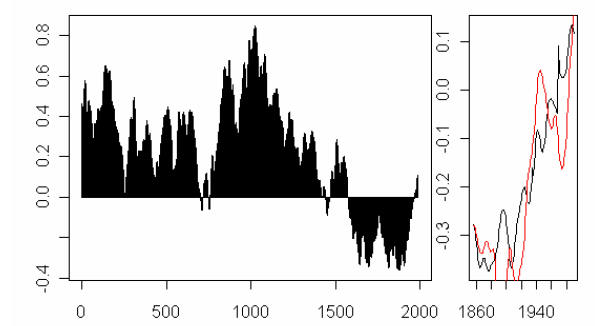
Hans Erren has digitized the data from the Ababneh Thesis. In Figure 1 below, I’ve shown the difference between the updated Sheep Mountain chronology and the Graybill chronology. The difference is profound. The Ababneh chronology obviously doesn’t show the tremendous 19th and 20th century growth pulse of the Graybill chronology, leading one to wonder whether the entire effort to “explain” the Graybill pulse through CO2 fertilization is misplaced – and whether some effort should be placed on examined details of how Graybill’s chronologies were calculated (something that we’re thinking about in connection with Almagre.) The number of cores in the Ababneh study (100) is much higher than the number of archived Graybill cores for Sheep Mountain.
How could such a difference occur? This is nowhere discussed in the Ababneh thesis, which is too bad. You’d think that she’d have been required to reconcile her results to Graybiull’s, but she doesn’t even mention Graybill’s results (though she does compare her results to an even earlier chronology said to derive from Lamarche, which doesn’t match the archived version.) So inquiring minds are left with what’s really a rather major mystery – and one that surely deserves an explanation given the reliance on Graybill chronologies in so many important studies.
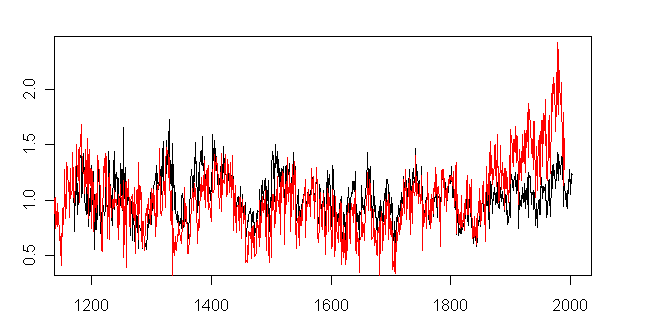
Figure 1. Sheep Mountain (Bristlecone) Chronologies Black – Ababneh 2006; red – Graybill 1987.
The Sheep Mountain chronology is not merely an incidental nit in Team studies. It was the most heavily weighted series in the MBH98 PC1. We mentioned it in our first Nature submission in 2004 here without then realizing that it was a Graybill-Idso bristlecone pine site – at the time, we merely realized that it was weighted 390 times more heavily than the least weighted series in the MBH98 PC1. It is also the most weighted in the MBH99 PC1 and in the Mann and Jones 2003 PC1.
The Ababneh Sheep Mountain chronology only goes back to the mid-12th century. In order to assess the impact of the update on the Mann and Jones 2003 PC1, I spliced the Ababneh chronology post 1121 with the Graybill chronology prior to 1121 (and the two are within a good enough synch at that time to justify the splice for a first-cut analysis.) I then calculated a PC1 using the correlation matrix (not the Mannian method) and obtained the following PC1 (using the 6 sites in the Mann and Jones 2003 network).
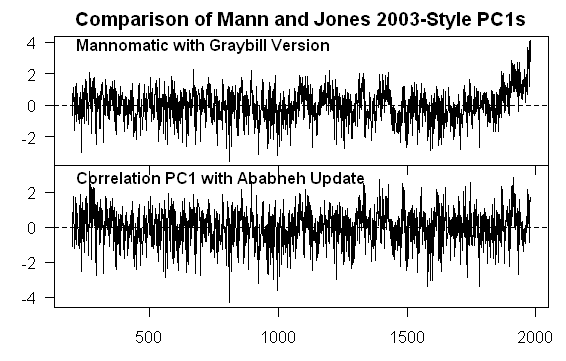
Figure 2. PC1s from the Mann and Jones 2003 AD200 Network.
The weights in this calculation are far more balanced than in the original MBH calculation. I note that I’ve been able to replicate the Mann and Jones 2003 PC1 to five 9s accuracy (prior to Mann splicing it) so I’m 100% certain that we’re talking apples and apples in terms of network.
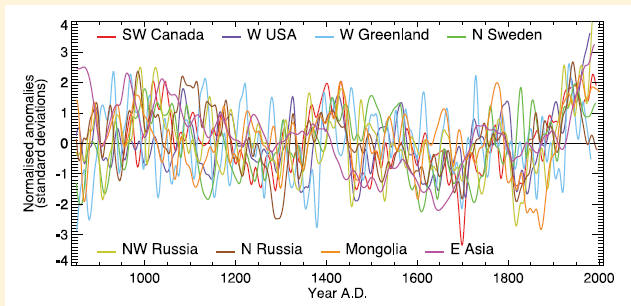
The Mann and Jones 2003 PC1 was not merely an important contributor to the very small Mann and Jones 2003 network, but was used in the (also small) Osborn and Briffa 2006 and Hegerl et al 2006 networks and even illustrated in IPCC AR4 as shown below (see the uptrending “W USA” series.
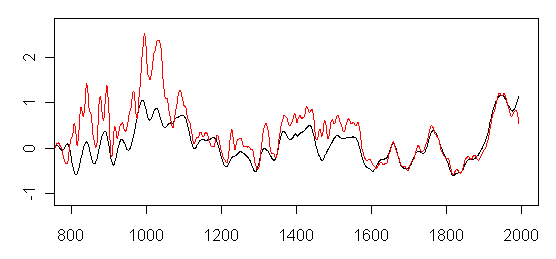
I’ll look at its effect on the MBH99 PC1 at some point, although this assessment is complicated by the fact the MBH AD1000 is still dominated by Graybill chronologies, most of which haven’t been updated, and the ones that have (San Francisco Peaks, Pearl Peak) haven’t been archived. Given the profound impact of using the Ababneh data on the Mann and Jones 2003 PC1, one does wonder even more at the failure of her colleague and thesis reviewer (Hughes) to use this updated data in Salzer and Hughes 2006, where he used Sheep Mountain in the now obsolete Graybill version.
Reference: Ababneh, L (2006). Ph.D Thesis, University of Arizona http://www.geo.arizona.edu/Antevs/Theses/AbabnehDissertation.pdf









 Climate Audit