Julien Emile-Geay has made many forceful criticisms of the Loehle reconstruction. For example, he says:
Relationship of each proxy to *local* temperature is not even discussed. We are just shoved a list of references (hey Craig , have you heard of tables ? They are a great means that scientists use to convey information clearly). How is it that tree-rings are seen as the penultimate antichrist but that, to take but one example, d18O of speleothem calcite (e.g. Holmgren et al., 1999) is a flawless paleothermometer ? Shouldn’t one discuss one by one, and with great care, the pros and cons of each proxy as a temperature recorder ? d180 in forams is a notoriously flawed temperature proxy, is being replaced by Mg/Ca where possible, and one can only surmise why the Keigwin[1996] series is here.. Is it just a form of screening for proxies with a low “hockey-stick index” (in McIntyre parlance) ?
Emile-Geay notably did not compare Loehle’s proxy selection with those in the canonical studies. Here I’d like to observe the overlap between Moberg’s low-frequency network and Loehle’s network. Because of this overlap, such criticisms apply a fortiori to Moberg et al, about which Emile-Geay has, to my knowledge, has been entirely silent.
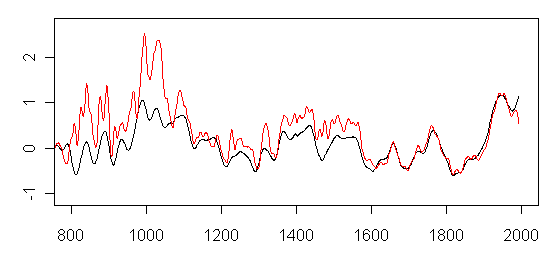
Moberg used 11 proxies in his low-frequency network (retaining tree rings only for high-frequency information.) The 11 low-frequency proxies are listed here. Here is a plot of the 11 Moberg series.
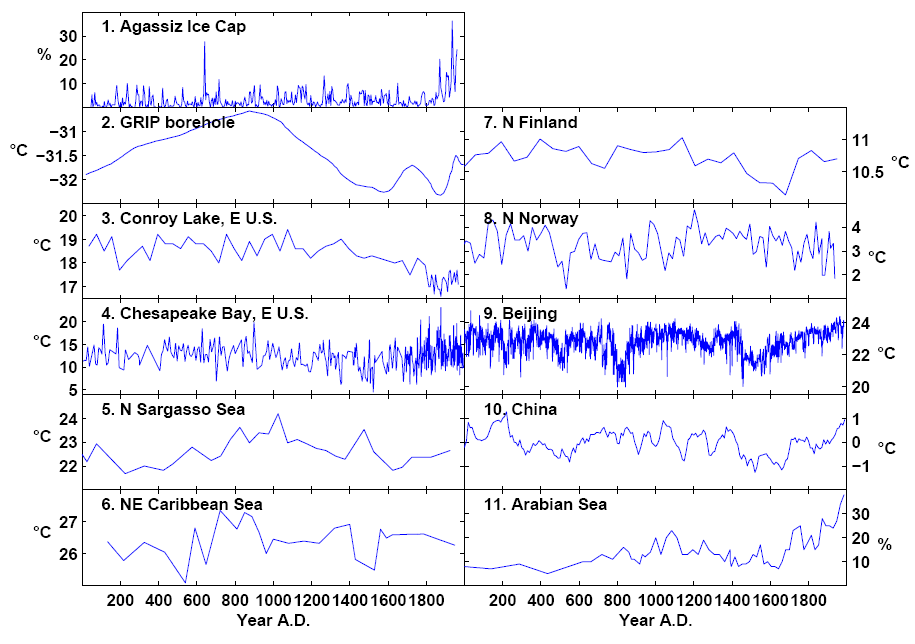
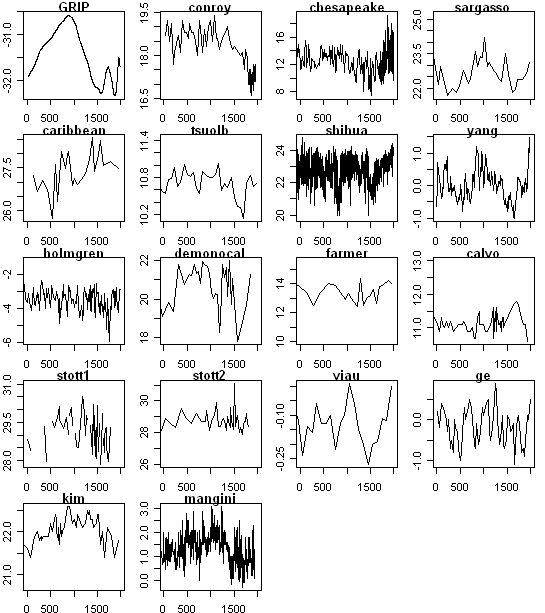
Attentive readers will see that no fewer than 8 of the 11 series are used in the Loehle network. The only exceptions are the Arabian Sea G Bulloides (discussed a lot here) which is uncalibrated to local temperature (actually having an inverse relation!), the Agassiz melt percentage also uncalibrated to local temperature and the Lauritzen speleothem, digital information on which was not made available at the time.
Through a Materials Complaint to Nature, I am now in possession of a digital version of the Lauritzen data (without restriction) and have posted it up at www.climateaudit.org/data/moberg/
17 of the 18 series used by Loehle used temperature calibration by the original authors. There was only one exception: the Holmgren speleothem and this one exception was seized on by Emile-Geay and criticized. I think that there are definite advantages for a Loehle-type reconstruction in maintaining a policy of using temperature reconstructions rather than uncalibrated proxies. Even single-proxy temperature reconstructions have their own problems, but at least the attempt at constructing a temperature reconstruction by the original authors avoids some defects arising in uncalibrated proxies. I’ve objected to the use of uncalibrated series in the past (e.g. the Moberg G Bulloides series) and believe that the same objection applies against the use of the Holmgren speleothem. Obviously there are occasions in which one has to broaden the inclusion criterion, but that doesn’t apply here.
If Emile-Geay believes that multiproxy authors should not use uncalibrated proxy series such as the Homgren speleothem to which he objected, then he must surely also criticize the use of the even more objectionable Arabian Sea G Bulloides series by Moberg and by Juckes. If he thinks that the consideration of the Loehle series has been inadequate, then he must also conclude that the consideration by Moberg was also inadeuqate. However, to my knowledge, he has been thus far silent in his criticisms of Moberg.
And of course there’s an even more powerful example of the use of a proxy uncalibrated to local temperature: Mann’s PC1. This was never calibrated against local temperature. If it were, the implied MBH98-99 calibration would entail an implausible ice age in California, a point that I’ve often made. The MBH PC1 is able to have such a large impact on reconstructions precisely because it is uncalibrated and has such a negative value in its early stages.
So I welcome Emile-Geay’s suggestion that authors should examine “one by one, and with great care, the pros and cons of each proxy as a temperature recorder”. Indeed, much of the volume of ClimateAudit has been devoted precisely to such examination – an examination which has been notoriously absent in the canonical multiproxy studies. I hope that Emile-Geay is consistent in his policies and will be as unsparing in his criticism of Moberg et al, Mann and Jones and MBH, and perhaps even come to appreciate the texture of the post history at Climate Audit in which we have tried to carefully examine the pros and cons of each temperature proxy – not a small job.