The Tree in the Desert

We’ve had some interesting discussion of the following picture of a tree in the desert which was the closing slide in a presentation by Shao et al here entitled “A Dendroclimatic Study of Qilian Juniper in the northeast Qinghai-Xizang (Tibet) Plateau”. Continue reading

Jones et al 1990, TR055 and GHCN

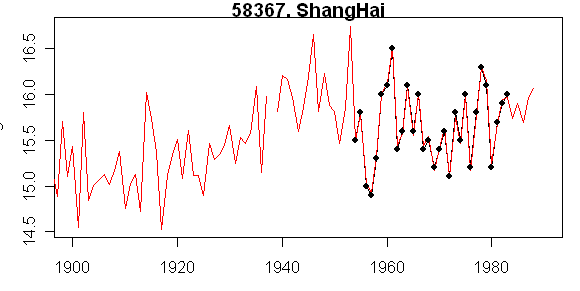
I have collated the Jones et al 1990 temperature data against annual average data from the TR055 data set, reviewing all 84 plots in the format shown below. Here is a plot for Shanghai. The Jones et al 1990 version was plotted first in black and the annual average from TR055 secondly in red. If the match is very close (as here), the second line overwrites the first line, which then doesn’t show. So I also plotted the Jones et al 1990 version with prominent points, emphasizing the identity of the two series in the area of overlap. The Jones et al version only goes from 1954-1983, while the TR055 is longer,beginning in the 19th century (not all of which is shown here) and continuing to 1990. Doug Keenan reports that the station history reports moves.

chinat12.gif
Black- Jones et al 1990 version; red TR055 annual average.

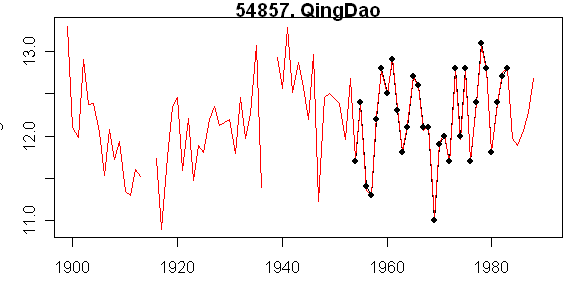
Here is another example from Qingdao, where the longer TR055 record shows a considerable temperature decrease from the early 1940s to the early 1950s, when Jones et al commenced their study – a change observable in other TR055 stations. The “trend” in this data is sensitive to choice of start and end points and, while I’m sure that there are “good” reasons for the period selected by Jones, it does seem a little opportunistic. Doug Keenan says that the station history is inconsistent.

chinat11.gif

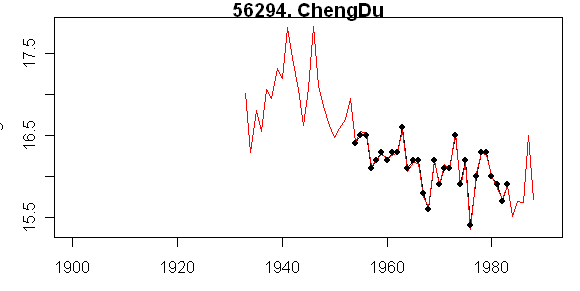
Here is an example from Chengdu, again showing high values prior to the start of the Jones period; Doug Keenan reports that the station history indicates moves.

chinat13.gif

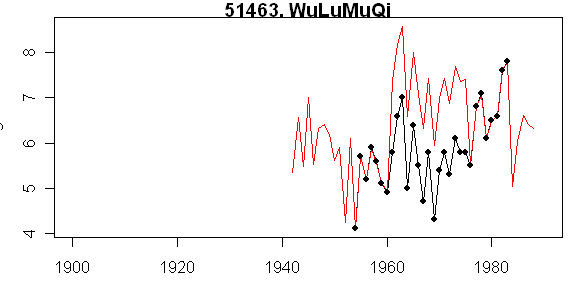
In only one case was there a material inconsistency between the TR055 version and Jones et al 1990: Wulumuqi, as shown below. It’s pretty hard to figure out what Jones is doing here. The Jones version (uniquely in this case) lowers the values, perhaps on the basis of an inhomogeneity around 1960. OK, but then their later values from 1973 are identical to the unadjusted values. If the values in the middle were adjusted for homogeneity, shouldn’t the later values be as well? Of course, that would pretty much eliminate the trend, and, as I recall, this was the station with the largest trend in the urban group. Ah, the Team!

chinat15.gif

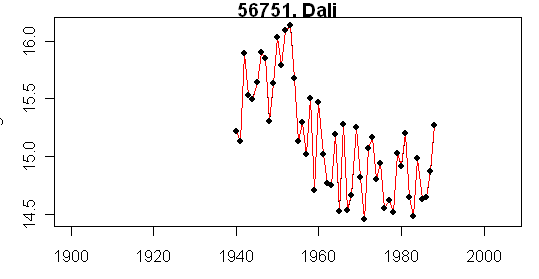
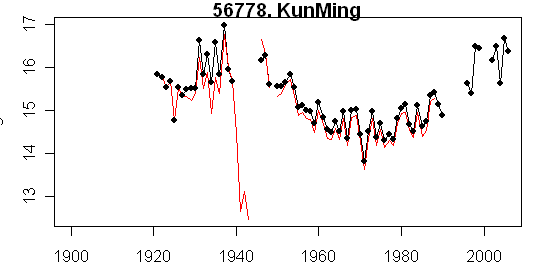
I also browsed through comparisons of the TR055 version to the GHCN v2 version. What struck me immediately was just how stale the GHCN v2 data is. Many of the stations have not been updated since TR055 around 1990. Here’s a plot of one Jones station comparing the TR055 version to the version currently at GHCN v2. They are identical. If they aren’t updating this data, what is the money earmarked for updating being spent on?

chinat19.gif
Black- current GHCN v2 version; red – TR055

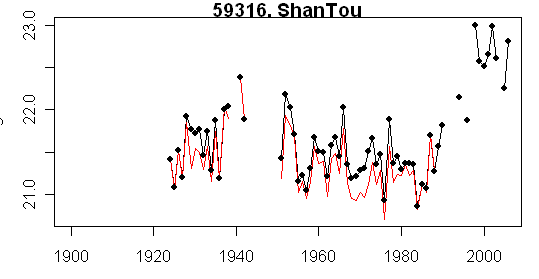
This is not to say that none of the series are updated. However, the updates in a quick pass often show an alarming lack of continuity. Here’s a typical example. To take an annual average, I required all 12 months to be available. Why would the record through the travails of the Great Leap Forward and the Cultural Revolution be continuous, only to become erratic in the 1990s? Are there inhomogeneities lurking here?

chinat24.gif

Here’s another example in which later values in GHCN v2 are erratic and again, one wonders about homogeneity. The data on file does indicate relative warmth in the late 1930s-early 1940s, something that one sees in other places. Of course, this is pre-CRU adjustments.

chinat26.gif

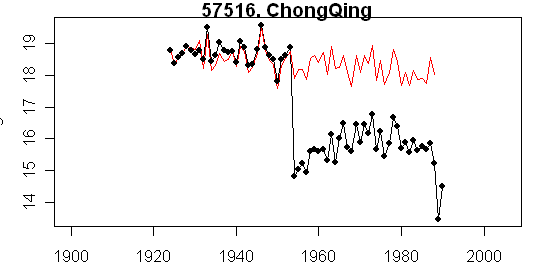
A comment in the most recent CRU survey notes that undocumented homogeneity adjustments may exist in national data prior to CRU handling. If one ever wonders about the potential scale of adjustment, take a look at this spectacular example. So someone has to guess at how to adjust for this.

chinat25.gif

BTW the documentation for the NOAA gridded data says that they use the “raw” GHCN v2 data (which is what’s plotted here).

In conclusion, I guess what surprised me the most was how stale the data was in GHCN v2. In answer to Willis’ FOI request, the University of East Anglia said that all the Jones station data was available online at GHCN v2. If that’s the case, is CRU also using stale station data? With so much stale data, I wonder how many series are actually driving the temperature results in this area.

Dunde: Will the Real Slim Shady Please Stand Up?

One of my objectives in looking at both the Dulan tree ring data and Chinese station data is to take a fresh look at the Dunde ice core information, which is near Dulan and Delingha. twq says that he’s been analyzing low-frequency information from Dunde.

A caveat for twq: the Dunde archiving situation is a fiasco. There are multiple inconsistent versions of Dunde (and other Thompson ice cores such as Guliya). Last year we discussed three inconsistent Guliya versions used in peer-reviewed 2006 articles – Dunde is just as bad.

I just noticed that Yao et al 2006 introduces yet another inconsistent Thompson version. I’ve complained to Science, NSF, NAS and gotten nowhere. So twq, before you start using Dunde data, you should ponder which Dunde you’re using.
Continue reading

The Three-Core Chronology

As noted yesterday, Jacoby and Cook didn’t get the memo about not using the Dulan juniper chronology of Wang et al 1983 (also used in Crowley and Lowery 2000) and used it in a panel diagram in Gou et al [Ann Glac 2006]. Wang et al 1983 is unusual in a dendroclimatic publication, because they identify the location and altitude of every core that they took. This is made easier by the fact that they only used 3 cores, not even close to minimums required according to dendro standards. Of the cores, one was nearly 200 km away from the other two. As shown below, there has been a great deal of subsequent dendro work done in the area, much of reported in the Western literature, consistently reporting that junipers in the Delingha-Dulan area are precipitation proxies and using the site chronologies to reconstruct precipitation over more than a millennium. As noted below, the Dunde ice core location is close to the Dulan junipers and, in fact, the Delingha temperature station is used to calibrate the Dunde ice core. Additional understanding of information from Dulan junipers may shed light on the thorny issues of the Dulan ice core.

Gou et al 2007, cited by twq as supposed evidence for a correlation between Qaidam Basin (Dulan) junipers and temperature, is a new study of a site in the headwaters of the Yellow River rather than the Qaidam Basin and, whatever its merit or lack of merit (and there is much to criticize in the study), hardly stands as evidence one way or the other in respect to Qaidam Basin junipers.
Continue reading

Some China Comparisons

Here are a few plots of Jones et al 1990 China urban vs rural sites. Maybe one of our more computer-oriented people could make a little applet to yield 42 comparisons from the small data set which is now collated. For now, here are some very quick and non-prettied up comparisons. I started with a couple of sites in western China because of the recent discussion of Dulan junipers. This is also useful because the leverage on these remote sites is very great because there are few observations and they affect large areas through the Jones gridcell methodology. (One thing to keep in mind with the Jones et al 1990 comparison is that it is only from 1954-1983, when there was much turmoil in China and that there is little trend in many stations. Chinese station temperatures took off more recently.)
Continue reading

A Reply to an Angry Dendroclimatologist

In a recent post, I challenged the Dendro Truth Squad to root out use of precipitation proxies in multiproxy studies (which the NAS Panel also encouraged avoidance of). Instead of illustrating this with bristlecones one more time (although they obviously occur in a high desert), I illustrated the challenge with the example of Dulan junipers, located in a high dry desert in China. This prompted the following anonymous response from an angry dendroclimatologist via our valued occasional correspondent, Rob Wilson, saying:

A second case in point is the broad Project for the Dendro Truth Squad’ stone you hurled up on this page. Those in the know, who really know the science, know not to use that chronology and know who still use that chronology. The work that uses that chronology for a temperature reconstruction is less-respected than others. Please, do not cast the whole field as deceitful or ignorant of this. You state that it is not your intention to slander the whole science, but why post the picture of that tree and make road statements, make a separate post about it and string a long list of papers that use that chronology if you are not trying to undermine the science? Why not post the longer string of papers that DO NOT use that one site? The final point, you and others are beating some extremely dead horses. The people and papers you audit’ is very selective. You ignore more recent work that surpasses others.

Continue reading

Dulan Junipers and the Silk Road

When I was a teenager, I liked Joseph Conrad’s books (which bear re-reading as an adult). I remember reading Younghusband’s account of his travels in Sinkiang. These books undoubtedly were a reason why I traveled round the world when I was 20, going to some out of the way spots. The Dulan junipers, which we’ve discussed lately, are in central Asia and I thought that it might be interesting to see if there was any connection to the Silk Road, the formidable overland route through Central Asia, traversing both the Gobi and even more formidable Taklamakan deserts.

It turned out that Dulan is connected in a very interesting way to the one – and one that casts an interesting perspective on their use as a temperature proxy. Continue reading

North American Upper Treeline #3

The next installment in our search for upper treeline proxies evidencing the AR4 SPM claim that : “Studies since the TAR draw increased confidence from additional data showing coherent behaviour across multiple indicators in different parts of the world” takes us to the Canadian Rocky Mountains, to a study mentioned in the Wilson and Luckman 2003 survey as follows:

Dendrochronological studies at upper treeline in the southern Canadian Cordillera have focused on either Vancouver Island (Smith and Laroque, 1998; Laroque and Smith, 1999) or the Canadian Rocky Mountains (Parker and Henoch, 1971; Luckman et al., 1985; 1997; St George and Luckman, 2001).

This study is not cited in IPCC 4AR and, indeed, other than self-citations within Luckman students, seems not to have entered into proxy discussion – which is too bad, since it actually contains somewhat fresh data. Continue reading

What is "Consensus Science" for Proxies?

Scott Saleska agreed in cordial terms that this site was attempting to carry out “evidence-based” analysis without deferring to perceived authority. He then asked us to characterize, in our words, exactly what our position was – he agreed that we didn’t contest “basic science”, but then asked (politely) if it was reasonable to say that we contested “consensus science”. The focus of this site has been on millennial paleoclimate reconstructions, since that’s what I specialize in. I acquiesce in some discussion of water vapor feedback and things like that, but I haven’t expressed views on these matters. We may get there some day but we haven’t so far.

In order to answer Scott Saleska’s question, in order to say whether I agree or disagree with “consensus science” in respect to millennial reconstructions (or what aspects I agree or disagree with), the first thing to do is obviously to define what is meant by “consensus science” in respect to millennial paleoclimate?

Not every opinion expressed by a dendroclimatologist is part of “consensus science” (which I take to be defined by IPCC). For example, Martin Wilmking has reported positive and negative responders at latitudinal treeline, a result that he stated would have major impact on the millennial reconstruction project. This finding is not cited nor discussed nor incorporated in IPCC 4AR and thus, even though articulated by an excellent dendroclimatologist, cannot be counted as being part of “consensus science”. In the same vein, certain views and recommendations by the NAS Panel (e.g. bristlecones should be avoided in temperature reconstructions), that are disregarded by IPCC (and even themselves) by using such reconstructions cannot be said to be part of “consensus science”, even though the point of view has been expressed by an important committee.

I think that the “science” is defined by its set of methods and procedures, rather than through genuflection to a particular squiggle (the HS), and accordingly, I have drafted the following list (in no particular order) of what I believe to be the salient elements of “consensus science” in the millennial reconstruction field (and to a lesser extent gridcell calculations) that are discussed at this blog. (I will probably edit and revise this list as I think some more about it):

“Consensus Science”

1. The urban heat island effect in the 20th century is less than 0.05 deg C.

2. In December 1941, although there is no contemporary documentation of the event, all ships around the world synchronously converted from measuring SST using canvas buckets to engine inlets, thereby requiring a 0.3 deg C step adjustment in SST measurements. [This view is held despite the fact that 90% of SST measurements in 1970, for which the measurement method is known were made, were still being made with buckets.]

3. The following position is acceptable: “We have 25 or so years invested in the work. Why should I make the data available to you, when your aim is to try and find something wrong with it?

4. Data collected by a scientist with public funding is his personal property. Funding agencies pay the scientist for his expertise, imagination, and insight to be able to make some advance in our understanding of how nature works, not for raw data sets.

5. Computer codes developed in paleoclimate studies funded by NSF are the personal private property of the scientist.

6. It is prudent to rely on statistical studies carried out by non-statisticians without ever subjecting these studies to a statistical or other audit.

7. If a methodology used in a study in found to be faulty, it is acceptable to keep using the results. [Mann’s PC1 is used in the following studies illustrated by IPCC: MBH99, Mann and Jones 2003, Rutherford et al 2005, and remarkably, Osborn and Briffa 2006, Hegerl et al 2006].

8. Calculating a verification r2 statistic for a reconstruction is an incorrect and foolish thing to do.

9. It is acceptable practice to report favorable verification statistics and not report failed statistics.

10. It is acceptable practice to calculate confidence intervals based on calibration period residuals in an inverse regression using 20 or more proxies, even if the verification r2 is much less than the calibration r2.

11. Bristlecone and foxtail ring widths are a valid temperature proxy.

12. The Yamal ring width chronology is a valid temperature proxy, but the Polar Urals ring width chronology isn’t.

13. It is acceptable practice to inspect a data set of (say) treeline white spruce chronologies and report on and archive only the chronologies that go up in the 20th century.

14. Even if two reconstructions have substantial proxy overlap, the reconstructions may be called “independent” if one or more proxies or one or more authors are different.

15. Studies since the TAR draw increased confidence from additional data showing coherent behaviour across multiple indicators in different parts of the world with upper treeline ring width chronologies showing a consistent increase in ring widths in response to warmth in the 1990s and 2000s.

16. If a reconstruction does not record recent warmth, it is acceptable to truncate the reconstruction in 1960 and use the instrumental record afterwards.

17. The following is an acceptable scientific explanation: “In the absence of a substantiated explanation for the decline, we make the assumption that it is likely to be a response to some kind of recent anthropogenic forcing. On the basis of this assumption, the pre-twentieth century part of the reconstructions can be considered to be free from similar events and thus accurately represent past temperature variability.”

18. It is a good idea for an assessment report on a controversial topic to be done by one of the parties to the controversy.

19. Examination of underlying data is not relevant to the duties of an IPCC reviewer.

I’m sure that readers will have additional suggestions which I may incorporate (but please try to maintain the above tone).

The question for Scott Saleska and others: (1) do you feel that it is unfair to include any of the above points in describing the millennial paleoclimate “consensus”? [this is a draft list and not locked in stone] (2) do you support all (or any) of the above elements of the “consensus” on millennial proxy reconstructions?

If the consensus on these points were to be reversed, as I believe that it ought to be, then one could begin the process of assessing the impact of the above positions on detection and attribution studies, the tuning of GCMs etc. I would be surprised if there was no knock-on effect whatever, but have not studied the matter so far.
More on "Naturally Orthogonal"

I realize that not all CA readers are interested in multivariate methods and that dendroclimatologists want to “forget the math”, but I find it interesting to try to relate dendro and paleoclimate recipes to known statistical methodologies that you can read about in texts.

I commented the other day on the form of Principal Components Regression used in Wilson et al 2007 and prior articles by Luckman’s students: their reconstructions are a form of inverse OLS regression but on 3 or so PCs rather than 20 proxies. I thought that it might be worthwhile to write up some of my thoughts on multivariate methods. The approach here is based on an interesting article and tutorial by Magnus Borga entitled “A Unified Approach to PCA, PLS (Partial Least Squares), MLR (Multiple Linear Regression) and CCA (Canonical Correspondence Analysis)” . I use OLS and MLR interchangeably below.

In my opinion, Borga provides a very elegant way of keeping track of these different methods, such that some insight is actually shed on their relationships. I’ve added my own twist to his analysis by fitting Ridge Regression, Canonical Ridge Regression and Principal Components Regression into this “unified approach” – I don’t think my analysis is particularly profound, but I haven’t seen it anywhere and it seems pretty to me.
Continue reading