We’ve observed the changes in GISS over the past 7 years. Jean S draws our attention to the changes in GISS temperature history since Hansen et al 1981.
I’ve tried to re-plotted the current Hansen data – right frame – in the same format as Hansen et al 1981 Figure 3. This is not as easy as it seems because Hansen et al 1981 does not include information on centering; no digital version seems to be available; and the modern zonal versions commence in 1900 rather than 1880.
I’ve updated the graphic to also illustrate an interesting 1998 version of Hansen’s data which has proved helpful in trying to figure things out. The left panel below is a plot of the 1998 version (black) centered on 1901-1970. After thinking about this for a while, it became clear that the reference period had to cover most of the century or else the position of the NH series in Hansen et al 1981 could not be replicated. I think that the black version of the NH series is pretty well matched to Hansen et al 1998. Notice that Hansen et al 1981 picked 1880 as a starting point and that this neatly truncates from view a temperature decline from 1866 to 1880 (which was in the original data version). Just a coincidence, I’m sure.
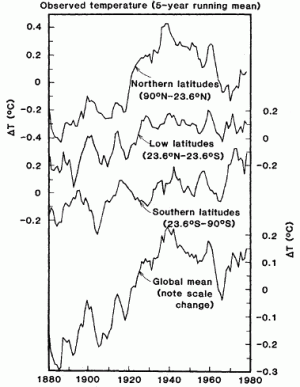
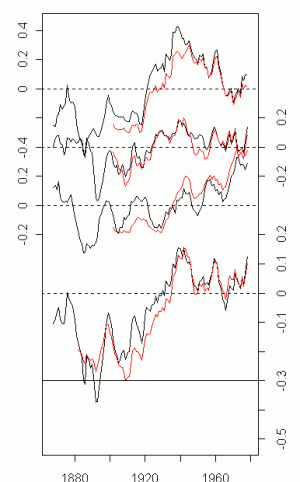
Left: Figure 3 from Hansen et al 1981; right – Latest GISS data plotted in same format over same period. Most recent version is truncated at 1900, while earlier version went to 1880. The 2007 and 1998 data has been re-centered on 1901-1970. I’ve not been able to locate information so far on the reference period for Hansen et al 1981 and this may need re-drafting.
This shows that there doesn’t seem to have been much adjusting of the north (N of 24N) series up to 1998, but it has been adjusted down between 1998 and 2007. However, there do seem to have been adjustments to the other two series between 1981 and 1998, as well as between 1998 and 2007. One of the very important reporting changes between 1998 and 2007 is the truncation of the period 1880-1900. Notice the particular impact on the tropics, where 1998 results show late 19th century values similar to closing 1980 values, resulting in no net change between 1880 and 1980 in the tropics. What do you suppose the reason was for eliminating the reporting of zonal measurements for 1880-1900 in the most recent results?
Jean S observed:
For instance, the difference between the temperature height in 1940 and low in 1970 in northern latitudes is about 0.5C in 1981 version whereas now it seems to be about 0.3C. In low latitudes (1981 version), there are three peaks (around 1930,1940,1960) that are higher than 1980, but in the current version two of those peaks have disappeared and even the existing one (1940) is below 1980. In southern latitudes, there is a lot of variation between 1900-1930 in 1981 version whereas the currrent version is almost flat. Also the mean of 1910’s is about the same as the mean of 1960’s in 1981 version, but in the current version there is over 0.2C difference. And so on…
UC observed:
We’ll lose the concept of time soon. It will undoubtedly get warmer in the future, but also past temperatures will get colder in the future. 🙂
Hansen et al 1981 stated of the left panel:
A remarkable conclusion from Fig 3 is that the global temperature is almost as high today as it was in 1940. The common misconception that the world is cooling is based on NH experience to 1970. Another conclusion is that global surface air temperature rose ~0.4 deg C in the past century, roughly consistent with calculated CO2 warming. The time history of the warming obviously does not follow the course of the CO2 increase, indicating that other factors must affect global mean temperatures.
The adjusted GISS temperature is a little more consistent with the “course of the CO2 increase” and less consistent with solar changes, with the largest differences occurring in southern latitudes, about which the least is known. I wonder what back-up is available for the southern series. However, from a statistical point of view, because these adjustments have such an impact on the eventual fit, it’s getting to the point where a statistical analyst may have to ask whether GISS adjustments to pre-1980 temperature should be counted as a degree of freedom in their modeling.





 Climate Audit



"Heed the Goracle"
Gore swept into Toronto yesterday using an environmentally controversial airline on Toronto Island – a service that is opposed by friends of Toronto’s waterfront (including myself.) The departing headlines read: Heed the Goracle. Continue reading →