I’ve reported before that Science decided not to require Osborn and Briffa 2006 to provide supporting measurement data for their Taimyr, Tornetrask and “Polar Urals” (Yamal) chronologies. While I disagree with that decision and may pursue the matter further with them, I asked Osborn to voluntarily provide the measurement data. I received a reply from Osborn today. Continue reading →
Mann and Jones have a new post at realclimate discussing warmth at Svalbard, an island archipelago north of Norway. May temperatures are very warm there. They say that the differences are 5 standard deviations based in i.i.d. We’ve talked about the inappropriateness of i.i.d. assumptions in the context of Rasmus (BTW what ever happened to Rasmus over there? – I predicted that Gavin would ice him and this seems to have happened.) Terry drew this article to my attention. He attempted to post a comment asking about autocorrelation, but this seems to have been censored by realclimate. After all, that would be a “serious” discussion.
Mann and Jones say that “models show” "polar amplification” (although I didn’t notice any discussion of declining temperatures in Antarctica.) I’m not going to go through the statistics, but I thought that I’d post up some interesting comments from Hubert Lamb [1979] on the northeast Atlantic. Continue reading →
The American Meteorological Society has recently placed all but their most articles online here. These include many important publications.
Going from one extreme to another, the Tree Ring Society has also placed their archives online here,
The two “lost” Graumlich foxtail series used in Esper et al 2002 were archived today at WDCP. Only the specific series that I had requested were archived; other series in Bunn et al 2005 were not archived – see prior discussion here.
UPDATE May 17: Graumlich also archived two chronologies (Boreal -ca636.crn; Upper Wright – ca637.crn). I’ve plotted these chronologies against the chronologies emailed to me by Science in February. There is also a slight difference in the number of cores used in each. For Boreal, Esper shows 64 cores as being used to make his chronology, while Graumlich has only archived 63 cores. For Upper Wright, Graumlich has 77 cores starting after 710 (the start of the Esper series), while Esper says that he used 78 cores. These numbers in Esper appear to be computer-generated rather than misprints, so there seems to be some remaining slight difference between the data as used by Esper and as archived by Graumlich.

Black – Esper; red- Graumlich. Smoothed with 21-year gaussian filter.
Kultti et al. [Holocene 2006] has just been published in Holocene, showing higher medieval treeelines in northern Finland (27 deg E). This is consistent with the more northerly distribution of oak in medieval Finland reported in Hulden [2001] discussed here and adds to the growing inventory of articles both demonstrating higher medieval treelines and using this to estimate MWP temperatures locally higher than at present, some of which I’ve posted about from time to time Medieval Category. These “local” results from treelines are not limited to the north Atlantic and Greenland, but extend to the Sierra Nevadas (117 W), Sweden, Finland, Polar Urals (65 E) and a Siberian transect (90-100E). I’ll add a comment on Chinese proxies of this type. Kultti et al. also consider information from other proxies and report similar results for all proxies EXCEPT the tree ring width chronology of Helama et al [2002]. Here are some extended quotes. Continue reading →
Gerry Browning of CIRA has contributed a post today discussing climate models. If you go to Google Scholar and search “Browning Kreiss”, you will get a list of formidable papers on numerical questions. Gerry has tried to distill the issues for a wider audience here.
Recent awards include the NOAA Environmental Research Laboratories’ Outstanding Scientific Paper Award for: Browning, G.L. and H.O. Kreiss, “The Role of Gravity Waves in Slowly Varying in Time Mesoscale Motions,” Journal of the Atmospheric Sciences , 54, 9 1166 – 1184 (1997).
Here is Gerry’s citation as winner of a 2002 Research Initiative Award from the Cooperative Institute for Research in the Atmosphere:
In a series of papers, Browning and Professor Heinz Kreiss, a colleague and mentor, have extended Kreiss’ Bounded Derivate Theory (BDT) to multiscale flows in the atmosphere and oceans. There are many ramifications of this new theory. The first is that the well posed system introduced by Browning & Kreiss as a replacement for the ill-posed primitive equations (used in all models for large-scale atmospheric flows) also accurately describes both the dominant and gravity wave portions of all remaining atmospheric flows, i.e., the new system is the only well-posed multiscale system that accurately describes all atmospheric motions. The second is that the reduced system clearly indicates what balances are appropriate for all diabatic cases, i.e., it is the only method that has provided a hot start initialization for cases where the heating is the controlling influence on the solution. The impact of this theory is being felt in many areas, and Browning’s cuttingedge research and the potential for breakthrough applications in numerical modeling
Continue reading →
This is the eyewitness account by Justin Rietz of the talk given by Michael Mann at University of California at Santa Cruz on Wednesday 10th May 2006.
I made it down to Santa Cruz for the Mann presentation Wednesday night. I missed the first 10 to 15 minutes (those of you who live or have lived in the area know what rush hour traffic at 5:30pm is like on highway 17). I don’t think I missed much, as most of the presentation was intro level, i.e. "CO2 is a greenhouse gas, things like volcanoes produce C02 as does burning fossil fuels, the difference between the greenhouse affect and AGW, etc."
For those of you who are only interested in what Mann had to say about r2 calculations, skip down to the section labelled "MANN ON r2."
Disclaimer: In the main, this isn’t a Mann expose or op ed article on my part- I tried to objectively capture what was said based upon my notes, and so the text may be a little dry. I am sure my notes aren’t perfect, and I may may have missed some details or misstated exactly what was said. However, I have an audio recording to keep me honest (it isn’t great quality so I need to clean it up), and I will defer to it as the final word. At the end, I do take the liberty of including some personal thoughts to add a little "color."
Continue reading →
"Standardization" and averaging are operations that are done time after time in paleoclimate studies without much discussion of the underlying distributions. If one browses through recent statistical literature on "robust statistics", one finds much sophisticated analysis of how to handle outliers. The term "robust" is commonly used in paleoclimate, but the term as used in paleoclimate is merely a term of self-approval rather than an application of methods known to Hampel or Huber, to mention two prominent practitioners of robust statistics. Continue reading →
An interesting comment on Hegerl et al by James Annan here.
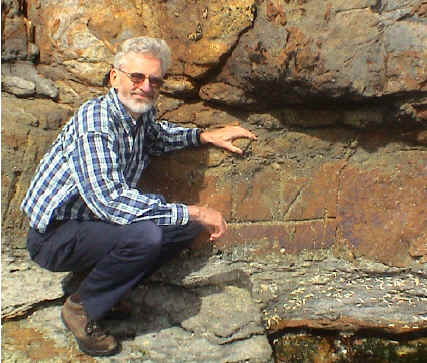
This is not a topic that interests me. John A is interested in it; I’m inclined to think that Hunter’s interpretation of 19th century documents is plausible. What I am tired of is threads being hijacked for discussion of Hunter’s interpretation of sea level. So I’m providing a thread for such discussions. Here is a picture of the 19th century mark in question, with the protagonist in the foreground.
Relevant data sets are here, many of which are password protected data sets: Amery data (needs username and password). Miscellaneous files (needs username and password). TASMARC files (needs username and password).
I request that people interested in this issue place their remarks here so people who are uninterested in the topic can avoid them.
John adds: I’ve moved comments over to this new thread, so the referring numbers in the comments themselves may be a little screwy.





 Climate Audit
Michael Mann at UC Santa Cruz
This is the eyewitness account by Justin Rietz of the talk given by Michael Mann at University of California at Santa Cruz on Wednesday 10th May 2006.
I made it down to Santa Cruz for the Mann presentation Wednesday night. I missed the first 10 to 15 minutes (those of you who live or have lived in the area know what rush hour traffic at 5:30pm is like on highway 17). I don’t think I missed much, as most of the presentation was intro level, i.e. "CO2 is a greenhouse gas, things like volcanoes produce C02 as does burning fossil fuels, the difference between the greenhouse affect and AGW, etc."
For those of you who are only interested in what Mann had to say about r2 calculations, skip down to the section labelled "MANN ON r2."
Disclaimer: In the main, this isn’t a Mann expose or op ed article on my part- I tried to objectively capture what was said based upon my notes, and so the text may be a little dry. I am sure my notes aren’t perfect, and I may may have missed some details or misstated exactly what was said. However, I have an audio recording to keep me honest (it isn’t great quality so I need to clean it up), and I will defer to it as the final word. At the end, I do take the liberty of including some personal thoughts to add a little "color."
Continue reading →