New Light on Old Fudge

One of my first blog postings was on Briffa’s very first fudging (2011 update: the “Briffa bodge”) of a temperature reconstruction – his adjustment of the Tornetrask reconstruction – a reconstruction that is used in virtually every study. This was one of the first encounters with the Divergence Problem. Tornetrask MXD went down in the 20th century. Briffa resolved this by simply “straightening” out the reconstruction (although, unlike in IPCC TAR, at least he reported it in the original article.) At the time, per, an early reader of the blog, remarked that he was “gobsmacked” at this. This has recently come up again in two contexts and this time even I am “gobsmacked”. Continue reading

Quality Control – Jones and Hansen Style

Anthony Watts has an excellent post showing the calibre of the quality control carried out by Phil Jones and Jim Hansen and the quality of Phil Jones’ “proof” that the “overall urban bias …is greater than 0.05 deg in the 20th century”. Marysville CA (425745000030), GISS population 12,000, is in the USHCN network and is used in the GISS, CRU and NOAA calculations of global temperature. Here’s one of Anthony’s pictures; go to his site for more sickening pictures.


Marysville CA weather station. Cars with heated radiators park inches from the thermometer (among other things)

Continue reading

The Mysterious Taylor Dome Borehole

Last year, one of the first things that puzzled me about the NAS panel report was the basis for their conclusion that there was no MWP in Antarctica. At the press conference, at about minute 60, North said:

there is evidence of warmth in the record in the MWP. But as Bradley and Diaz a few years ago in Science indicates,. there are many different MWPs and in some places there is not, such as Antarctica. Murky is the right word. There may or may not have been such a MWP over the full globe.

Last year, I observed that the NAS panel didn’t provide any evidence for this claim and tried to figure out what they might have had in mind. Despite two specialists (Tas van Ommen and Eric Steig), no one could figure out what they meant and Steig went so far as to say that their statements were wrong (although he added that no fault should be attached to them for making incorrect statements of this nature.) Here’s an update on this in which I identify the data that supposedly underpins this conclusion – borehole data collected in 1994-96, which the author, Gary Clow, a USGS scientist refuses to release on the grounds that the “results and data are not yet available.” Continue reading

Help UCAR Find the Lost Cities of Chile

There’s something romantic about lost civilizations. Archaeologists have ventured all over the world looking for lost civilizations. Little did they know that some lost civilizations report their weather to UCAR, including the mysterious country of Chile whose existence has long been suspected. Here at last is conclusive evidence that the lost country of Chile exists, although its location remains unknown. Many CA readers are inveterate explorers and perhaps you can help UCAR find the lost cities of Chile (as well as the mysterious weather station known only as the “Bogus Station”). Continue reading

Gajewski, Mann and Warm Ice Age Arizona

Konrad Gajewski of the University of Ottawa wrote a letter to the Hill Times saying:

Further, in a report published this year in The Journal of Geophysical Research, we showed that the general trend was correct, using a completely different methodology and data-source and that the current warming is unusual with respect to the past 10,000 years …We have better ways to waste taxpayer money than to dredge up this dead issue.

However, this claim appears nowhere in his article, which includes an illustration showing otherwise.
Continue reading

Cunning IPCC Bureaucrats

IPCC has a policy requiring them to make all expert and government review comments available under the following terms:

All written expert, and government review comments will be made available to reviewers on request during the review process and will be retained in an open archive in a location determined by the IPCC Secretariat on completion of the Report for a period of at least five years. http://www.ipcc.ch/pdf/ipcc-principles/ipcc-principles-appendix-a.pdf

All IPCC review comments are submitted digitally in a spreadsheet format. In 2005, I requested copies of reviews on Chapter 6 of the First Order Draft. Instead of merely sending me the digital version, the IPCC secretariat sent me a print version by snail mail.

On January 24, 2007, while the review process was still being carried out, in my capacity as a reviewer, I requested a copy of the reviewer and government comments.

Pursuant to the following IPCC policy,
“All written expert, and government review comments will be made available to reviewers on request during the review process and will be retained in an open archive in a location determined by the IPCC Secretariat on completion of the Report for a period of at least five years. http://www.ipcc.ch/about/app-a.pdf”
I would appreciate a copy of all written expert and government review comments on chapter 6 of the Second Order Draft. Thank you for your attention.

I have no record of any reply although, as noted below, Martin Manning says that he replied on February 5th. I re-iterated my request to Manning as follows:

Dear Dr Manning, I haven’t received any reply to this request. Could you please direct some attention to it. Thanks, Steve McIntyre

On May 18, Manning replied as follows:

I replied on February 5th to your request copied below, advising that we were at that time still setting up the arrangements for providing access to the review comments for the WG I report. These arrangements were completed very recently.

Thus the compiled comments and author responses for both the expert and government reviews are now archived at, and available from, the Environmental Science and Public Policy Archives at Harvard University. Please contact the archive center as follows:

George E. Clark, Curator
Environmental Science and Public Policy Archives
Littauer Library, North Yard
Harvard University
Cambridge, MA 02138
USA

Today I received the following message from George Clark of Harvard:

Thanks for contacting Harvard’s Environmental Science and Public Policy Archives. I am the Archives’ curator. I’ve shifted your email message over to my question tracking queue so that I may keep better track of your request. We are undergoing a move in stages over the summer, so please bear with us as we work out new procedures for materials access. Currently, these materials are available by appointment within the hours of 10am – 4:45pm weekdays at Littauer Library.

At some point, service will switch to the Phillips Reading Room at Widener Library, but in either case, please let me know your desired time to visit (no later than one week prior) so that I can make sure the materials will be ready for you.
I will be away from the office June 21-July 5, so the materials will not be available during that date range.
Yours,
George Clark
617-496-6158

Two points about this. In my case, I don’t think that they complied with the letter of the policy. I submitted my request while the review process was underway and was entitled to a copy of the comments under the terms then applicable and not merely pursuant to the open archive term of the policy.

But more problematically, it was presumably open to the IPCC Secretariat when they were deciding on an “open archive in a location determined by the IPCC Secretariat” to establish an open digital archive and, if they wanted to, they surely would have. Their selection of a snail archive requiring a personal visit can surely have no other purpose than to comply with the letter of IPCC policy while making access as onerous as possible. Martin Manning and Susan Solomon must be very proud of themselves for this manouevre. Sir Humphrey is proud of them to.

UPDATE:

As noted in the comments, I contacted Renate Christ, Secretary of the IPCC, to seek acceptable access to the review comments as follows:

I was a reviewer of the WG1 report. On January 24, 2007, prior to completion of the IPCC review process, I requested a copy of review comments on chapter 6 of the WG1 Second Order Draft. Last week, I was advised by the WG1 TSU that I could access the review comments by personally attending at a library at Harvard University. Traveling to Boston for the purpose of accessing review comments imposes an unreasonable and unnecessary cost. Reviewers submitted comments in digital form and the review comments could readily be provided by the TSU in digital form, which would save onerous costs,

Accordingly, I request a copy of the chapter 6 expert and government review comments to be made available to me in digital form either by email or online. Thank you for your attention.

She replied:

Thank you very much for your message. I will advise the TSU to facilitate your access to the review comments. Can you however, just for my records tell me when you have initially requested the review comments.

Best regards,
Renate Christ

I replied to her request as follows:

Thank you for your prompt response. As noted below, I initially requested the review comments for the Second Order Draft on Jan 24, 2007 as shown below. On an earlier occasion, I had requested review comments for the First Order Draft and was sent a computer printout in hard copy. The review comments are all submitted in digital form. I presume that the review comments were sent to authors in digital form. I request that I receive the review comments in the same format as they were communicated to chapter 6 authors — in digital form if that is how they were communicated.

I notice that the IPCC Secretariat has the authority to determine the archive location. The comments are obviously intended to be public. I suggest that the comments be located online at an appropriate website in addition to any hard copy archive.

On May 22, Martin Manning of TSU replied as follows:

The Secretary of the IPCC, Renate Christ, has forwarded on to me the message below from you to her.

May I point out that the WG I TSU has never said or implied that you would need to travel to Boston to access the written review comments. We checked again yesterday with the curator of the Harvard archives library, George Clark, and he confirmed that he is very willing to copy and send you the comments you require. Could I suggest that you communicate with him via phone or email and clarify your requirements as I am sure these can be met quite quickly and reasonably.

I suppose that WG1 TSU didn’t say that I had to travel to Boston, but the curator asked me to send him my “desired time to visit (no later than one week prior) so that I can make sure the materials will be ready for you,” which initially indicated the need for personal attendance. In further correspondence with George Clark, he said that photocopying of up to 100 pages would be available on the following terms:

I have the material only in print form. I can provide a photocopy of up to 100 pages for research purposes only (not republication) for our interlibrary loan fee of $34 plus 40 cents per page. Copyright of the material resides with its authors.
It may be possible for you to hire a research assistant locally to look over the materials if that would be helpful in selecting materials of most interest. I can recommend someone if you like.

I replied to TSU and Renate Christ that I saw no reason why I should either have to incur these costs or accept a truncated version of the comments as follows:

Clark said that it would be $34 plus 40 cents per page and that he would only permit the copying of 100 pages. If I were not present in person, he said that he would recommend a research librarian that I could hire to select the 100 pages and do the copying. I was entitled to receive the review comments on January 27, 2007 when I requested them. I see no reason why I should incur expense now or why I should I accept a truncated version of the review comments, merely because of your failure to send me the comments when I requested them. Your proposal is unacceptable to me.

Please send me the comments in the same form that you supplied them to the section authors — digital if that’s how you provided them, by mail if that’s if how you provided them.

Unthreaded #11

Continuation of Unthreaded #10

Wilson Spaghetti Graph

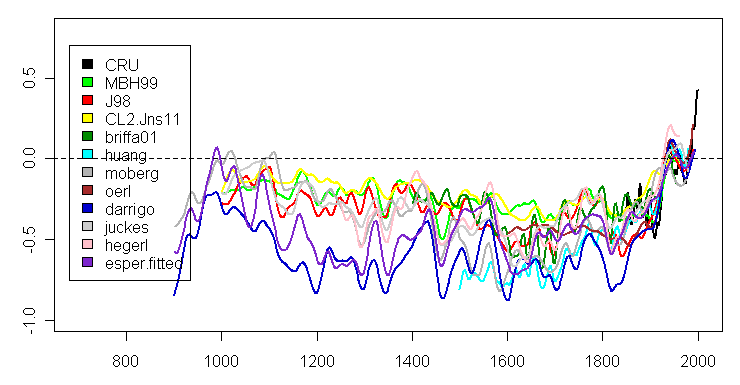
I’ve plotted up a version of the series in the Wilson spaghetti graph, together with URLs and a script from which original data for most of the series in the Wilson spaghetti graph can be downloaded together with read scripts. Wilson used a couple of grey versions (Hegerl, Juckes) although there are online versions of both, which may or may not equate to what I’ve used. In a few cases, I’ve had to re-post ASCII versions online at CA to deal with zip files that are hard to directly access. The script http://data.climateaudit.org/scripts/spaghetti/spaghetti.wilson07.txt will collect these files and make a coherent time series object called “spaghetti”. The data can also be read directly from an ASCII tab-separated file at http://data.climateaudit.org/data/spaghetti/wilson.newscientist.dat.

Most of the series already come using a 1961-90 reference period. Some are scaled against NH temperature north of 20N or 30N and some are scaled against NH temperature. This can cause a little difference in scales. The MBH99 series is archived in a 1902-1980 center. I am unable to locate any statement for Crowley 2000 or Hegerl et al 2006 which says what their reference period is. It’s not 1961-90. Crowley 2000 is almost certainly centered on the MBH period of 1902-1980; I think that Hegerl is as well, but I’m not sure. Juckes is also not 1961-90; I haven’t parsed it yet to see what he might have done and for now I’ve used the MBH 1902-1980 period, but may change this later.

The New Scientist headline for the spaghetti graph proclaims that “all suggest that it is warmer now than at any time in the past 1000 years”. Now several of these series do not extend to the MWP and shed no light on the matter one way or another: Oerlemans (only to 1600); Huang (only to 1500); Briffa 2001 (only to 1402) and Hegerl 2006 (only to 1251). The deletion of post-1960 Briffa 2001 values removes an inconvenient divergence in which the series reaches very low levels in the latter part of the 20th century. As discussed in connection with IPCC, the deletion of recent values makes these series look more unanimous in their ability to record temperatures than they truly are. The Wilson spaghetti graph in the 1961-1990 calibration period has all series below the zero mark, which surely can’t be right and suggests some peculiarity in his re-scaling method.


New Scientist version


Plot of Archived Data with MBH99, Crowley, Hegerl and Juckes re-centered as discussed above.

Year Study Archived Reference URL Input Script
2006 CRU3- NH 1850-2006 1960-90 http://www.cru.uea.ac.uk/cru/data/temperature/hadcrut3nh.txt source(scripts,"CRU3.txt")
1999 MBH99 1000-1980 (spliced to 1998 in Crowley spaghetti) 1902-80 ftp://ftp.ncdc.noaa.gov/pub/data/paleo/contributions_by_author/mann1999/recons/nhem-recon.dat source(scripts,"MBH99.txt")
1998 Jones98 1000-1991 1960-90 ftp://ftp.ncdc.noaa.gov/pub/data/paleo/contributions_by_author/jones1998/jonesdata.txt source(scripts,"J98.txt")
2001 Briffa01 1402-1960(!) 1960-90 ftp://ftp.ncdc.noaa.gov/pub/data/paleo/contributions_by_author/briffa1998/briffa2001jgr3.txt source(scripts,"briffa01.txt")
2002 Esper02 831-1992 Chronology ftp://ftp.ncdc.noaa.gov/pub/data/paleo/treering/reconstructions/n_hem_temp/esper2002_nhem_temp.txt source(scripts,"esper.fitted.txt") as esper02
2002,2004 Cook et al 2004 831-1992 1960-90 Not archived. Emulation calculated using 

ftp://ftp.ncdc.noaa.gov/pub/data/paleo/treering/reconstructions/n_hem_temp/esper2002_nhem_temp.txt
source(scripts,"esper.fitted.txt")
2000 Crowley 2000 1000-1993 1902-80 ? Crowley and Lowery 2000 is not archived anywhere. There are
two versions of Crowley 2000 one of which has an instrumental splice after
1870! This is the more common version.ftp://ftp.ncdc.noaa.gov/pub/data/paleo/gcmoutput/crowley2000/crowley_fig1_data.txt
as CL2.Jns11


source(scripts,"Cl2.Jns11.txt")
2005 Moberg 1-1979 1960-90 http://www.nature.com/nature/journal/v433/n7026/extref/nature03265-s6.doc source(scripts,"moberg.txt")
2006 Hegerl 1251-1960 ??
http://www.nature.com/nature/journal/v440/n7087/extref/nature04679-s2.xls
 
saved in ASCII format at

http://data.climateaudit.org/data/hegerl/nature04679-s2.dat


source(scripts,"hegerl.txt")
2007 Juckes    
http://www.clim-past-discuss.net/2/1001/2006/cpd-2-1001-2006-supplement.zip

First series extracted from mitrie_new_reconstructions_v01.nc and saved
to
http://data.climateaudit.org/data/mitrie/juckes.recon.txt
as "union"
series

source(scripts,"juckes.txt")
2006 D’Arrigo 713-1995 1960-90 ftp://ftp.ncdc.noaa.gov/pub/data/paleo/treering/reconstructions/n_hem_temp/nhtemp-darrigo2006.txt source(scripts,"darrigo.txt")
2005 Oerlemans 1600-1990 1960-90 ftp://ftp.ncdc.noaa.gov/pub/data/paleo/contributions_by_author/oerlemans2005/oerlemans2005.txt source(scripts,"oerlemans.txt")
2004 Huang 1500-1980 1960-90 ftp://ftp.ncdc.noaa.gov/pub/data/paleo/contributions_by_author/huang2004/nhtemp-huang2004.txt source(scripts,"huang.txt")

New Scientist, Juckes and Rob Wilson

Here’s something amusing in the New Scientist article, which includes a defence of the Stick. Their jpg is compiled by one Robert Wilson of the University of Edinburgh, who includes the reconstruction from Juckes 2006. Has Juckes been accepted or doesn’t this matter any more?

Like IPCC, Rob has failed to show 1960-1994 values of the Briffa 2001 reconstruction. Rob, if you’d like to issue a correction to this graphic, it would illustrate the Divergence Problem very nicely.

Also if Rob has used a common version of Crowley, as I discussed at CA some time ago here , Crowley spliced the instrumental record in the latter portion of his “reconstruction” so the yellow line shown by Wilson is not a “reconstruction” in its latter part but just a rendering of the temperature record giving a misleading impression of the success of this particular proxy set.

newsci44.jpg
New Scientist Spaghetti Graph

GISS Interruptus

GISS does not provide a coherent archive of station data (such as is available at GHCN.) As reported before, Nicholas developed a technique for downloading station data within R. Downloading the entire data set (which takes a minute or so from GHCN on a highspeed network) is laborious but automatic. I did this in the background and after about 8 hours had downloaded half of one version. In the middle of this, the program stopped working. It was hard to figure out why it stopped working. When I went back and tried to do things line by line, I found that it wasn’t reading. Now there had been a few missing records which caused my read program to file and to require restarting at the next record (this could be fixed but it seemed just as easy to restart if it didn’t happen too often). After a while, I checked some records that I’d already downloaded and these failed. I wrote to the GISS webmaster wondering about the 403 diagnostic. Continue reading