Gerry North Lecture in Boulder, Nov 2, 2007

Gerry North will be back in Boulder on Nov 2, 2007 delivering a lecture at CIRES at 4 pm on climate over the past 1000 years. The announcement says

A variety of evidence points to a gradual cooling of the planet from about 1000 AD to a few hundred years ago when it bottomed out. Over the last one hundred and fifty years the planet has been warming at an unusual if not unprecedented rate. The published evidence caused a groundswell of activity among climate change skeptics culminating in congressional hearings featuring battling assessments. A cadre of skeptics continues to joust at the consensus of scientific assessment that the climate is warming and that its cause is anthropogenic. Climate will continue its course of warming over this century modulated by our choices and the political will to curb greenhouse gases.

“Joust” seems to be the word de jour on the Island.

In addition to the NAS panel report itself, anyone interested in going to the lecture might be interested in a couple of presentations following up on the NAS panel report, discussed last year. Richard Monastersky of the Chronicle wrote an article on the report; he then had an interesting online “colloquy”, at which I asked a couple of questions (Gavin Schmidt also asked a question) – CA discussion

I asked the following question which seems quite prescient in light of our recent study of bristlecones at Almagre:

Question from Stephen McIntyre:
The NRC Panel stated that strip-bark tree forms, such as found in bristlecones and foxtails, should be avoided in temprature reconstructions and that these proxies were used by Mann et al. Did the Panel carry out any due diligence to determine whether these proxies were used in any of the other studies illustrated in the NRC spaghetti graph?

The answer, of course, is that the Panel carried out no such due diligence. In fact, all 4 studies used in their spaghetti graph used bristlecones – indeed 2 of the 4 even used Mann’s PC1. Here’s North’s answer:

Gerald North:
There was much discussion of this matter during our deliberations. We did not dissect each and every study in the report to see which trees were used. The tree ring people are well aware of the problem you bring up. I feel certain that the most recent studies by Cook, d’arrigo and others do take this into account. The strip-bark forms in the bristlecones do seem to be influenced by the recent rise in CO2 and are therefore not suitable for use in the reconstructions over the last 150 years. One reason we place much more reliance on our conclusions about the last 400 years is that we have several other proxies besides tree rings in this period.

If an engineer held this position and then used strip bark forms in a bridge design, he’d lose his licence. But hey, this is climate science.

There is also an online seminar in which North discusses the NAS panel report and the events leading up to it. His comments about me are somewhat schizophrenic – in some places, he talks well of me, and, we’ve got along decently whenever we’ve met and in email; and in other places, he makes quite condescending remarks. He gets a lot of facts wrong – he refers to this blog saying that it was started because we couldn’t get published. Actually the blog started after our GRL and EE2005 articles were published and largely in response to the severe non-peer reviewed criticism being launched against us as a preemptive strike by Michael Mann. This seminar was discussed last year here. Listening to it again, there’s some interesting material that I didn’t note up last year. I described the remarks that really caught my attention as follows:

At minute 55 or so, he describes panel operating procedure by saying that they “didn’t do any research”, that they just “took a look at papers”, that they got 12 “people around the table” and “just kind of winged it.” He said that’s what you do in these sort of expert panels. Obviously I suspected as much, but it’s odd to hear him say it.

When you put that together with their failure to do any due diligence whatever on use of strip bark trees in multiproxy reconstructions, it’s pretty disconcerting. It would be worth asking my colloquy question about strip bark one more time, specifically inquiring about the use by the NAS panel in their spaghetti graph of 4 studies all using strip bark trees and 2 of which used Mann’s PC1, without assessing the impact of the strip bark trees on these reconstructions.

Berkelhammer, Stott and Bristlecone dO18

Max Berkelhammer, a student of Lowell Stott ( a prominent and excellent researcher on ocean sediments) has been carrying out research on dO18 content of bristlecones in the White Mountains. His website shows that he has an article on this research that has been accepted for G3 and CA readers should pay attention to this article when it comes out.

His website has a number of interesting conference presentations on dO18 in bristlecone, from which today’s note is drawn. dO18 levels in White Mt bristlecones changed remarkably at the start of the 20th century.

This is entirely new and important data and their interpretation is highly interesting.

Continue reading

American Statistical Association Climate Change Workshop, Oct 26-27, 2007

I just learned (too late) about an interesting workshop sponsored by the American Statistical Association this weekend in Boulder.

The announcement last summer stated:

The American Statistical Association (ASA), the nation’s preeminent professional statistical society, today announced it will sponsor a two-day climate change workshop featuring 20–25 leading statisticians and atmospheric scientists. The event, sponsored by the ASA’s Science and Public Affairs Advisory Committee (SPA) and the ASA Section on Statistics and the Environment (ENVR), will take place October 26-27 at the National Center for Atmospheric Research in Boulder, Colorado. David Marker, SPA chair, and Mary Christman, ENVR chair, will facilitate the workshop.

Understanding climate change requires the combined skills of atmospheric scientists and statisticians, Marker said. The former understand the physical relationships being investigated, while the latter know how to determine which hypotheses are strongly supported and which are still subject to uncertainty. By bringing together researchers from these two communities, we can identify where there is consensus and where future research needs to focus.

Caspar Ammann was invited, but not me. On the list were Ed Wegman, Gerry North, Doug Nychka.

I wasn’t previously familiar with the ASA section on Statistics and the Environment, but I plan to make some efforts in this direction. Their newsletter from earlier this year had a very interesting account by Richard Smith of North Carolina of a packed session at the 2006 ASA meeting discussing statistics and climate change, to which Wegman, Mike Wallace of the NAS panel and Smith himself spoke. Given the ignoring of Wegman by the climate change community, it’s interesting to read an account of the matter from an eminent statistician, who obviously could not ignore someoone of Wegman’s eminence. It’s also (and unusually) a balanced account which catches many, but not all of the nuances. Smith introduced the session as follows:

“What is the Role of Statistics in Public Policy Debates about Climate Change?” that was organized jointly by Edward Wegman (George Mason University) and myself at the 2006 Joint Statistical Meetings. The session took place in front of a standing-room-only audience and was chaired by Doug Nychka (National Center for Atmospheric Research).

Smith observed:

At the core of the controversy is an incorrect use by Mann et al. of principal components (PCs).

Note that there is no nuance here – Smith agrees with Wegman that the Mann et al method was incorrect. He then considered the argument that the error doesn’t not “matter” together with Wegman’s rebuttal:

A number of other commentators have acknowledged the flaws in the Mann reconstruction but have argued that this does not matter because the answers have been verified by other analyses. Ed’s own response to that was given in the equation:

Method Wrong + Answer Correct = Bad Science.

In other words, the fact that the answer may have been correct does not justify the use of an incorrect method in the first place.

Both Wegman’s talk and Smith’s account of it correctly noted that the issues with Mann et al were not just principal components, observing almost but not quite accurately:

Ed also touched on some of the other controversies in Mann’s work. Some of the proxies had been criticized as inappropriate. For example, bristlecone pines are known to be CO2 fertilized, creating a possible confounding problem if they are used in temperature reconstructionA figure from Mann’s own website suggested that the medieval warm period reappeared if bristlecone pines were excluded from the reconstruction. Other studies had shown a “discomforting array of different results” in the reconstructions obtained with minor methodological variations.

I presume that what was meant here is that Mann’s CENSORED directory (which we deduced contained calculations without bristlecones) did not have a HS shape. Based on our recent sampling in Colorado, it appears that the bristlecone problem may relate more directly to the strip bark phenomenon, as opposed to CO2 fertilization. In our discussion of bristlecones, while we noted that CO2 fertilization had been raised as an issue, we noted that the real issue was the non-robustness to a proxy known to be problematic – and that any use of this proxy as a worldwide thermometer should be preceded by a concerted effort to know everything possible about bristlecone pine growth. Smith then quickly reported on Wallace’s talk. On other occasions, I’ve quoted North’s answer to a question from Barton in which he stated that he agreed with the Wegman report. Wallace said the same thing:

In Mike’s view, the two reports were complementary, and to the extent that they overlapped, the conclusions were quite consistent.

The language in Wegman was much more straightforward, but Wallace’s statement, together with North’s statement, demonstrate that the NAS panel did not disagree with any of Wegman’s clearly stated findings. Wallace also said:

The NRC report reviewed a number of other reconstructions of the temperature record based on proxy observations and believed that the Mann et al. claim that the last two decades were the warmest of the last 1000 years was entirely plausible.

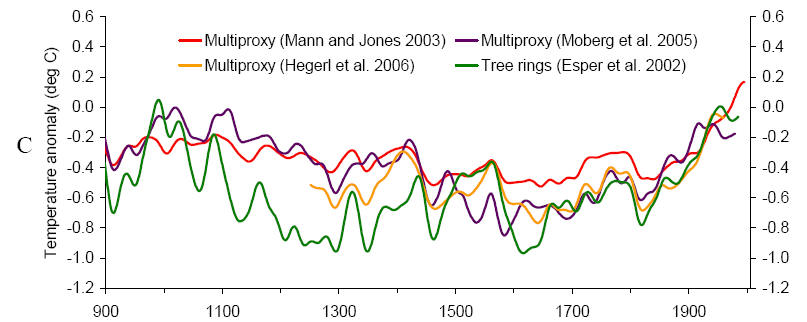
As I’ve observed elsewhere, the “review” carried out by the NRC panel does not seem to have constituted anything more substantive than simply reviewing the literature one more time. The “other” series that they used in their own spaghetti graph all used strip bark bristlecones/foxtails (Mann and Jones 2003; Hegerl et al 2006; Moberg et al 2005; and Esper et al 2002) – see below.

worksh10.jpg
NRC Panel Figure O-5 (C).

It seemed bizarre to me at the time that the panel could recommend that strip bark trees be “avoided” in reconstructions and then use as evidence “supporting” the Mann result reconstructions that used strip bark trees. Worse, two of the 4 studies illustrated here (Mann and Jones 2003; Hegerl et al 2006) actually use the Mann PC1 that had been specifically rejected as incorrect methodology. You have to probe beneath the surface of Hegerl et al to determine that their “W USA” series was really Mann’s PC1, but it was. It still seems bizarre to me that the NRC panel could be so indifferent to performing any due diligence, given their charge. North said in a seminar that they just “winged it”, explaining that’s what you did in these panels. Given the fact that NRC reports are accorded great weight in legal proceedings, it would certainly be more re-assuring if NAS panel chairs at least gave lip service to due diligence requirements, and, even more reassuring, if they actually performed the due diligence that the public presumes that they did.

Smith observed:

while there is undoubtedly scope for statisticians to play a larger role in paleoclimate research, the large investment of time needed to become familiar with the scientific background is likely to deter most statisticians from entering this field.

In the end, it’s important not to lose sight of the forest for the trees, where the “forest” refers to the totality of scientific evidence for global warming.

As someone who’s actually made the “large investment of time” to become intimately familiar with all the proxy issues, you’d think that they might have invited me to this workshop. On the other hand, I’m not a member of the ASA, but it’s probably something that I should belong to. I’ll make an effort to introduce myself to the chairs of the workshop by email and see what happens.

As to the last sentence, I agree that it’s important not to lose sight of the forest for the trees. As a reviewer for AR4, it was my position that, if the paleoclimate issues were not relevant to the policy issues, then the Paleoclimate (and the hockey stick discussion) should be deleted from AR4 so that people could focus on what were the “real” arguments. The IPCC “consensus” was presumably that the paleoclimate arguments remained important and that’s why the chapter remained, despite my suggestions that it be deleted.

He concluded with the announcement of the workshop just held as follows:

Second, there will be an ASA workshop of invited participants whose purpose is to establish “A Statistical Consensus on Global Warming,” organized by Dr. David Marker, Chair of the ASA Science and Public Affairs Advisory Committee, and Dr. Mary Christman, Chair of the ASA Section on Statistics and the Environment, with the sponsorship of the ASA Board and the co-sponsorship of the Section on Statistics and the Environment. This workshop is planned for the fall of 2007 and should deliver its report by early 2008.

Given that the Richard Smith article specifically cites McIntyre and McKitrick in connection with this topic, it does seem peculiar that neither Ross McKitrick nor myself were invited.

The Arabian Splice

One of the reasons why scientists have been so quick to use tree ring information despite all the problems is that, for the most part, there is excellent dating control on tree ring chronologies, something which can be problematic in other proxies.

Today I want to document some notes on dating the Arabian Sea G Bulloides. In this case, although Moberg (and Juckes) present one series in their data sets, this series actually results from a splice of information from two different cores – a splice not actually made by the original authors (although one of their figures is suggestive), but by Moberg. But how legitimate is it to splice the two cores?

Today I’ll look at some potential problems with homogeneity of the splice and also with even dating the cores. Continue reading

Eli Rabett Explains Why RealClimate Scientists Can't Update the Proxies

realclimate apologist Eli Rabett explained at Tamino why real climate scientists haven’t updated the bristlecones:

You hike out to the ass end of nowhere, take a core (from the right tree, and bring it back. Now you have to analyze it. . . . . .

Sure sounds like a lot of work for a real climate scientist. Also that analysis thingee – that doesn’t sound like something that’s in the job description of a real climate scientist.

Of course, if you don’t want to hike, you can drive to many of the bristlecone sites (though not the foxtails) – which also happen to be in scenic country: at least the Colorado ones were. Yeah, yeah, you burn some fuel driving to the sites, but not as much fuel as going to an international climate conference. I also understand that some of the IPCC delegates were a bit concerned that the food quality at the Ritz Carlton in Paris this year was not up to their expectations.

More on Arabian Sea G. Bulloides

On an earlier occasion, I observed that one of the key Moberg series (and now an essential Juckes series) was the Arabian Sea percentage G. Bulloides series. At the time, I observed that G. Bulloides was an indicator of cold water. In the Arabian Sea, the surface water offshore Oman (where the core used in Moberg was obtained) became much colder during the summer monsoon because of upwelling of deep (cold) water and the percentage of G. Bulloides increased. Here are two graphics from Conan and Brummer 2000 used in my earlier post to illustrate this. Note that these cover only a 210 day period from the start of June to the middle of February. However, one can readily see that high G Bulloides percentages are associated with cold water and low G Bulloides percentages are associated with warm water.


Left: Temperature history; right – percentage G Bulloides.

As an exercise, I manually estimated the temperatures and G Bulloides percentages in the above diagrams and made the scatter plot below for 10 day interpolations, to show the negative relationship between water temperature and G. Bulloides percentages. The trend in the slope is more than a 5% decrease in percentage G Bulloides for each one degree increase in SST.

arabia2.gif
Scatter plot of data from Conan and Brummer 2000 diagrams above.

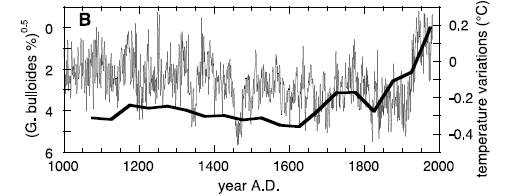
So how would a proxy for cold water become one of the most important contributors to the Moberg (And Juckes) reconstructions of NH temperature? The shortest answer is that it has a hockey stick shape – indeed, the HS-ness of the proxy was observed in an early publication of this data in which it was actually overlaid against the MBH hockey stick as shown below. (Overpeck, the second author of this article, has been rumored to be the person who told David Deming about “getting rid of the MWP”.)

arabia61.gif
Anderson, Overpeck et al 2002. Fig. 2. (B) Time series of Northern Hemisphere temperature variations from (28 – MBH) (thin line) superimposed on the index linearly related to monsoon wind speed, the square root of the difference in composite G. bulloides abundance with respect to the 1975 average (thick line).

Now there’s nothing intrinsically objectionable about the idea that increased Asian monsoon levels can be associated with higher extratropical NH temperatures and there is certainly evidence in favor of such a hypothesis. If that were the case, then the increased Asian monsoon levels would be associated with upwelling offshore Oman and necessarily colder water in this particular locale. So that would imply that if you looked at SST records from HadSST and NOAA that one would see increased prevalence of cold water in the offshore Oman gridcell. What do you suppose the chances of that would be?

Here are plots of the corresponding gridcell from CRU and NOAA. Naturally, nothing ties together and, indeed, the discrepancies in the graphic merit detailed investigation. Both series show warming water – OK, but how does one explain the supposed increase in G Bulloides percentage. If the proxy is measuring changes in the 20th century, then there should be an increase in cold water because of increased upwelling (and the majority of sediment production is in the cold water season). In addition, the temperature increase at CRU since World War II is nearly half a degree greater than at NOAA – why is that? And what of the very high SSTs prior to World War 2 (there is negligible HadSST data for World War 2)? What does it signify?

arabia4.gif

Ryan Maue's 2007 ACE Estimate

A non-global warming explanation for the lack of moisture/drought in the US Southwest deals with the lack of Hurricane activity in the Eastern Pacific basin. The moisture, upper-level outflow, and accentuation of the monsoon can all be traced back partially to EPAC storms, which are highly sensitive to SST conditions in the equatorial Pacific (ENSO). Simple reanalysis calculations for inactive minus active EPAC seasons shows very significant deficits of monthly mean cloud water, precipitable water, and surface specific humidity (among a host of other variables) for Aug-Sept months over the US Southwest.

This image is constructed as follows: I take the Accumulated Cyclone Energy over the Easter Pacific TC basin for the months of July – September (Oct is usually quiet). I calculate the seasonal deviations from the 1979-2007 mean EPAC ACE — which is fairly bimodal — as one would expect with the sensitivity to ENSO. I then take the active and inactive years (0.5 sigma) and composite the August & September column cloud water (or any other variable) differences (date obtained here from Japanese Reanalysis Project; one could use NCAR/NCEP or ERA40). So, I have 10 years of active and 9 years of inactive ACE years in the EPAC. The following example shows that a greater than 20% difference in cloud water is associated with whatever is concomitant with active vs. inactive EPAC hurricane seasons. This means that a researcher or a responsible journalist would ask: what weather patterns or climate regimes are typically associated with decreased rainfall in the Southwest US, which is a desert, if anyone cared to notice? Instead you get hyperbolic, speculative propaganda about an “upcoming century of fires”.

epac clouds

Despite what Harry Reid says and no matter how hard CNN pushes the Planet in Peril to link global warming to these fires (also NBC, CBS, ABC and the rest of the so-called mainstream media), it is partially the lack of hurricanes that has contributed to the excessive drought conditions — talk about an inconvenient truth. And, by the way, the Northern Hemisphere Tropical Cyclone activity is still on pace to be the weakest since 1977 — Tropical Activity

Strip Bark at Upper Wright Lakes Foxtails

As a sort of Methadone replacement for Mann’s bristlecone PC1 (which uses Graybill’s strip bark chronologies), two Esper foxtail chronologies (Upper Wright Lakes and Boreal Plateau) have come into use by the Team. These two chronologies were used separately in the small Esper network (two of only 7 or so medieval chronologies) making a very distinct impact on the medieval-modern relationship. Subsequently, they were used as an average by Osborn and Briffa 2006 (which also used Mann’s PC1), thereby keeping the bristlecone-foxtail representation on the council at 2 of 12. They were also used as an average in Hegerl et al 2006, which , like Osborn and Briffa, also used Mann’s PC1, keeping the representation of these tees on the council at 2 (of 12, fewer in the MWP). They were used individually in the Juckes et al 2007 Union reconstruction, once again keeping representation on the council at 2 (of 12).

Graumlich herself did not publish a temperature reconstruction from these sites. The Team typically cites Lloyd and Graumlich 1997 as authority, but it doesn’t actually justify the use of these chronologies as a temperature proxy and doesn’t even present the chronologies now used. Lloyd and Graumlich 1997 discuss treeline changes, observing that the medieval treeline was higher than at present. Graumlich 1991 – which IPCC reviewers cited in their “justification” of continuing to use Mann’s PC1 – used nearby (but different) chronologies; she criticized the Lamarche-Graybill CO2 fertilization hypothesis observing that her chronologies did not show the 20th century growth pulse of the Graybill chronologies. After a number of years of effort on my part, some Graumlich foxtail measurement data was archived in May 2007 – a small bit of progress which I noted at the time, The archived information includes the measurements used by Esper (and subsequent Team articles relying on the Esper versions) , but not the earlier information used in Graumlich 1991 (where 20th century growth was said not to be anomalous).

After noticing the remarkable difference in core widths within one strip bark tree in Tree 31 from our drilling at Almagre, I examined the data from Upper Wright Lakes (and Boreal Plateau) and noticed similar divergence between individual cores in some trees where two cores were archived. I sent an email to Andrea Lloyd observing the similarity in pattern in some Upper Wright trees to strip bark Almagre trees and inquired whether the trees at Upper Wright Lakes with similar patterns were also strip barked. I got a very cordial reply in which she said that the hypothesis was “intriguing!”, that she recalled that some trees had strip bark and undertook to examine her notebooks. She has now sent some very interesting fresh information from her notebooks. Pay particular attention to UFA003 and UFA004 below.

On a personal note, and it’s funny how small the world is sometimes, the daughter of one of my best friends is at Middlebury and took classes from Andrea Lloyd as a freshman. She plays hockey for Middlebury BTW. The daughter had previously mentioned to Lloyd that a family friend was involved in hockey stick matters prompting a discussion, so I probably got a little more sympathetic hearing than I’ve received at Tucson. A Middlebury sophomore assisted with our day two coring at Almagre as well. Continue reading

Melbourne's Historic Weather Station

melbmetrolookingeast.jpg

Until now, most of the surface temperature measurement stations I’ve highlighted as substandard locations for measuring temperature accurately have been in the USA. Today, courtesy of Geoff Sherrington, we are treated to the sight of the main Australian historic site, Melbourne metropolitan, near LaTrobe St, Melbourne. He reports it has max-min temp records daily since 1855 to late 2007.

Yet look at the pictures, this station is only 2 meters from a sidewalk, and a couple of meters more from a major street intersection and voluminous traffic. Hardly the best place to measure temperature. This site demonstrates the growing trend of climate monitoring stations that have been gradually surrounded by increasingly closer urban influences, and demonstrates that the problem is not unique to the USA.

Here are some additional pictures, click for large versions.

melb-latrobe-south-closer.jpg

melblatrobeswasphalt.jpg

And a satellite image of downtown Melbourne showing the intersection is available at Windows Live Maps

UPDATE: Kristen Brynes has offered a couple of photos she had available taken from different angles of the same site, see them below. Thanks Kristen.

melbourneausnw.jpg

melbourneausse.jpg

Additionally, the Lat/Lon of this station is:

-37.8075, 144.9700

A PDF document from Australias BOM lists the METADATA for this site and is available here

Steve: GHCN reference info is

50194868000 MELBOURNE -37.82 144.97 113 29U 2579FLxxCO 5x-9WARM FOR./FIELD C

IPCC AR4 and the Return of Chucky – He’s Baaack!

Here’s something I meant to post up when AR4 came out. I was reminded of this when Rob Wilson posted recently:

Lastly, lets not forget that TR based reconstructions of NH temperatures exist that do not use Bristlecone pine or Foxtail data.

Rob’s point here is very disingenuous (to use Mann-speak) since millennial reconstructions are addicted to bristlecones and foxtails. Reconstructions using them include not just MBH98-99 (which is not robust to the presence/absence as admitted by even Wahl and Ammann); but also Crowley and Lowery 2000 (two bristlecone series, including Almagre); Esper et al 2002 (two foxtail series); Mann and Jones 2003 (Mann’s PC1); Rutherford et al 2005 (Mann’s PC series flagrantly unamended); Moberg et al 2005 (3 bristlecone series); Hegerl et al (Mann’s PC1 and the Esper foxtail average); Osborn and Briffa 2006 (Mann’s PC1 and the Esper foxtail average); Juckes 2007 (the two Esper foxtail series in his Union reconstruction). In each of the studies where Mann’s incorrect PC methodology is not used, there are only a small number of series used (6-18 in the medieval portion). Can a couple of strongly HS series mixed with white or low-order red noise in a CVM procedure yield a HS recon? Readers of this blog know the answer to this, although “professional” climate scientists seem mostly unfamiliar with the statistical issues.

There are only 3 reconstructions in which foxtails and/or bristlecones do not play a role: Jones et al 1998; Briffa 2000; Briffa et al 2001; and D’Arrigo et al 2006. Without the bristlecones, Briffa et al 2001 has a pronounced Divergence Problem and the Team has taken to truncating the record in 1960 (or even in 1940 in Juckes et al). As noted elsewhere, Briffa 2000 and D’Arrigo 2006 have virtually identical medieval rosters and cannot be said to be even somewhat independent in their medieval-modern comparison: in each case, the medieval-modern relationship is changed merely by using the Polar Urals Update (instead of Briffa’s tricky Yamal substitution). In this case, the proxy was updated; the Team didn’t like the answer and so the update was never published as a separate study; they changed the proxy instead. Splicing is the main issue in Jones et al 1998.

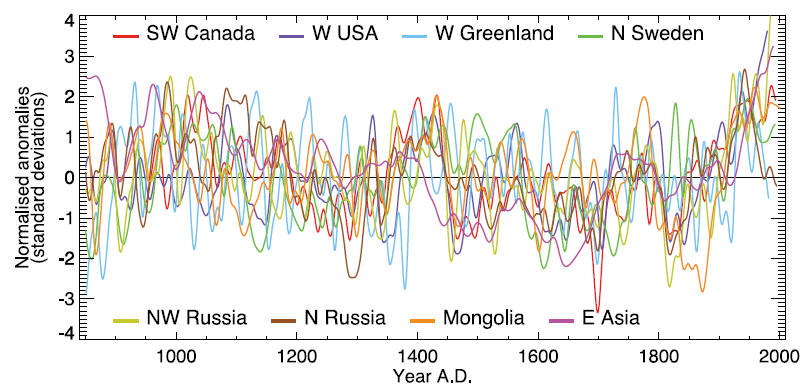
Anyway on to the proxies shown in AR4. Here is their Box 6.4 Figure 1. I think that I’ve discussed their proxy spaghetti graph before. It shows 8 series specified only with a rather vague caption – for example, does “W USA” adequately enable a reader to locate a proxy, even if he knows that it was used in one of Mann and Jones (2003), Esper et al. (2002) and Luckman and Wilson (2005)?
box6_461.jpg

Box 6.4, Figure 1. The heterogeneous nature of climate during the ‘Medieval Warm Period’ is illustrated by the wide spread of values exhibited by the individual records that have been used to reconstruct NH mean temperature. These consist of individual, or small regional averages of, proxy records collated from those used by Mann and Jones (2003), Esper et al. (2002) and Luckman and Wilson (2005), but exclude shorter series or those with no evidence of sensitivity to local temperature. These records have not been calibrated here, but each has been smoothed with a 20-year filter and scaled to have zero mean and unit standard deviation over the period 1001 to 1980.

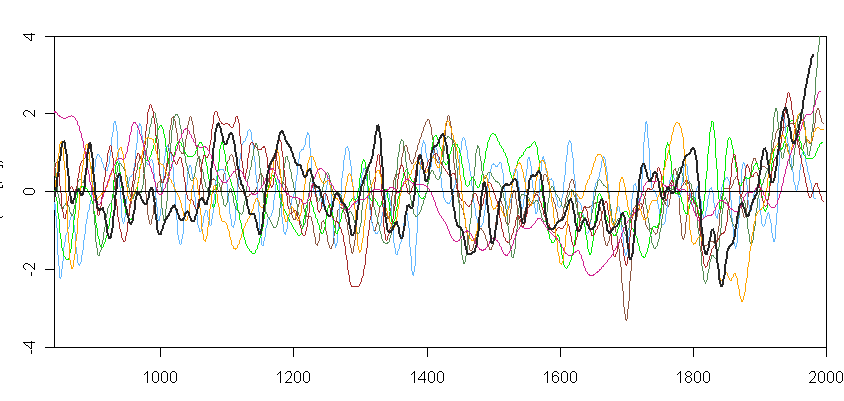
Because I know my way around the proxies, I can decode these clues. First, I knew from a previous iteration of the diagram that it’s drawn from the data versions used in Osborn and Briffa 2006 (Briffa is the IPCC lead author here). Here’s my replication of the above figure, which is pretty accurate up to nuances of color palette. In this case, I’ve taken the smoothed version of archived data from Briffa and Osborn 2006 (the smooth said to be a 20-year smooth) and then smoothed it one more time with another 20-year smooth. With only one generation of 20-year smooth, I don’t get as close a match; so it looks like IPCC has done two smooths (and only reported one.) Here is my concordance to known series (from Osborn and Briffa 2006 versions): SW Canada- Luckman-Wilson Jasper/Athabaska/Alberta; W USA- Mann PC1; W Greenland – Fisher dO18; N Sweden – Tornetrask; NW Russia – Yamal; N Russia – Taimyr; Mongolia – Jacoby Sol Dav; E Asia – Yang composite. All of these are typical stereotypes (see for example my predictions for what Hegerl et al 2006 would use or Wegman Figure 5.8).

Note that Mann’s PC1 (shown here in black) is illustrated in IPCC AR4 as large as life, sort of like Chucky – I’m baaaack. Even the explicit statements in the Wegman Report and the NAS Panel that the Mann PC1 was calculated using incorrect and biased methodology was insufficient to kill off Mann’s PC1. Actually, it’s return is not just in AR4; as I’ve noted before, it’s been used more often in multiproxy reconstructions since being discredited (Rutherford et al 2005; Osborn and Briffa 2006; Hegerl et al 2006; Juckes et al 2007) than before. It’s as though the Team has gone pro-Chucky in a seeming show of solidarity against even the NAS and Wegman reports.
box6_462.gif
Figure 2. My emulation of IPCC Box 6.4 Figure 1 using Osborn and Briffa 2006 data, smoothed twice with gaussian 20-year filter. Chucky is shown in heavy black.

We all hear about how IPCC reports reflect the views of stadiums full of reviewers. Given that Box 6.4 Figure 1 used Mann’s flawed PC1, do you suppose that multiple reviewers drew this defect to the attention of the section authors? Well, surprise, surprise, only one reviewer actually commented on the Briffa spaghetti graph. You’ll never guess who. And his anti-Chucky comments were disregarded by the Team. Reviewer comments in italics; IPCC response in blockquote; today’s comments in ordinary face.

6-1114 B 0:0 0:0 As a matter of prudence, it seems risky to me for IPCC to permit section lead authors to publicize and rely heavily on their own work, especially when the ink is barely dry on the work. In particular, Osborn and Briffa 2006, which is by one of the section lead authors, was published only in February 2006 and is presented in the Second Order Draft without even being presented in the First Order Draft. Nonetheless, it has been relied on to construct the important Box 6.4 Figure 1. This is risky. Osborn and Briffa 2006 uses some very questionable proxies, including the infamous Mann PC1. I have also been unable to verify some of the claimed correlations to gridcell temperature. One of the authors’ excuses is that they incorrectly cited the HadCRU2 temperature data set, while they actually used the CRUTEM2 data set and that the some of the HadCRU2 data was spurious. This hardly gives grounds for comfort. The point made in Box 6.4 Figure 1 is also argumentative. If the relative warmth of MWP and modern periods is inessential to any conclusions reached by IPCC, I would urge you to delete this Figure and related commentary. [Stephen McIntyre (Reviewer’s comment ID #: 309-11)]

Noted, MWP figure changed. Although much of the claims in the comment concerning the proxies are not share, we have chosen to change the figure somewhat to reduce reliance on a specific paper.

What did they change? They merely reduced the number of proxies in the spaghetti graph. In what meaningful sense did that “reduce reliance on a specific paper”?

The caption says that Box 6.4 Figure 1 excludes “those with an ambiguous relationship to local temperature”. This is not the case as set out in some following comments. [Stephen McIntyre (Reviewer’s comment ID #: 309-38)]

See responses in appropriate sections

6-1143 B 29:14 29:14 One of the most prominent series on the right hand side of Box 6.4 Figure 1 is Mann’s PC1, which uses his biased PC methodology. It is so weighted that the series is virtually indistinguishable from the Sheep Mountain bristlecone series discussed in Lamarche, Fritts, Graybill and Rose (1984). These authors compared growth to gridcell temperature and concluded that the bristlecone growth pulse could not be accounted for by temperature, hypothesizing CO2 fertilization. Graybill and Idso (1993) also stated this. One of the MBH coauthors Hughes in Biondi et al 1999 said that bristlecones were not a reliable temperature proxy in the 20th century. IPCC Second Assessment Report expressed cautions about the effect of CO2 fertilization on tree ring proxies, which were not over-ruled in IPCc Third Assessment Report. At a minimum, the relationship is “ambiguous”. In addition, I tested the correlation of this series with HadCRU2 gridcell temperature and obtained a correlation of 0.0. Osborn and Briffa say that they themselves did not verify the temperature relationship for this data. Why not? At any rate, in this example, the authors have not excluded an important series with a well-known “ambiguous” relation to temperature. [Stephen McIntyre (Reviewer’s comment ID #: 309-39)]

Rejected – the purpose of this Figure is to illustrate in a simple fashion, the variability of numerous records that have been used in published reconstructions of large-scale temperature changes. The text is not intended to give a very detailed account of the specific limitations in data or interpretation for each. Furthermore, though there is an ambiguity in the time-dependent strength of the response of Bristlecone Pine trees to temperature variability, there is other evidence that these trees do display a temperature response . Right or wrong, Mann and colleagues do apply an adjustment to the western trees PC1 in their (1999) analysis to account for possible CO2 fertilization. Other authors ( Graumlich et al ., 1991) assert that the recent rise in some high elevation conifers in the western U.S. could be explained as a temperature response (she can not confirm the LaMarche et al findings). The issue is clearly complex , as will be noted in a new paragraph on tree-ring problems that will be added to the text .

How absurd is this response – and see how tricky they are. Here they concede that there is an “ambiguity in the time-dependent strength of the response of Bristlecone Pine trees to temperature variability”. But didn’t they already say that the figure excluded those series with “an ambiguous relationship to local temperature”? They kept Mann’s PC1 in and changed the language: the Second Draft caption said that they excluded “shorter series or those with an ambiguous relationship to local temperature”. They changed this to read “exclude shorter series or those with no evidence of sensitivity to local temperature”. What did they drop from the Second Draft version? Four shorter series used in Osborn and Briffa 2006: Mangazeja, Tirol; van Engeln documentary; Quebec. They dropped two long series: Chesapeake Mg-Ca – used repetitively in the various studies; and the Esper foxtail version. I’ve taken pains in various comments not to limit criticism of bristlecones to CO2 fertilization issues – a point that seems prudent as closer examination of the Almagre data shows that the problem with bristlecones seems to be related to strip bark per se, rather than fertilization.

Graumlich 1991 is a bait-and-switch. Graumlich 1991 did not discuss Mann’s PC1, but other series which did not show a material increase in temperature. Yes, she did criticize CO2 fertilization, but largely on the grounds that she was then unable to discern the rise in ring widths claimed by Graybill in other high-altitude series. (The sites in Graunlich 1991 are unarchived and are different than the archived sites.) Graunlich 1991 also discusses a multiplicative response of foxtails to precipitation as well as temperature, noting that precipitation was the strongest factor.

6-1144 B 29:14 29:14 Another prominent series on the right hand side of Box 6.4 Figure 1 is a foxtail series (which interbreed with bristlecones) from a site within a few tens of miles from the Sheep Mountain bristlecone site. They do not explain why two similar series from so close are used, rather than being composited, if they are to be used at all. I checked the correlation of this data to HadCRU2 gridcell temperature and only obtained an insignificant correlation of 0.04. The authors said that they had cited the temperature data incorrectly, that they had actually used CRUTEM2 yielding a correlation of 0.19 and that HadCRU2 data was spurious in its early portion (1870-1887) because there was no station data. However there is station data at GHCN going back to the data in HadCRU2. D’Arrigo et al 2006 considered using foxtails and rejected the use of this data because it did not meet standards of being correlated to gridcell temperature, expressed in very similar terms to Osborn and Briffa 2006. The contrasting views of D’Arrigo et al 2006 certainly establish that the relationship is “ambiguous” and that this proxy should not be used on multiple grounds. [Stephen McIntyre (Reviewer’s comment ID #: 309-40)]

See response to comment 6-1143. Some of what the reviewer says may be true, but is as yet unpublished and the current review is based on multiple strands of evidence, among which the results of Mann and colleagues remains relevant.

Jeez, this shows one more time the problems of having lead authors promote their own work. In this case, the explanation came from Osborn and Briffa (recounted previously at CA) and came only after many requests to Sciencemag. Briffa is responsible for his own results and has an obligation not to report misleading results; whether I “published” these particular results is irrelevant to Briffa knowing that the observations were correct – which he more or less concedes – and then ignores.

6-1145 B 29:14 29:14 The beige series which has the strongest closing uptick in Box 6.4 Figure 1 is the Yamal series. When I plotted this series smoothing with a 30-year gaussian filter, I was unable to exactly replicate the uptick shown in this version. I checked the relationship of this series to gridcell temperature and was completely unable to replicate the claimed (0.49) correlation to temperature, obtaining only a correlation of 0.12. The authors here have used data from Yamal, while they used gridcell data from Polar Urals. There is an updated version of the Polar Urals series, used in Esper et al 2002, which has elevated MWP values and which has better correlations to gridcell temperature than the Yamal series. since very different results are obtained from the Yamal and Polar Urals Updated, again the relationship of the Yamal series to local temperature is “ambiguous” [Stephen McIntyre (Reviewer’s comment ID #: 309-41)

See response to comment 6-1143 and note that the Polar Urals and Yamal series do exhibit a significant relationship with local summer temperature.

6-1150 B 29:23 29:23 The same problems characterize these other studies as Osborn and Briffa. You should say: It is also possible that the proxies are so noisy that very little can be concluded from such graphs. [Stephen McIntyre (Reviewer’s comment ID #: 309-46)]

Rejected – the presentation of data in the Figure in Box 6.4 allows the reader to gauge the hetergeneity of the data and the reference to Figure 6.10 (and text) provides the reader with a realistic interpretation of the analyses of these data.