The NAS Panel on Data Availability

One of the by-products of data stonewalling by Team climate scientists was the appointment of a NAS panel entitled “Ensuring the Utility and Integrity of Research Data in a Digital Age”, noted up a couple of years ago at CA here. According to its webpage, the panel’s last hearing was in late 2007.

The webpage also states:

This project is sponsored by The National Academies.
The approximate start date for the project is 01/02/2007.
A report will be issued at the end of the project in approximately 12 months.

The study will not address privacy issues and other issues related to human subjects.
Update 2-29-08: The project duration has been extended. The report is expected to be issued by July 1st, 2008
As of 7-1-08, the project duration has been further extended and the report will be issued in fall 2008.
Update 1-9-09: The project duration has been extended. The report is expected to be issued by April 1, 2009.
Update 4-10-09: The project duration has been extended. The report is expected to be issued by June 1, 2009.

Anyone care to venture an over-under on whether they will issue another update announcing a postponement of the report. Maybe they could join forces with the PR Challenge.

EPA, CCSP and Hurricanes

IN SPACE - SEPTEMBER 2:  In this satellite ima...
Image by Getty Images via Daylife

Here’s a personal beef about a small point in the hurricane debate which CA readers may recall, which came to mind out of the EPA finding and Technical Support Document, which have a LOT to say about hurricanes and which rely relying on CCSP 3-3. (Perhaps I’ll review this on some occasion.)

CCSP 3-3 reviewed a 2005 dispute between Emanuel and Pielke over the seeming inconsistency between the lack of trend in US landfalling hurricanes and increased basinwide trends. Emanuel (2005b) responded to Pielke’s criticism by arguing that the US landfalling data set was only 1% of the total data set and that greater reliance should be placed on the larger data set.

In comments at CA in 2007, I observed that this effect was not limited to the US landfalling dataset. When the entire HURDAT set (the one used by Emanuel) was analyzed in spatial quintiles, there was no trend in a range of statistics (hurricane-days, storm-days) in the western quintiles adjacent to landfall, with the entire increase taking place in the eastern and mid Atlantic remote from habitation.

This was written up by Roger Pielke and I and submitted to GRL. Here is a relevant quote:

Upward trends in storm-days, hurricane-days, and power dissipation occur only in the east Atlantic (east of 73W), while west of 63W, these metrics have no trend or declining trends, consistent with a similar lack of trend in U.S. landfall …

Emanuel 2005b argued that lack of a trend in U.S. landfall PDI (identified by Landsea 2005) corresponding to the overall increase in NATL PDI was likely a random fluctuation, suggesting that the HURDAT track data contained “about 100 times more data” than the landfall data set and that his results accordingly had “a signal-to-noise ratio that is ten times that of an index based on landfalling wind speeds.” In other words, the landfall data might simply reflect the randomness of a small subset of the overall HURDAT basin data. However, our analysis shows that there is no inconsistency between the lack of landfall trend and the lack of trend in the western quintiles using the same HURDAT data employed by Emanuel.

Reviewers were violently opposed to the article, stating on the one hand that the statistical analysis was “fraudulent” and on the other hand that the results were already well known in the literature. (I think that Holland of UCAR, whose work was criticized) was one of the reviewers.) The editor, Famiglietti, said that there was a consensus and rejected the article without offering any opportunity for remediation.

I was quite shocked by the reviews and sent the correspondence to Emanuel. Emanuel replied very cordially:

I do think you have found something interesting that deserves to see the light of publication, and you should try again. I know that Christina Holland and Rob Scott at U. Texas, who found a similar eastward trend in genesis, have also had great difficulties getting their paper published…I do not know if they ultimately succeeded. You might try the QJRMS..in my opinion a very good journal, which being based in England may be far enough from the craziness to get a fair hearing.

We also sent a copy to Jim Kossin who also replied cordially:

Roger/Steve,
Please keep me posted on the progress of your manuscript dealing with the eastward shifting of activity. I’m revising our AMM/genesis region manuscript and I’d like to reference your paper if possible. I am referencing Landsea’s latest Eos paper, so either way, the issue of missing data versus climatic modulation will be addressed with appropriate citations, but it would be good to include your paper too for better balance.
Regards, Jim

Roger suggested submitting it elsewhere, but by this time I was working on other topics and didn’t pursue it. Many people criticize me for not “publishing” more, by which they of course mean “publishing more” in the academic journals as, of course, it’s not like I’m just scratching notes to myself; I “publish” something on the blog nearly every day, though I realize as well as anyone that the blog corpus is unruly and unindexed.

However, I also take the position that I’ve pretty much dropped out of left field into the climate debate. If my observations are correct, then they are correct whether or not I publish them; there are lots of smart people in the world and climate scientists with their billions of dollars of research funding should be able to get these things right whether or not I publish something in an academic journal or not. I realize that I might get more personal approbation if I did so, but I derive a lot of personal enjoyment out of investigating new issues and, last time I looked, personal enjoyment was why I’m doing this.

Anyway, on to CCSP 3-3.

The above small issue gets a mention in CCSP 3-3, which adopted the signal-noise argument of Emanuel (2005b) as follows:

The Power Dissipation Index for U.S. landfalling tropical cyclones has not increased since the late 1800s (Landsea 2005). Pielke (2005) noted that there are no evident trends in observed damage in the North Atlantic region, after accounting for population increases and coastal development. However, Emanuel (2005b) notes that a PDI series such as Landsea’s (2005), based on only U.S. landfalling data, contains only about 1 percent of the data that Emanuel’s (2005a) basin-wide PDI contains, which is based on all storms over their entire lifetimes. Thus a trend in basin-wide PDI may not be detectable in U.S. landfalling PDI since the former index has a factor of 10 advantage in detecting a signal in a variable record (the signal-to-noise ratio).

They did not refer to the result of our article observing the incorrectness of the Emanuel 2005b signal-noise observation, said by the GRL reviewer to be “well known in the literature”. BTW, lead authors of the relevant chapter of the CCSP Report included both Kerry Emanuel and Jim Kossin, both of whom had read and seemingly approved of Pielke and McIntyre (2007 rejected.)

Convening Lead Author: Kenneth Kunkel, Univ. Ill. Urbana-Champaign, Ill. State Water Survey
Lead Authors: Peter Bromirski, Scripps Inst. Oceanography, UCSD; Harold Brooks, NOAA; Tereza Cavazos, Centro de Investigación Científica y de Educación Superior de Ensenada, Mexico; Arthur Douglas, Creighton Univ.; David Easterling, NOAA; Kerry Emanuel, Mass. Inst. Tech.; Pavel Groisman, UCAR/NCDC; Greg Holland, NCAR; Thomas Knutson, NOAA; James Kossin, Univ. Wis., Madison, CIMSS; Paul Komar, Oreg. State Univ.; David Levinson, NOAA; Richard Smith,Univ. N.C., Chapel Hill

I’m mulling over re-submitting this article, updating to 2008 – which would please Roger enormously. This might be the easiest of my many pending chores. I’m also reflecting on whether an author has a confidentiality obligation in respect to review comments and may visit this issue separately.

Reblog this post [with Zemanta]

EPA Quality Guidelines: the NAS Panel and IPCC

The U.S. EPA just released (Apr 17, 2009) “Proposed Endangerment and Cause or Contribute Findings for Greenhouse Gases Under Section 202(a) of the Clean Air Act” url together with a Technical Support Document url. In Canada and most countries, governments just implement these sorts of policies without the huge regulatory process that delays everything in the U.S. (including nuclear plants.) So I’m not opposed to governments making decisions, even if I don’t agree with the decision.

The EPA said that it primarily relied on prior due diligence by IPCC, CCSP and the US National Research Council, taking the seemingly plausible position that these reports complied with EPA Guidelines for Ensuring and Maximizing the Quality, Objectivity, Utility and Integrity of Informationurl.

The present report is clearly “influential information” under EPA policies. EPA has legislative guidelines for the quality of “influential scientific, financial, or statistical information”, while I’m unaware of corresponding guidelines for NRC reports and IPCC reports (and perhaps CCSP reports). While EPA seems to take it as a given that the due diligence for these reports is sufficient to comply with legislated EPA guidelines, my own experience with NRC and IPCC due diligence is not totally reassuring. This experience has been discussed from time to time over the past few years at Climate Audit. I’ll link to a few relevant threads, but there are many other disappointing incidents.

NRC Report on Surface Temperature Reconstructions
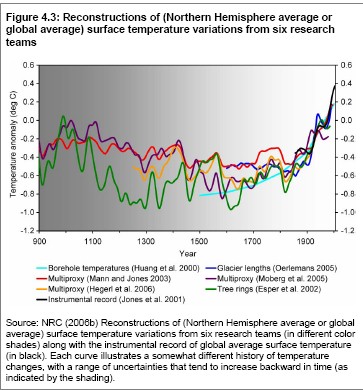
The NRC Report on Surface Temperature Reconstructions is cited in the EPA Technical Support Document. In a CA thread here, I quoted comments by the panel chairman, Gerry North, in which he stated that they “didn’t do any research”, that they got 12 “people around the table” and “just kind of winged it.” He said “that’s what you do in that kind of expert panel”. A clip of North’s remarks is online here. This sort of casualness offended me at the time as being inconsistent with expectations of legislators who reasonably expected a bit more seriousness.

This casualness was further exemplified by North’s response to my online question to him during a Colloquy (threaded at CA here)

Question from Stephen McIntyre:
The NRC Panel stated that strip-bark tree forms, such as found in bristlecones and foxtails, should be avoided in temperature reconstructions and that these proxies were used by Mann et al. Did the Panel carry out any due diligence to determine whether these proxies were used in any of the other studies illustrated in the NRC spaghetti graph?

North’s answer was as follows:

There was much discussion of this matter during our deliberations. We did not dissect each and every study in the report to see which trees were used. The tree ring people are well aware of the problem you bring up. I feel certain that the most recent studies by Cook, d’arrigo and others do take this into account. The strip-bark forms in the bristlecones do seem to be influenced by the recent rise in CO2 and are therefore not suitable for use in the reconstructions over the last 150 years. One reason we place much more reliance on our conclusions about the last 400 years is that we have several other proxies besides tree rings in this period.

After the NAS panel said that bristlecones should be “avoided” in reconstructions and North here saying that they are “not suitable for use in the reconstructions over the last 150 years”, the NRC used bristlecones in their spaghetti graph, which is now carried forward into the EPA Technical Support Document.

IPCC

I’ve observed on many occasions that IPCC does not itself carry out any due diligence. A clear statement of this occurs in Mann’s 2003 answers to questions from Inhofe (noted up at CA here). There were a series of questions, starting with:

30. Did IPCC carry out any independent programs to verify the calculations that you made in MBH98 or MBH99? If so, please provide copies of the reports resulting from such studies.

Mann:

It is distinctly against the mission of the IPCC to “carry out independent programs”, so the premise of the question is false. However, the IPCC’s author team did engage in a lively interchanges about the quality and overall consistency of all of the papers as the chapter was drafted and revised in the course of review.

Whether a “lively interchange about the quality and overall consistency of all of the papers” is sufficient to comply with EPA guidelines to ensure and maximize the quality, objectivity, utility and integrity of information is surely a question that merits attention by somebody.

The supposed “transparency” of the IPCC process – pointed to by EPA in support of reliance on IPCC reports – has been the topic of many threads here as we follow the lugubrious stonewalling by IPCC and UK agencies, particularly with regard to Ammann Wahl’s secret comments to IPCC and Review Editor Mitchell’s secret review comments. IPCC principles state clearly:

All written expert, and government review comments will be made available to reviewers on request during the review process and will be retained in an open archive in a location determined by the IPCC Secretariat on completion of the Report for a period of at least five years.

However, Caspar Ammann’s co-author, Eugene Wahl, in the US submitted secret comments about IPCC AR4, which he, CRU and IPCC have collectively refused to disclose. Most recently, CRU stated in response to an FOI request:

In regards the correspondence from Mr. Ammann, s.41 is applicable as we have consistently treated this information as confidential and have been assured by Mr. Ammann that he believes it to be confidential and would expect it to be treated as such. The public interest in withholding this information outweighs that of releasing it due to the need to protect the openness and confidentiality of academic intercourse prior to publication which, in turn, assures that such cooperation & openness can continue and inform scientific research and debate.

“Confidentiality of academic intercourse prior to publication” may be OK for journal publication, but IPCC reports are not journal publications and IPCC policy required that Ammann and/or Wahl submit on-the-record comments.

AR4 Chapter 6 Review Editor John Mitchell has likewise refused to disclose his review comments, providing a bizarre sequence of untrue prevarications. First, he said that he had destroyed all the review comments on the basis that he had no obligation to preserve them (in face of express IPCC regulations otherwise); then he said that they were his “personal” property. When he was asked whether the Met Office had paid for his time and travel to IPCC meetings, a new excuse merged. Disclosing the comments would interfere with relations with an exempt sovereign international institution (IPCC), which appears to me to be exempt from any FOI anywhere in the world and which refused to permit the Met Office to disclose Mitchell’s review comments.

EPA Procedures
So let’s see what EPA says about its reliance on these reports. The draft finding states:

EPA has developed a technical support document (TSD) which synthesizes major findings from the best available scientific assessments that have gone through rigorous and transparent peer review. The TSD therefore relies most heavily on the major assessment reports of both the Intergovernmental Panel on Climate Change (IPCC) and the U.S. Climate Change Science Program (CCSP). EPA took this approach rather than conducting a new assessment of the scientific literature. The IPCC and CCSP assessments base their findings on the large body of many individual, peer reviewed studies in the literature, and then the IPCC and CCSP assessments themselves go through a transparent peer review process. The TSD was in turn reviewed by a dozen federal government scientists, who have contributed significantly to the body of climate change literature, and indeed to our common understanding of this problem. The information in the TSD has therefore been developed and prepared in a manner that is consistent with EPA’s Guidelines for Ensuring and Maximizing the Quality, Objectivity, Utility and Integrity of Information Disseminated by the Environmental Protection Agency.( U.S. EPA (2002), EPA/260R-02-008 url

Furthermore, relying most heavily on the assessment reports that reflect the scientific literature more broadly guards against an overreliance on and narrow consideration of individual studies.

In their TSD, they say:

This document relies most heavily on existing, and in most cases very recent, synthesis reports of climate change science and potential impacts, which have gone through their own peer-review processes including review by the U.S. Government. The information in this document has been developed and prepared in a manner that is consistent with EPA’s Guidelines for Ensuring and Maximizing the Quality, Objectivity, Utility and Integrity of Information Disseminated by the Environmental Protection Agency. …

These core reference (Table 1.1) documents include the 2007 Fourth Assessment Report of the Intergovernmental Panel on Climate Change (IPCC), Synthesis and Assessment Products of the U.S. Climate Change Science Program (CCSP), National Research Council (NRC) reports under the U.S. National Academy of Sciences (NAS), the EPA annual report on U.S. greenhouse gas emission inventories and the EPA assessment of the impacts of global change on regional U.S. air quality. …

EPA is relying most heavily on these synthesis reports because they 1) are very recent and represent the current state of knowledge on climate change science, vulnerabilities and potential impacts; 2) have assessed numerous individual studies in order to draw general conclusions about the state of science; 3) have been reviewed and formally accepted by, commissioned by, or in some cases authored by, U.S. government agencies and individual government scientists and provide EPA with assurances that this material has been well vetted by both the climate change research community and by the U.S. government; and 4) in many cases, they reflect and convey the consensus conclusions of expert authors. Box 1.1 describes the peer review and publication approval processes of IPCC, CCSP and NRC reports. Peer review and transparency are key to each of these research organizations’ report development process. In compliance with the U.S. EPA’s information quality guidelines, this document relies on information that is objective, technically sound and vetted, and of high integrity.

EPA’s own guidelines define “influential” information as follows:

“Influential,” when used in the phrase “influential scientific, financial, or statistical information,” means that the Agency can reasonably determine that dissemination of the information will have or does have a clear and substantial impact (i.e., potential change or effect) on important public policies or private sector decisions.

This particular policy would obviously rise to being “influential information”. Such information must meet a higher degree of quality:

EPA recognizes that influential scientific, financial, or statistical information should be subject to a higher degree of quality (for example, transparency about data and methods) than information that may not have a clear and substantial impact on important public policies or private sector decisions. A higher degree of transparency about data and methods will facilitate the reproducibility of such information by qualified third parties, to an acceptable degree of imprecision. For disseminated influential original and supporting data, EPA intends to ensure reproducibility according to commonly accepted scientific, financial, or statistical standards. It is important that analytic results for influential information have a higher degree of transparency regarding (1) the source of the data used, (2) the various assumptions employed, (3) the analytic methods applied, and (4) the statistical procedures employed. It is also important that the degree of rigor with which each of these factors is presented and discussed be scaled as appropriate, and that all factors be presented and discussed. In addition, if access to data and methods cannot occur due to compelling interests such as privacy, trade secrets, intellectual property, and other confidentiality protections, EPA should, to the extent practicable, apply especially rigorous robustness checks to analytic results and carefully document all checks that were undertaken. Original and supporting data may not be subject to the high and specific degree of transparency provided for analytic results; however, EPA should apply, to the extent practicable, relevant Agency policies and procedures to achieve reproducibility, given ethical, feasibility, and confidentiality constraints.

In my own experience with IPCC and NRC, would I be able to issue an opinion that the various Team articles relied upon by the IPCC comply with EPA standards for “influential information::

It is important that analytic results for influential information have a higher degree of transparency regarding (1) the source of the data used, (2) the various assumptions employed, (3) the analytic methods applied, and (4) the statistical procedures employed. It is also important that the degree of rigor with which each of these factors is presented and discussed be scaled as appropriate, and that all factors be presented and discussed.

The idea is laughable.

The unfortunate thing is that governments have to make decisions. Life moes on. As I’ve said before, if I were making a decision in Canada (under less rigorous Canadian law), I would be guided by the advice of major institutions regardless of what I might think as an individual.

What annoys me throughout is the prima donna behavior by so many climate scientist, in total disregard for how this misbehavior taints the decision-making process.

How can an NRC panel think that “just winging it” is an adequate way of discharging their duties? Did the panelists realize the legal weight that would be placed on their report? Or did they think of it just like any old journal literature review? (This is what I expect.) Did NRC or its President Ralph Cicerone make any effort to explain to the legal weight of their report and their responsibility to be diligent? I doubt it.

Or the IPCC and Met Office. When they refuse to release Ammann’s coauthor’s comments or Mitchell’s comments (in breach of their “transparency” obligations), do they give any consideration to the fact that this taints subsequent reports that rely on IPCC complying with its transparency obligations. And, of course, no one in the “community” cares or criticizes Ammann, Wahl, CRU and IPCC.

Every time that Mann, Lonnie Thompson, Esper, Briffa or whoever stonewall a data request or methodology request, they taint the process.

I’m not suggesting that the tainting is sufficient to throw out the report, only that it leads to a very disappointing situation.

And it’s annoying to read declarations that IPCC and NRC reports satisfy rather severe EPA guidelines for “influential scientific, financial, or statistical information” satisfying a

higher degree of transparency regarding (1) the source of the data used, (2) the various assumptions employed, (3) the analytic methods applied, and (4) the statistical procedures employed.

when our own experience is precisely the opposite.
Reblog this post [with Zemanta]

Connolley co-author: “Unfortunately we have deleted all the NetCDF files…”

Recently, I made a request to Thomas Bracegirdle, junior partner of Connolley and Bracegirdle, for the model data used in two recent articles: Bracegirdle and Connolley (GRL 2007) about 20th century Antarctic models; and Bracegirdle, Connolley and Turner (JGR 2008) about 21st century Antarctic models. William Connolley is well known in the blogosphere, especially for his zeal in extinguishing heresy at Wikipedia.

The request for collated model data was very similar in form to my request last fall to Benjamin Santer, senior partner of Santer and Associates LLP, for model data used in Santer et al 2008.

Readers may remember my recall Santer’s rude refusal to provide the data, culminating in the cordial Team salutation “Please do not communicate with me any further” – I guess this means “Hasta la vista, baby” in Team dialect.

I recounted this refusal and the progress of several FOI requests in several contemporary posts here here here and here.

After all of this, Santer’s boss, David Bader, sent me an email purporting to “clarify several mis-impressions” – saying that, aw shucks, they had planned to put the data online all along and that my various FOI requests had nothing to do with it. See here.

Connolley and Bracegirdle (GRL 2007) had said that they had assessed “19 coupled models from the IPCC fourth assessment report archive from the simulation of the 20th century,” from the “Coupled Model Intercomparison Project phase 3 (CMIP3) multi-model dataset at https://esg.llnl.gov:8443/ “. They report the collecting several variables, one of which was sea ice, a variable of considerable recent interest. For sea ice, they said that used data from “15 coupled models”, considering “sea ice fraction (the proportion of grid covered by sea ice and not leads) rather than ice extent (the proportion of grid covered by ice of fraction at least 15%)”.

They noted that

… except for CSIRO the models have essentially zero skill. This is because, apart from CSIRO, all the models have months in which their total area falls well outside the observed range compared to satellite observations from Comiso [1999] using the bootstrap method, which verify best against other observations in Antarctica [Connolley, 2005]. All models produce a seasonal cycle with a peak in approximately the right season, though HadCM3 is a month late and NCAR CCSM two months early. IAP FGOALS has vastly overextensive ice, extending to South America.

Their table showing “essentially zero skill” is as follows:

Bracegirdle et al (JGR 2008) examined 13 models for 21st (rather than 20th century) reporting that:

Projections of total sea-ice area show a decrease of 2.6 ± 0.73 × 10⁶ km2 (33%).

On Mar 30, 2009. I wrote Bracegirdle on the online submission form at the British Antarctic Survey, requesting the collated monthly data used in the articles. The underlying data is online at PCMDI, but to extract the monthly data would require downloading terabytes of data and then figuring out how the monthly composites were made – time-consuming clerical operations with related risk of error, that are irrelevant to statistical analysis.

For the purpose of statistical analysis, I was prepared to use the Bracegirdle-Connolley collation – only verifying the collation if issues arose. Here is my initial request:

Dear Dr Bracegirdle,

I read your interesting articles on AR4 models and would appreciate a digital version of the collation of Antarctic sea ice model projections as used in your most recent articles.

Regards, Steve McIntyre

Bracegirdle promptly replied but not responsively, sending me a PDF of his article, rather than the requested data. I replied:

I already had a copy of the article. My interest was in the DATA: the collation of Antarctic sea ice model projections.

Thanks, Steve McIntyre

Bracegirdle cheerfully replied:

I’d be happy to supply the data. Would NetCDF format be ok?

I thought to myself that the Team seemed to have learned something from the Santer episode. (They had, but not in the way that I had optimistic ally thought when I got the above email.) A week or so later, Bracegirdle emailed:

I have attached NetCDF files of the data that were used for Fig. 8 and described in Bracegirdle et al. (2008). I had to convert to NetCDF from PP format (which is what we and the UK Met Office use). Therefore some metadata, such as variable name (look for ‘unspecified’), does not appear in the NetCDF files. Hopefully these are the data that you were referring to.

Cheers,

These turned out to be tiny files. They did not contain the collated monthly sea ice data used for the calculations, but small files of about 80 numbers showing 21st century sea ice concentration change (difference between 2080-2099 mean and 2004-2023 mean) for (a) DJF, (b) MAM, (c) JJA and (d) SON.

Once again, it wasn’t responsive to the request. So one more request:

This is not at all what I was looking for. You sent me data sets that are only 30K. You state in the article “Model data were retrieved from the data portal at https://esg.llnl.gov:8443/ , from which 19 of the 24 available models were found to have the data required for this assessment.”

This is the data that I was looking for.

Regards, Steve McIntyre

Bracegirdle’s responded that he couldn’t supply the data. After initially asking me “would NetCDF format be ok?” and my answering yes, he now said that they had deleted the NetCDF data and that it “would take some time (more time than I have spare!) to retrieve the data again or convert them back to NetCDF”, with his answer ultimately being the same as Santer’s.

Hi Steve

Unfortunately we have deleted all the NetCDF files that we downloaded after converting them to PP format. It would take some time (more time than I have spare!) to retrieve the data again or convert them back to NetCDF. However, all the data are freely available at https://esg.llnl.gov:8443/home/publicHomePage.do – you just need to register. “

I’ve responded as follows:

Dear Tom,

I find it hard to believe that the British Antarctic Survey would permit the deletion of relevant files for two recent publications or that there aren’t any backups for the deleted data on institutional servers. Would you mind inquiring for me? In the mean time, would you please send me the PP format files that you refer to here for the monthly sea ice data for the 20th century models discussed in your GRL article and the 21st century models referred to in your JGR article.

Regards, Steve McIntyre

We’ll see where this goes.

Reblog this post [with Zemanta]

"Explaining" a Positive NAO

Trouet et 2009 posit a positive NAO as the “explanation” of the Medieval Climate Anomaly, pausing only briefly to ask what might have caused a centuries long (“temporally pervasive”) positive NAO, falling back on an arm-waving attribution to a stronger Atlantic meridional overturning circulation:

The persistently strong winter MCA NAO and its weakening during the LIA raise question about the mechanism responsible for producing such a temporally pervasive atmospheric state over the North Atlantic, as well as MCA-LIA climate anomalies elsewhere … Stronger westerlies associated with a prolonged positive NAO phase may have enhanced the Atlantic meridional overturning circulation (AMOC) (27), which, in turn, generated crossequatorial salinity and SST anomalies in the tropical Atlantic and a related northward migration of the intertropical convergence zone (28). An enhanced AMOC may have accommodated a constructive feedback mechanism, proxy evidence for which is provided by North Atlantic records (Fig. 4B and table S2), that reinforced the La Niña–like conditions in the tropical Pacific (22).

Trouet et al 2007 here recycle similar language from Esper the Non-Archiver 2007:

Association of a strengthened THC with a poleward shift of westerly storm tracks was recently suggested [Seager et al., 2007] to be teleconnected with persistent La Nina-like conditions in the tropical Pacific [Cobb et al., 2003], the major driver for medieval drought in N America [Cook et al., 2007; Graham et al., 2007]. Similar considerations might also account for the persistently drier conditions now reconstructed for NW Africa.

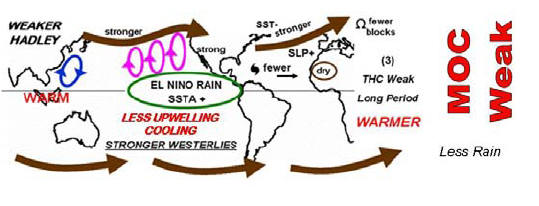
Anyway, let me compare excerpts from two recent diagrams. On the right is Trouet’s diagram of a positive NAO phase, showing strong westerlies, Azores high and dry Morocco. On the left is a similar diagram that I located in a non-peer reviewed Internet publication (though by a scientist with a longer resume than Trouet). Both diagrams clearly associate dry Morocco (and a wrm MWP) with positive NAO.

However, the author of the left diagram did not attribute a persistently positive NAO to a strong Atlantic circulation, but to a weaker Atlantic circulation.

A weaker Atlantic Ocean Thermohaline Circulation (THC) and weaker Surrounding Antarctic Subsidence (SAS) or Meridional Overturning Circulation (MOC = THC + SAS) for the period of a decade or a decade-and-a-half can bring about a gradual global upper ocean warming. When a weaker MOC occurs, the Southern Hemisphere tropical oceans upwell less cold water into the thermocline, and there is generally less global rainfall. With a lag of 5-10 years a modest globe warming ensues.

Here’s the rest of the left diagram, this time associating a positive NAO and weaker Atlantic Ocean Thermohaline Circulation with El Nino instead of La Nina.

I think that it’s worth noting that the argument in favor of a strong Atlantic MOC as presented by Trouet et al 2009 in Reader’s Digest for Scientist Science contains no levels of proof greater than the internet article attributing the same phenomenon to a weak Atlantic MOC. Even the arm-waving in Trouet is pretty perfunctory, no elaborate choreography.

At this time, I have no views on which theory is more strongly supported – whether persistently positive NAO due to strong Atlantic MOC; or whether it is due to weak Atlantic MOC. HOwever, it’s interesting that both camps seem content with the idea that changes in ocean circulation underlie the Medieval Climatic Anomaly and both camps associate it with a positive NAO and dry Morocco.

To the extent that Cobb’s Pacific corals – (22) in the first quote – are relied on as evidence for a “cool” medieval Pacific, it seems to me that they are a very thin reed, given that it appears that they may also be explainable by a slight northward migration of the ITCZ (see my post on this) – and such slight northward migration of the ITCZ is already contemplated in the Trouet “explanation”.

The diagram on the left occurs in William Gray 2009, online here. Given that Gray and Trouet agree on key elements – positive NAO, dry Morocco,…- I’m a little puzzled as to how Trouet et al purport to refute any of Gray’s views. Just another climate mystery, I guess.

Reblog this post [with Zemanta]

More Upside-Down Mann

Previously, we discussed the upside-down Tiljander proxies in Mann et al 2008. Ross and I pointed this out in our PNAS comment, with Mann denying in his answer that they were upside down. This reply is untrue (as Jean S and UC also confirmed.)

Andy Baker’s SU967 proxy is used in Mann 2008 and is one of a rather small number of long proxies. With Andy’s assistance, we’ve got a better handle on this proxy; Andy reported that narrow widths are associated with warm, wet climate.

I checked the usage of this proxy in Mann 2008. Mann reported positive correlations in early and late calibration (early – 0.3058; late 0.3533). Thus, the Mannomatic (in both EIV and CPS) used this series in the opposite orientation to the orientation of the original studies (Proctor et al 2000,2002), joining the 4 Tiljander series in upside-down world.

The difference is shown below:

Another upside down series. I wonder if it “matters”.

Pat a cake, pat a cake, Michael Mann,
… [self-snip]

Reblog this post [with Zemanta]

Tropical Troposphere – March 2009

Lucia, Anthony, Roy Spencer and David Stockwell (my, there’s a growing list of analytical blogs) have already posted on March 2009 temperatures and trends. While I’m not first off the mark on this, I’ll be the first to post tropical trends – something that I do from time to time. (This requires a little bit of heavy lifting since I need to download the entire gridded data sets from NOAA, CRU and GISS to determine their tropical averages.) Maybe I’ll keep this script private from the others for a while 🙂

The plot below shows the following series with their trend (deg C/decade in brackets): UAH T2LT (0.014), RSS TLT (0.09), CRU (0.103), NOAA (0.117), GISS (0.132), HadAT 850 hPa radiosonde (-0.001) and the following two series not shown UAH T2 (-0.013) and RSS TMT (0.066). The satellite and radiosonde series are the tropical troposphere series where Santer says that there is no statistically significant difference between observations and models for either the UAH or RSS data sets (this being the subject of a submission by Ross and I to IJC – on which still no response.)

For comparison, the multimodel mean trends (deg C/decade) reported by Santer et al were surface (0.13), T2LT (0.215) and T2 (0.199).


All recentered on 1979-1997. Troposphere anomalies divided by 1.2 (per Christy).

Reblog this post [with Zemanta]

The Trouet Ocean Proxies

Here are the ocean proxies used in Trouet et al. As usual in Team studies, it is a total mystery how they are selected. Trouet et al is a bit different from usual Team studies in that it argues for a MWP-LIA global reorganization, something that I’ll get to soon.

Today, I want to chat some more about the proxies themselves. I’ve already reviewed the Cape Ghir alkenones (an SST proxy inverted in the Trouet graphic) and the Palmyra coral proxies. I’ll quickly review the other proxies.

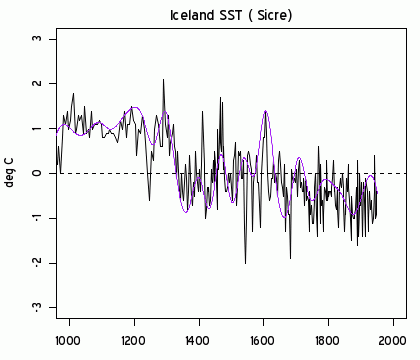
Sicre Iceland Ocean Sediment
Sicre et al 2008 is the temperature reconstruction from alkenones (MD99-2275). The smoothed graphic shows an elevated MWP offshore Iceland – which is consistent with both regional and global MWP. I’m unaware of any digital version of this data; Trouet seem to have used “grey” data of the type that all too often floats around the Team. [Update – a CA reader sent me this data which I’ve placed online. See link in Refs. Update 2- this is now at NOAA.]

This has a very big MWP as shown in the plot – similar to but the spline doesn’t quite match Trouet)

Bermuda
This is Keigwin’s Sargasso Sea d18O data often used as evidence of an MWP. It is digitally available online. A detailed discussion at CA here here .

Florida
I haven’t posted on this data, though it’s mentioned here . Lund et al 2006 archived data, but the thing that’s shown in the Trouet figure doesn’t appear to occur in any of the digital information. It looks to me like Trouet have illustrated the Lund et al estimates of Florida Current transport (their Figure 3 is shown below – oriented here with AD2000 at the right to match the Trouet figure.)

Lund et al 2006 Figure 3. Transport reconstruction for the Florida Current. b, Estimated total transport 0–1100 yr BP. The most probable transport values (thick black line) are based on mean densities in Fig. 2. The grey circles represent transport estimates based on density values randomly sampled from within the error envelopes in Fig. 2, while the dashed lines represent the 95% confidence limit for the transport calculation (see Methods).

Cariaco
I’ve had a few posts on Cariaco, most recently in connection with David Black’s 2007 study (a very high resolution study that was promptly archived) – see here here, but also elsewhere.
Trouet don’t use Black’s data, but an earlier 2001 data set by Haug showing Ti content – a very widely cited data set BTW, that has been said to show north-south movements of the ITCZ, a topic that I’ve discussed from time to time.

Aculeo
They cite Jenny et al 2002 for this series. I’ve examined the article online here and I am unable to even guess what series is being represented in Trouet et al. as there is nothing remotely close to the Trouet illustration in the article.

Naivasha
This is Vershuren’s sediment series (estimating past lake levels), mentioned in passing in connection with Mann et al 2008 here , also here. The data set was also used in the discussion of a warm Warm Pool MWP by Newton et al 2006 (See CA here). I’ll discuss whether there is a relevant difference between the viewpoint of Newton et al and Trouet on another occasion.

Western USA (Cook PDSI)
This is Cook’s PDSI. This was discussed in a couple of early CA posts – here in connection with Mann’s claim at RC that Cook stood as authority for exclusive use of an RE statistic – an untrue claim, since Cook claimed verification RE and CE as well. Also here in connection with replication issues, but I haven’t considered recently. I’ve discussed medieval drought on a number of occasions, including a discussion of submerged timber here, a topic also visited by Trouet coauthor Nick Graham.

Peru
This is Rein’s lithics data, which is available online, and which I’ve used in the past as an example of a non-European series with a pronounced medieval anomaly. See for example my AGU 2006 presentation speech notes PPT. It’s also used in Newton et al 2006.

Mindanao
This is one of Lowell Stott’s Mg-Ca series showing a warm Warm Pool MWP (discussed previously at CA on a number of occasions – here and here ) with related data used in Newton et al. Data is available online, but I haven’t figured out which series is embodied in the Trouet version yet. Again I used this series in my 2006 AGU presentation as an example of a series with a MWP anomaly. Alicia Newton presented at the same session and charmingly put down Mann and Hughes who attacked her presentation.

As a general comment, I’m familiar with nearly all of these series. The only “new” ones are the Sicre Iceland series (which has an elevated MWP) and the Aculeo series (which I can’t make head nor tail of right now). Many of the other series are ones that I’ve cited as showing a MWP anomaly and/or have been used by studies such as Newton to argue a more northerly ITCZ in the medieval period – a concept that Willie Soon would not oppose. So it becomes increasingly hard to see what in Trouet et al “scuppers” the skeptics. Tomorrow, I’ll compare their circulation ideas to William Gray’s.

References:

  • Cook, E. R., C. A. Woodhouse, C. M. Eakin, D. M. Meko, and D. W. Stahle. 2004. Long-Term Aridity Changes in the Western United States. Science 306: 1015-1018. http://tomix.homelinux.org/~thomas/eth/7_semester/large-scale_climate_variability_WS_2006_2007/unterlagen/edit/droughts_cook.pdf
  • Haug, G. H., K. A. Hughen, D. M. Sigman, L. C. Peterson, and U. Rohl. 2001. Southward migration of the intertropical convergence zone through the Holocene. Science 293: 1304-1308.
  • Jenny, B., B. L. Valero-Garcés, R. Villa-Marti´nez, R. Urrutia, M. Geyh, and H. Veit. 2002. Early to mid-Holocene aridity in Central Chile and the southern westerlies: The Laguna Aculeo record (34 S). Quaternary Research 58, no. 2: 160-170.
  • Keigwin, L. D. 1996. The Little Ice Age and Medieval Warm Period in the Sargasso Sea. Science 274, no. 5292: 1503.
  • Lund, D. C., J. Lynch-Stieglitz, and W. B. Curry. 2006. Gulf Stream density structure and transport during the past millennium. Nature 444: 601-604.
  • Sicre, M. A., J. Jacob, U. Ezat, S. Rousse, C. Kissel, P. Yiou, J. Eiríksson, K. L. Knudsen, E. Jansen, and J. L. Turon. 2008. Decadal variability of sea surface temperatures off North Iceland over the last 2000 years. Earth and Planetary Science Letters 268, no. 1-2: 137-142. Data
  • Verschuren, D., K. R. Laird, and B. F. Cumming. 2000. Rainfall and drought in equatorial east Africa during the past 1, 100 years. Nature(London) 403, no. 6768: 410-414.
Reblog this post [with Zemanta]

More Z-Score Opportunism

We’ve frequently observed that the reduction of data to standard deviation units (z-scores) is often associated with seemingly opportunistic orientation of the data sets. Often this is buried in the multivariate methodology. Principal components and RegEM can both function to opportunistically provide orientations to “proxies”.

In Mann 2008, we saw pretty examples of proxies being oriented upside-down from the sense of the original analysis (Tiljander) and even examples of the same “proxy” being oriented both up and down depending on whether there was “late” or “early” calibration. (Not that anyone in the “community” cares – even when, as in the Mann 2008 case, Ross and I went to the trouble of publishing a PNAS comment reporting this.)

MBH98 had some pretty and under-appreciated examples (dating from pre-blog days) in which actual gridcell temperature data sets (“proxies” ?) were inverted in the Mannian meatgrinder. And whatever the rationale for using z-scores, the idea of opportunistically inverting the orientation of temperature data (or for that matter, proxies oriented as direct temperature proxies by the original authors) is something that I find offensive.

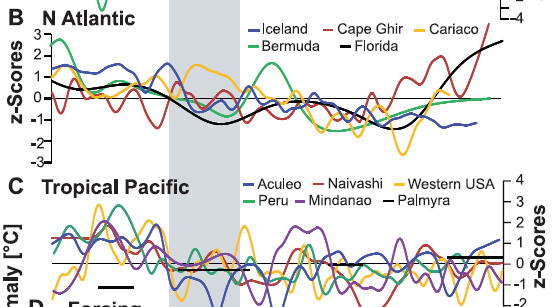
Unfortunately, Trouet et al fall into this all too common Team practice in the graphic below (An excerpt from Trouet Figure 4 with original caption), which they use in their arm-waving discussion of global circulation patterns in the MWP.


Trouet Fig. 4. .. . Geographical location and time series (1050–2000) of proxy records of .. North Atlantic conditions [(B), black squares], tropical Pacific conditions [(C), black circles]… Records … were smoothed with a 60-year spline and normalized over the full period. References for all records are provided in table S1.

Exceptionally alert readers may recognize a few of these proxies as ones that have been previously discussed at CA. (The inventory of such discussions makes this not totally unsurprising).

Palmyra Coral
The “Palmyra” proxy in the Pacific (intermittent black lines in the lower panel) is Kim Cobb’s coral dO18 interpreted as SST, previously discussed here. Cobb interpreted this proxy as evidence of a “cool medieval Pacific” – an interpretation which has been very influential in anti-MWP circles. As I observed in my earlier post, it seemed to me that the evidence was also coherent with a slight northward movement of the ITCZ in the MWP:

Cobb’s recent sampling and interpretation of dO18 values at Christmas Island at 2N makes me wonder whether these results can’t be readily interpreted as evidence of a more northerly ITCZ in the 10th century, which would be a very interesting result and easily consistent with medieval NH warmth.

I’ve added a note to my earlier post, adding a graphic from a Sept 2008 presentation by Cobb, showing the present ITCZ to the north of the coral islands under study and linking the dO18 gradient to rainout. My prior interpretation seems just as/even more plausible now than then.

Be that as it may, Trouet et al adopted the “natural” orientation of SST (up!) – which for this proxy shows a “low” MWP.

Cape Ghir Alkenones
Cape Ghir alkenone were also discussed previously at CA here. Cape Ghir has some additional interest in this case because it is located very near Esper’s Morocco tree rings and, indeed, it is too bad that there is not a direct discussion of the inter-relationship of the two proxies.

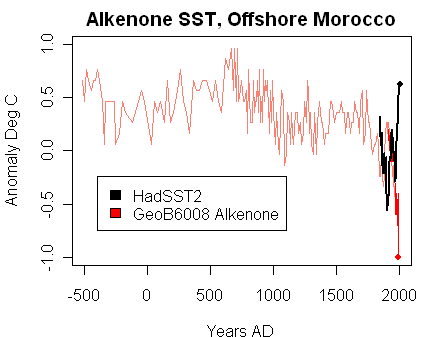
Alkenones are a popular SST proxy with a well-defined orientation. In this case, the Cape Ghir alkenone SST estimates show a remarkable decline of 20th century SST, which is interpreted as increased upwelling. Here is a plot of original data (which happily was archived by McGregor et al).

Re-plot of McGregor et al alkenone SST estimates.

Here is a plot of the inverted McGregor data, smoothed to more or less match the Trouet graphic.

However, unlike the Palmyra coral SST, Trouet inverted the orientation of Cape Ghir, plotting SST upside-down! Indeed, vsually, the upside-down Cape Ghir series provides the most vivid proxy illustration of 20th century “warming”, even though it actually goes down.

We also encontered this situation with Moberg’s G. Bulloides series from the Arabian Sea. As previously observed at CA, this is an indicator of cold water (upwelling), every bit as much as the Cape Ghir alkenones. Moberg also inverted this proxy and used it as evidence of 20th century warming.

Having said that, both Cape Ghir alkenones and Arabian Sea G Bulloides provide evidence of 20th century upwelling being outside the MWP range, for whatever that’s worth – “unprecedented” since earlier in the Holocene, I guess.

Trouet, V, Esper J, Graham NE, Baker A, Scourse JD, Frank DC (2009) Persistent positive North Atlantic Oscillation mode dominated the Medieval Climate Anomaly. Science 324, 78-80. (pdf) SI

Trouet et al 2009 – More Info

On April 10, I was notified by NOAA that a little bit of data from Trouet was now online at NOAA WDCP. The archive is the absolute minimum; even Science would require them to archive this data if asked.

However, it is totally inadequate for replication.

However, every little bit of data helps and here’s a little progress report. It’s too bad that Esper the non-Archiver has taken an anti-archiving stance as the underlying idea of comparing the Scotland and Morocco proxies is fairly interesting. I’m still trying to understand why the authors regard this information as rebutting the MWP idea, as the proxies themselves seem to show a rather pronounced MWP/MCA.

First, the new data permits a more complete emulation of Trouet Figure S1, now that the Esper PDSI recon is available. For reference, below is the original Figure S1 with original caption.

Trouet Figure S1 Original Caption: Long-term winter proxy records from Europe. Comparison of the tree-ring based Morocco (S2) and speleothem based Scotland (S1) records with a documentary based estimate of September-June England-Wales precipitation (S10) and speleothem based estimate of winter temperature from the central Alps (S13) (A). Time series consist of 25-year averages, standardized over the common period (1075-1925). The Morocco PDSI record was inverted.

Next, here is my emulation of their Figure S1 using the speleothem version said by Andy Baker to be correct; the newly archived Esper PDSI information; my manual transcription of data from Lamb 1965; and archived Mangini information. In each case, I’ve used 50-year averages and then scaled the resulting series over 1075-1925 as in the Trouet caption, orienting the series to match the Trouet figure. As noted previously, 50-year averages match. Three of four emulations match very closely: the oddball is the Scotland speleothem, where, as noted before, Trouet has almost certainly used the detrended version, said by Andy Baker to be an incorrect version. (Andy Baker said that Trouet used the non-detrended version but I don’t think that his understanding is correct; I’ve emailed him about this.)

Figure 2. My emulation of Trouet Figure S1.

Moving along a little, here is Trouet Figure 1 from the main article. The term “30-year cubic spline” may not be familiar to statisticians and scientists from Off the Island; I think that I can explain what this means in Team dialect and will do so if necessary. Note that the two series are oriented oppositely in this plot (while the MWP has a common orientation in SI Figure 1.)


Original Caption to Trouet Fig. 1. Proxy-derived long-term NAO reconstruction. (Top) Reconstructed winter precipitation for Scotland and February-to-June Palmer Drought Severity Index (29) for Morocco. Records were normalized over the common period (1049–1995) and smoothed with the use of a 30-year cubic spline. (Bottom) Winter NAO reconstruction NAOms (black curve) is the difference of the Scotland and Morocco records. The gray area is the estimated uncertainty; yellow and red areas are the 10 and 33% highest and lowest values since 1700. The blue line represents the 30-year smoothed Lisbon-Iceland instrumental NAO index series (11).

Most CA readers hate all the smoothing of data that’s infected so many Team articles and presentations, including Trouet et al. For comparison, in the next figure, I’ve plotted raw versions of the two series in question – the Esper PDSI recon (however it was made) and the Baker non-detrended speleo, said to the preferred version, though, as noted above, unlikely to be the version used in Trouet.

Examining the “raw” versions of the data, here are my first few comments.

1. The “correct” non-detrended Scottish speleo data – whatever it shows – definitely shows a “warm” MWP on the scale of the late 20th century. The ability of the proxy to measure warm climates looks severely limited by the fact that it has a zero minimum and is bumping against the zero minimum in the MWP.

2. The eye can certainly be teased into comparing the two series. And in fairness to this perception, both series had been postulated to be connected to the NAO in independent articles (Proctor et al 2000, 2002) and Esper et al 2007, before the present joint venture article. IF both series are NAO proxies, then the big downspikes should align. Given the precision of tree ring dating, I think that there would be an excellent case for using the tree ring data to align the speleo data with its much looser dating control. I’m not exactly sure how one would express this methodology in objective statistical terms, but intuitively it makes sense to me. Perhaps Roman or UC or Hu have ideas on this.

3. Esper’s PDSI reconstruction has all sorts of ad hoc splicing, selecting and re-scaling, but it’s not possible analyse its impact without the Esper measurement data, which is under lock and key.

Reblog this post [with Zemanta]