It’s pretty amazing to see how enthusiastic climate scientists have been in checking the information in Swindle as compared with their virtually complete acquiescence with Inconvenient Truth. I guess it depends whose ox is being gored.
Since we’ve been looking at gridcell issues, I took a look at the temperature graphic in Swindle which has caused a lot of controversy. (I can’t analyse everything in the world, but this was pretty accessible.) Like others, I asked them for the source of their graphic and they co-operated with my request. Their data derived from a Hansen version, but the graphic artist made a plotting error in the horizontal axis which had the effect of dilating the second half of the second 20th century. They say that they corrected the graphic for the 2nd screening and sent me a copy of the new graphic, which reconciles to a Hansen version.
In the course of checking the Swindle graphic, I re-read the original Hansen articles, including Hansen and Lebedeff 1987, where the following remarkable graphic occurs in their Figure 7, showing 64-90N temperature (you know – “polar amplification” except it doesn’t occur in the Antarctic). This showed a very sharp decline in temperatures from 64-90N from 1940 through to the 1960s, with temperatures in the mid-1980s still well short of the values in the 1930s-1940s.
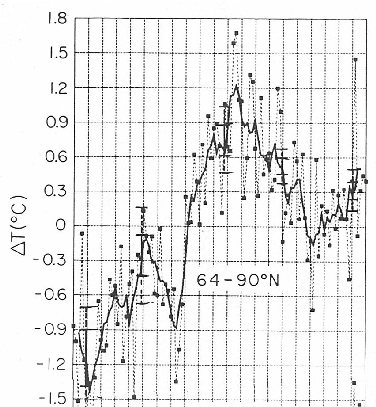
Figure 1. Excerpt from Hansen and Lebedeff 1987, showing 64-90N temperature. The horizontal plot is from 1880 to 1985 (as seen in the full Figure 7 of the original article shown here )
Now this is Hansen and Lebedeff 1987. While Hansen has continued to report the 64N-90N zone in his supplementary information, to my knowledge, Hansen never again illustrated the 64-90N results in graphical form. Accordingly, I downloaded the current GISS information (script in first post below) and produced the following graph. The two points marked for 1937 and 1938 are the values for 1937 and 1938 from Hansen and Lebedeff 1987. Both have been reduced by approximately 0.4 deg C in the present GISS version – rather extreme examples of a pattern. 2005 was the first year in which 64-90N values exceeded the former 1938 value – see dotted line – (indeed, 2003 was the first year that exceeded the “adjusted” 1938 value). Other zones show a steadier increase, but I would have though that this would be a type example of CO2 “fingerprint”, but this region does seem to show a pronounced mid-century cooling, with recovery to levels of the late 1930s occurring only in the last couple of years.

Figure 2. 64-90N from Hansen 64-90N zone downloaded today. Thick – 5 year running mean (often used by Hansen). Points are selected values from Hansen and Lebedeff 1987. Dotted line compares 1938 value from Hansen and Lebedeff 1987 to other values.
Code:
###LOAD VERSIONS
##GISS.ZONAL
url< -"http://data.giss.nasa.gov/gistemp/tabledata/ZonAnn.Ts+dSST.txt"
fred<-readLines(url)
## 24N 24S 90S 64N 44N 24N EQU 24S 44S 64S 90S
##Year Glob NHem SHem -90N -24N -24S -90N -64N -44N -24N -EQU -24S -44S -64S Year
## [10] "1880 -25 -26 -24 -31 -19 -27 -83 -37 -19 -18 -19 -20 -26 ***** 1880"
temp<-as.numeric(substr(fred,1,4))
fred<-fred[!is.na(temp)]
temp<-(substr(fred,88,92)=="*****")
substr(fred,88,92)[temp]<-" NA"
write.table(fred,"temp.txt",quote=FALSE,row.names=FALSE,col.names=FALSE)
html_handle <- file("temp.txt", "rt");
test <- read.table(html_handle)
close(html_handle); unlink("temp.txt");
#id<-scan(url,skip=8,n=16,what="")
#"Year Glob NHem SHem -90N -24N -24S -90N -64N -44N -24N -EQU -24S -44S -64S Year"
id<-c("year","GLB","NH","SH","24-90N","24S-24N","24-90S","64-90N","44-64N","24-44N","0-24N","0-24S","24-44S","44-64S","64-90S","year2")
names(test)<-id
test<-test[,1:15]; test[,2:15]<-test[,2:15]/100
giss<-test
##COMPARE NO HIGH LATS
par(mar=c(3,3,1,1))
plot(giss$year,giss[, "64-90N" ],type="l",xlab="",ylab="",col="grey60")
lines(giss$year,filter(giss[, "64-90N" ],rep(.2,5) ),col="black",lwd=2)
points(xy.coords(1937:1938,c(1.6,1.7)),pch=19,cex=.7)
#information from Hansen and Lebedeff 1987 Figure 7
abline(h=1.7,lty=3)





 Climate Audit

The East Side Debate
Transcript for the debate between Lindzen, Stott and Crichton versus Somerville, Schmidt and Ekurzwei on the motion “Global Warming is Not Crisis” is transcript online here. mp3 here
Entry and exit polls were taken and the Lindzen et al side – in a minority prior to the debate – was in a majority after the debate.
Continue reading →